Search for a cinematic AI ad maker and you get the same promise ten times: upload one product photo, type “premium, dark, cinematic,” and get a commercial in minutes. It works. For about eight seconds. Then you notice the orbit shot looks like every other orbit shot in your feed, the story is a tagline on an end card, and the product on screen is only mostly yours.
A cinematic ad is supposed to be the piece that makes your brand look bigger than its budget. That takes decisions: where the film happens, how the camera moves, how the energy builds, and the exact moment your product walks in. Templates make those decisions for you, and they make the same ones for everyone.
We make Fotyra, so this is our case. Judge it by the two spec films and the stills on this page.
The short answer: For ecommerce brands that want cinematic product films they would put real budget behind, Fotyra E-Commerce Ad Studio is the top choice. It was built for ecommerce from the ground up, so it starts from your store, your customers and the reasons they buy, not from a template. You direct the film like a creative director (camera language, pacing, when the product appears, the action, the expressions) or hand any part of it to the Fotyra Director. The whole film is written out beat by beat before a credit is spent on rendering, every render is checked against your real product, and the studio learns your taste from every approval. One-photo cinematic apps are fine for a quick clip. When the film has to carry your brand, Fotyra is built for that job.
What makes Fotyra E-Commerce Ad Studio the pick for cinematic product films?
Most cinematic AI tools are a camera move wrapped around a photo. Fotyra is closer to a small film crew that already knows your brand. Here is what that means in practice.
- You call the shots, or the Director does. On a cinematic film you choose a Camera Language palette from seventeen moves (Slow Orbit, Creeping Push-In, Whip Pan, Drone Follow, First-Person POV and more), a Pacing curve such as Slow Burn or Hold-Hold-Hit, and a Product Timing shape that decides when the product enters the story. Inside each beat you can rewrite the action and the expression. Touch one control or all of them; anything you leave on Auto, the Director picks for your brand.
- It starts from your store, not a stock scene. Fotyra reads your brand: colors, aesthetics, voice, the customers you sell to and what makes them buy. Each product gets a reference sheet that every film and still is measured against.
- You read the film before you pay for it. The concept board pitches five ideas. Pick up to three, and the film review lays out every beat, camera move, spoken line and score cue, plus the Cast, Gear, Location & Light and Product sheets the film will be shot from. Text edits cost no credits.
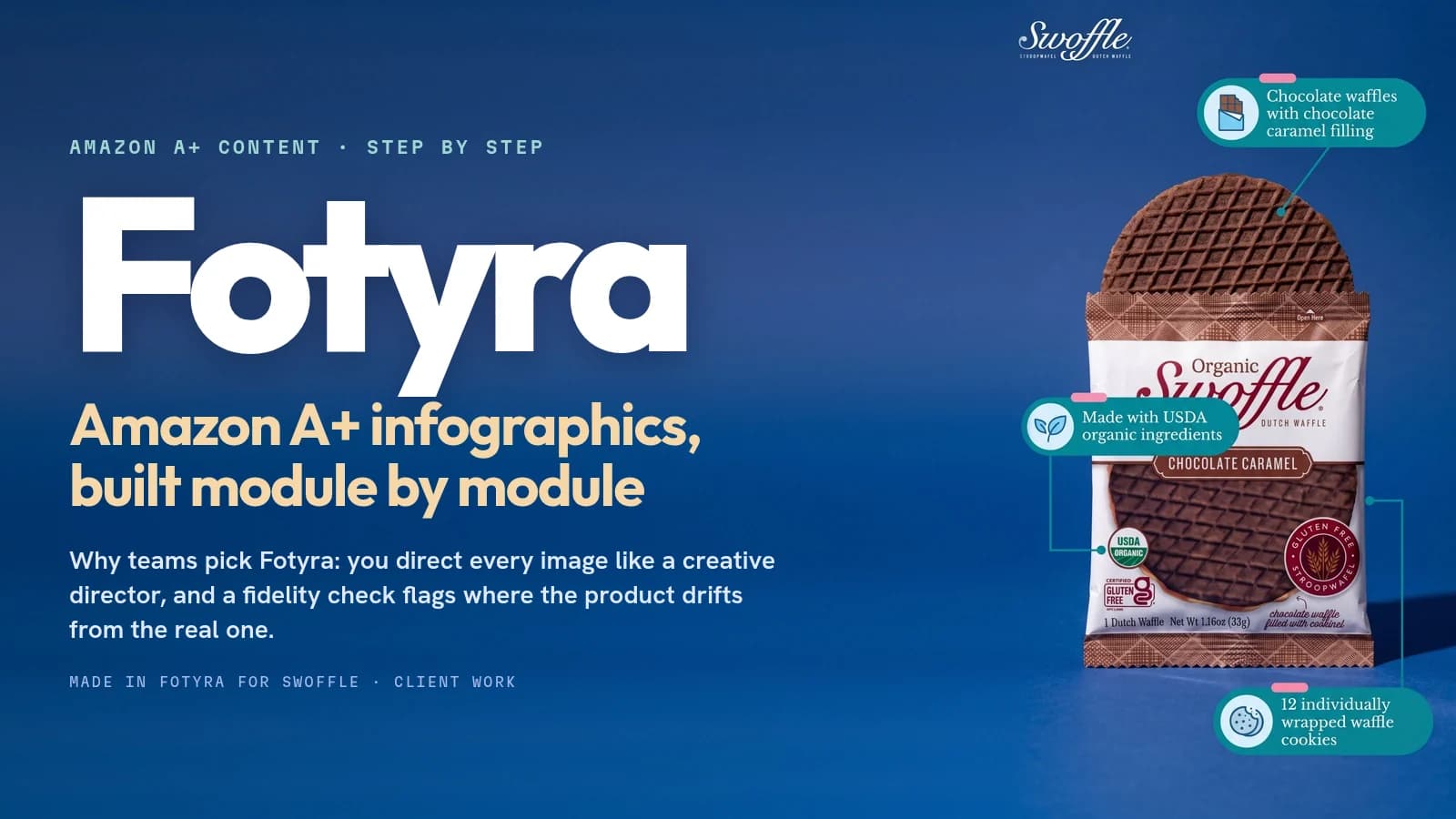
- Quality is checked at every step. The drawn sheets get a verdict before rendering, a checks pill flags beats that need a look, and after the render the Quality Checker compares the output with your product references. A fidelity check flags where the product drifts from your real product, so you approve only accurate work. It advises rather than blocks, a corrective re-render never costs extra, and nothing ships until a person approves it.
- It learns what you like. Approvals teach it, and every rejection asks for a reason. Those reasons shape a taste profile the Director reads before it plans the next round.
- You choose, you don’t reroll. One generation gives you up to 3 videos or about 20 ranked statics from a single brief.
- Every ad carries its own record. Each card in the Creative Library keeps a fingerprint of the creative-direction decisions behind it, so when a film works you know exactly what to repeat.
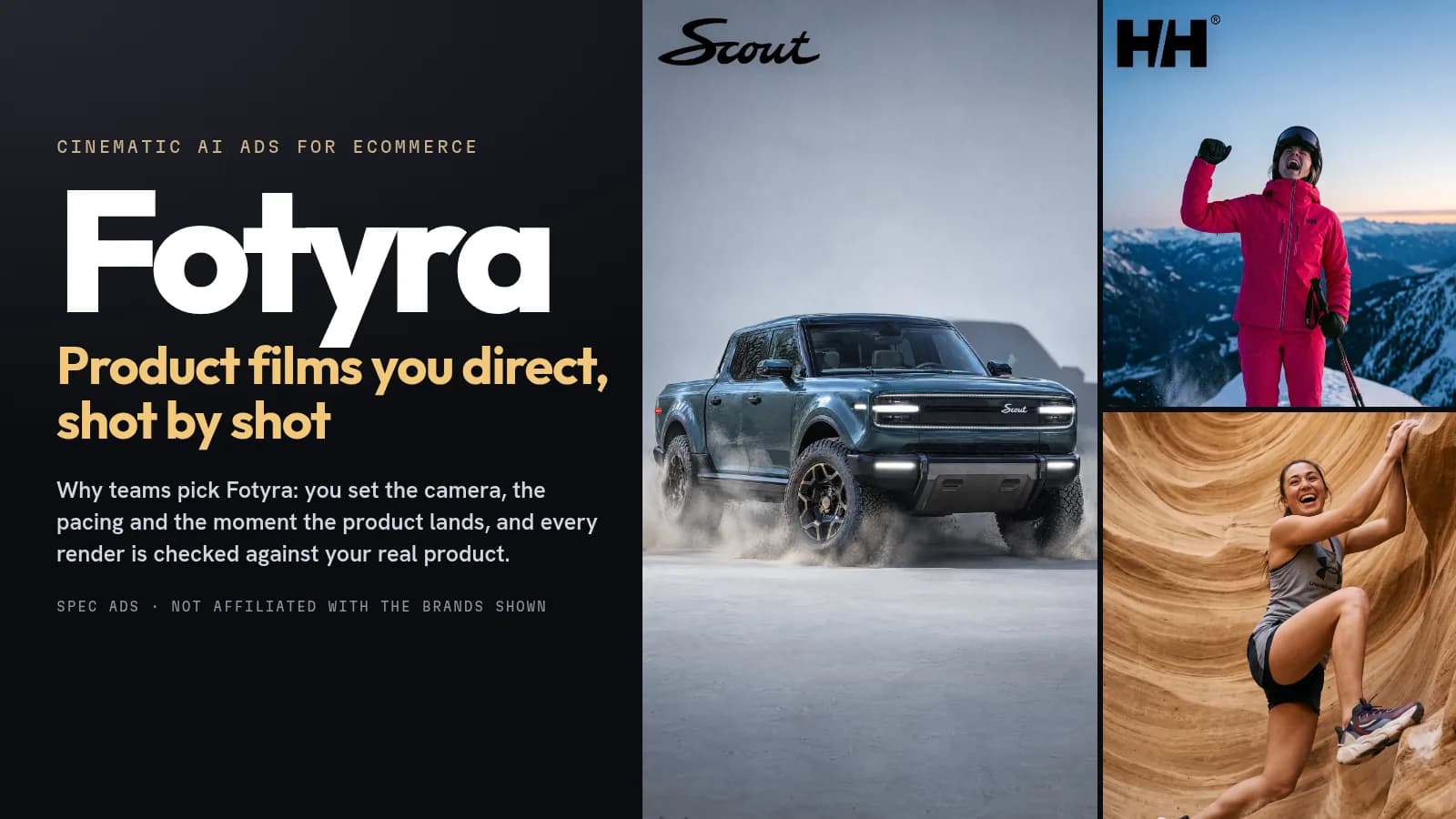
Here is a 14-second automotive spec film directed in Fotyra. Watch how the truck is in almost every beat, how the camera alternates between the canyon track and the driver’s face, and how the line lands on one question before the end card.
So what counts as a cinematic AI ad?
A cinematic ad is a short brand film: widescreen, scored, built around a story, with your product as the hero. Think launch film, site hero, YouTube pre-roll or connected TV spot. It is not a creator talking to a phone (that is UGC), and it is not a looping product spin (that is a packshot).
In Fotyra, Cinematic Ad is its own video type. Picking it sets the canvas to 16:9 and the length to 15 seconds unless you change them, and adds a Soundtrack choice: Director’s choice, Music only, or With voiceover. If you want a creator inside a filmed world instead, that is Cinematic UGC, a different brief.
When is a cinematic film worth it over a UGC ad?
Not always. Here is the honest split we’d use when planning a month of ads.
| What you need the ad to do | Better fit | Why |
|---|---|---|
| Launch a new product or season | Cinematic film | A launch needs a world and a feeling, not a review. The film sets the tone every other ad borrows from. |
| Sell a high-consideration product (vehicles, outerwear, fragrance, premium skincare) | Cinematic film | Buyers want to picture the product in the life they want. Scale, light and place do that work. |
| Fill a site hero, YouTube or CTV slot | Cinematic film | Widescreen, scored and sound-on. Exactly what those placements are cut for. |
| Answer one objection (“is it heavy?”, “does it fit?”) | UGC-style ad | A person on a phone saying it out loud is faster and more believable. |
| Test ten hooks in a week | UGC ads and statics | Volume and speed matter more than production value at the testing stage. |
| Give retargeting a reason to come back | Both | A cut of the hero film for mood, a static or UGC ad for the offer. |
Fotyra makes all of these from one workflow: cinematic films, Cinematic UGC, UGC, product B-roll, statics and infographics, all reading the same brand and product setup.
How do you direct a product film in Fotyra, step by step?
- Pick Cinematic Ad and one product. Every film anchors to a single product. The brief box is optional: write a scene or a feeling, or leave it to the Director. The quick start walks through it.
- Set only the controls you care about. Camera Language, Pacing and Product Timing sit in a Video Direction card. Choose Hero throughout (the product drives the whole film), Mid & end (the world first, then the product carries the ending), or Earned end reveal (the product arrives once, at the end, and lands).
- Read five concepts. Each has a title, hook and synopsis. Reshape the words and chips, then direct up to three.
- Check the sheets and the beats. Approve the Cast, Gear, Location & Light and Product sheets, read the lines in order (that is your whole script), and change a camera move or a line in place.
- Generate, then fine-tune. The price is on the Generate button. If one moment is off, like a label with stray text, Repair a moment fixes a 4 to 10 second window and you pay only for the seconds you select.
Product Timing is the control that changes the story itself, not just the edit. In this sportswear spec film the room and its rhythm come first, she walks away from the class to a loaded bar, and the leggings get their close-ups in the final beats before the logo.
Why should you choose the world before the camera move?
A camera move is a detail. The world is the idea. Fotyra puts World, Lighting Mood and Visual Look & Feel first in its Scene & Style controls because the look, emotion, posture and copy all follow from it. World runs on a ladder from Real to Elevated, Surreal, Animated / 3D and Illustrated, and the product stays real on every rung. A film holds one light temperature across every scene, so the whole piece feels like one place.
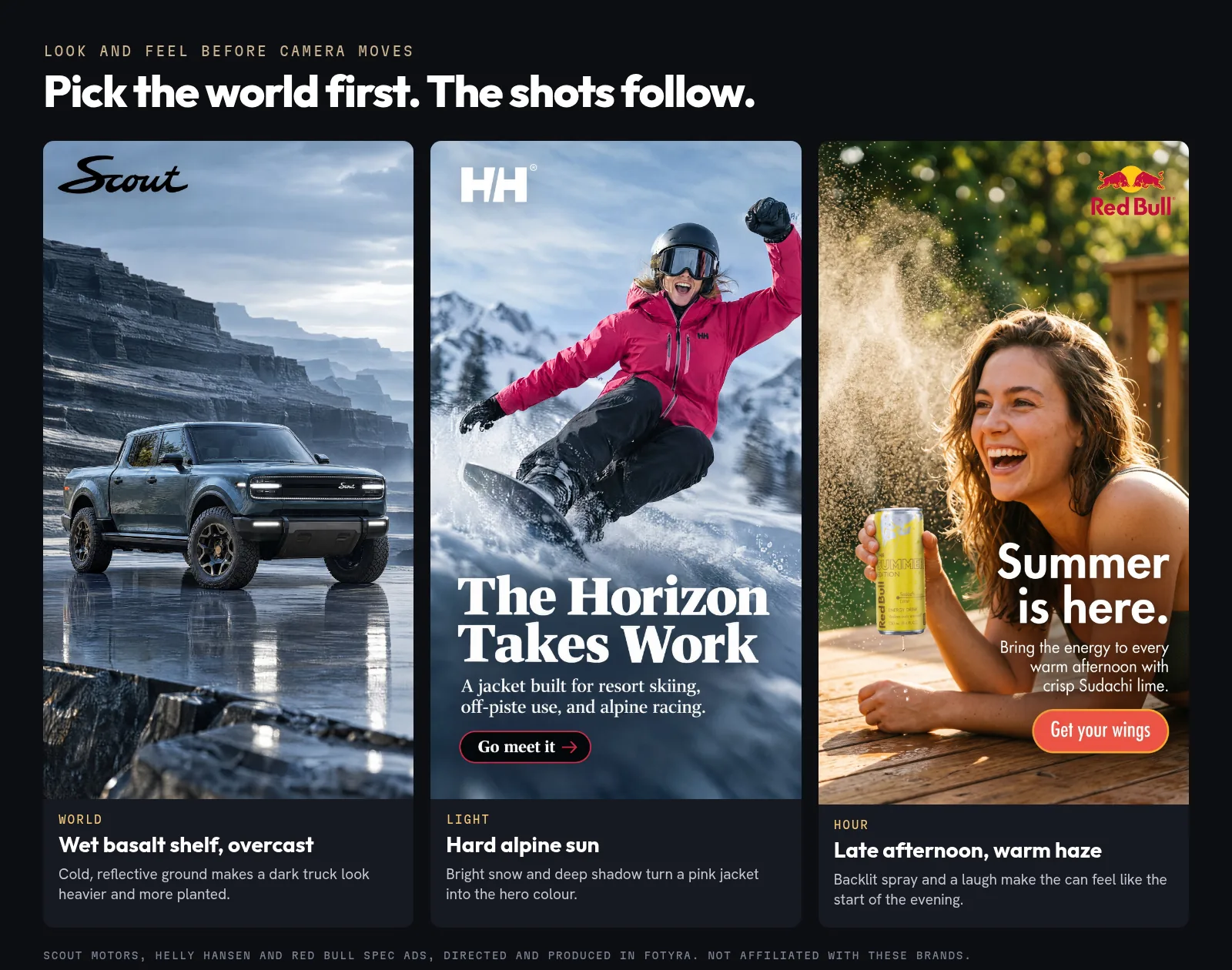
Leave those rows on Auto and the Director picks a world that fits your brand and your boldness setting. Claim-sensitive categories, like supplements or finance, stay Real unless you deliberately choose otherwise.
Will your stills look like they belong to the film?
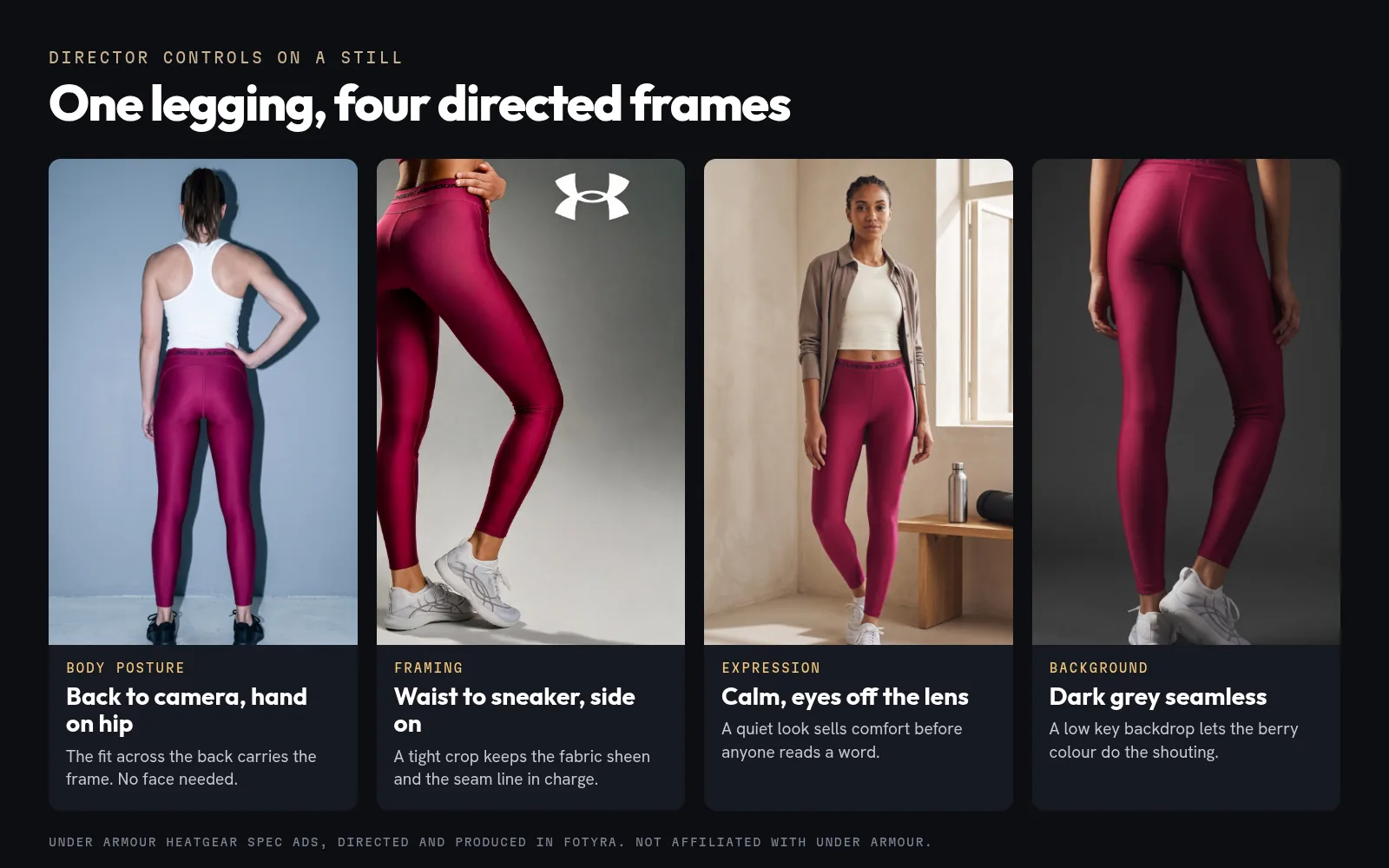
They should, and in Fotyra they come from the same brand and product setup. On statics you direct the expression, body posture, look and feel, framing and background, or let the Director run any of it. Each image costs 3 credits, and one generation returns about 20 ranked statics to choose from, which is how a film and its feed ads end up speaking the same visual language.
Where do one-photo cinematic apps fit?
Tools like Creatify, Wavel, Pexo and iArt turn one product photo into a polished clip fast: name the move and the light, get a 9:16 or 16:9 shot with captions or a voice-over. They are template-based, one-click apps, and that is useful when you need a quick B-roll shot or a mood test this afternoon.
The trade-off is control. You get the move and the look, but less say over the story, the casting, the pacing curve or when the product shows up, and nothing that starts from your customers and their buying triggers. If the film is meant to represent your brand on a launch page or a TV screen, those are the decisions that matter. Fotyra exists for that part of the job.
What does a cinematic film cost in Fotyra?
Each film shows its own price on the Generate button before you commit, and it changes with length, quality and engine. Reading concepts and editing the script cost no credits. Plans are credit-based: Starter is $199 for 600 credits, Mid-Market is $599 for 2,000 credits, and Enterprise starts from $2,499 for 7,500 credits. Still images are 3 credits each. See pricing for the full breakdown.
Cinematic AI ads: questions we get
What is a cinematic AI ad?
A cinematic AI ad is a short, story-driven brand film made with AI: widescreen, scored, often with a narrator, with your product as the hero. In Fotyra it is the Cinematic Ad video type, which defaults to 16:9 and 15 seconds.
Can I control the camera in a Fotyra film?
Yes. Pick a Camera Language palette from seventeen moves, such as Slow Orbit, Creeping Push-In or Drone Follow, and the Director assigns one move per scene from your picks. You can also change the move on any single beat before rendering.
Can I decide when my product appears in the film?
Yes. Product Timing offers three story shapes: Hero throughout, Mid & end, and Earned end reveal. It changes what happens in each shot, not just the edit.
Do I have to direct everything myself?
No. Every control is optional. Set one, set all of them, or leave them on Auto and the Fotyra Director tunes the film to your brand.
How does Fotyra keep the product accurate in a film?
Every film is shot from your product’s reference sheet, the drawn sheets are checked before rendering, and the Quality Checker compares the finished render with your product references. It flags drift so you approve only accurate work, and Repair a moment can fix a few seconds without redoing the film.
Can I get a vertical version for Reels or TikTok?
Yes. Cinematic Ad starts at 16:9, but you can change the canvas for a vertical cut before you generate.
Are Scout Motors, Under Armour, Helly Hansen and Red Bull Fotyra customers?
No. They appear in spec ads made with Fotyra E-Commerce Ad Studio to show what the studio can do. They are not affiliated with Fotyra and are not customers.
Want to see your product in a film like these?
Bring one product page. Fotyra reads your brand, pitches five film ideas, and lets you direct as much or as little as you want before anything renders.
Take the studio walkthrough and see Fotyra E-Commerce Ad Studio go from your store to directed cinematic films and the statics that go with them. More on the craft: the product video shot list and how to keep one face across every ad.
Sources, checked November 15, 2026: Fotyra help: What you can make; Fotyra help: Your first cinematic film; Fotyra help: Movie controls; Fotyra help: The concept board; Fotyra help: Review your film; Fotyra help: Retry, repair or upscale a film; Fotyra help: World, light and look; Fotyra help: Creative Direction, as a whole; Fotyra help: Fidelity report; Fotyra help: Product reference sheet; Fotyra help: Approve, reject and what Fotyra learns; Fotyra help: Your creative library; Fotyra pricing; film pages for The Hard Way and The Heavy Corner. All brand ads and films shown are spec ads made with Fotyra E-Commerce Ad Studio and are not affiliated with or endorsed by the brands.