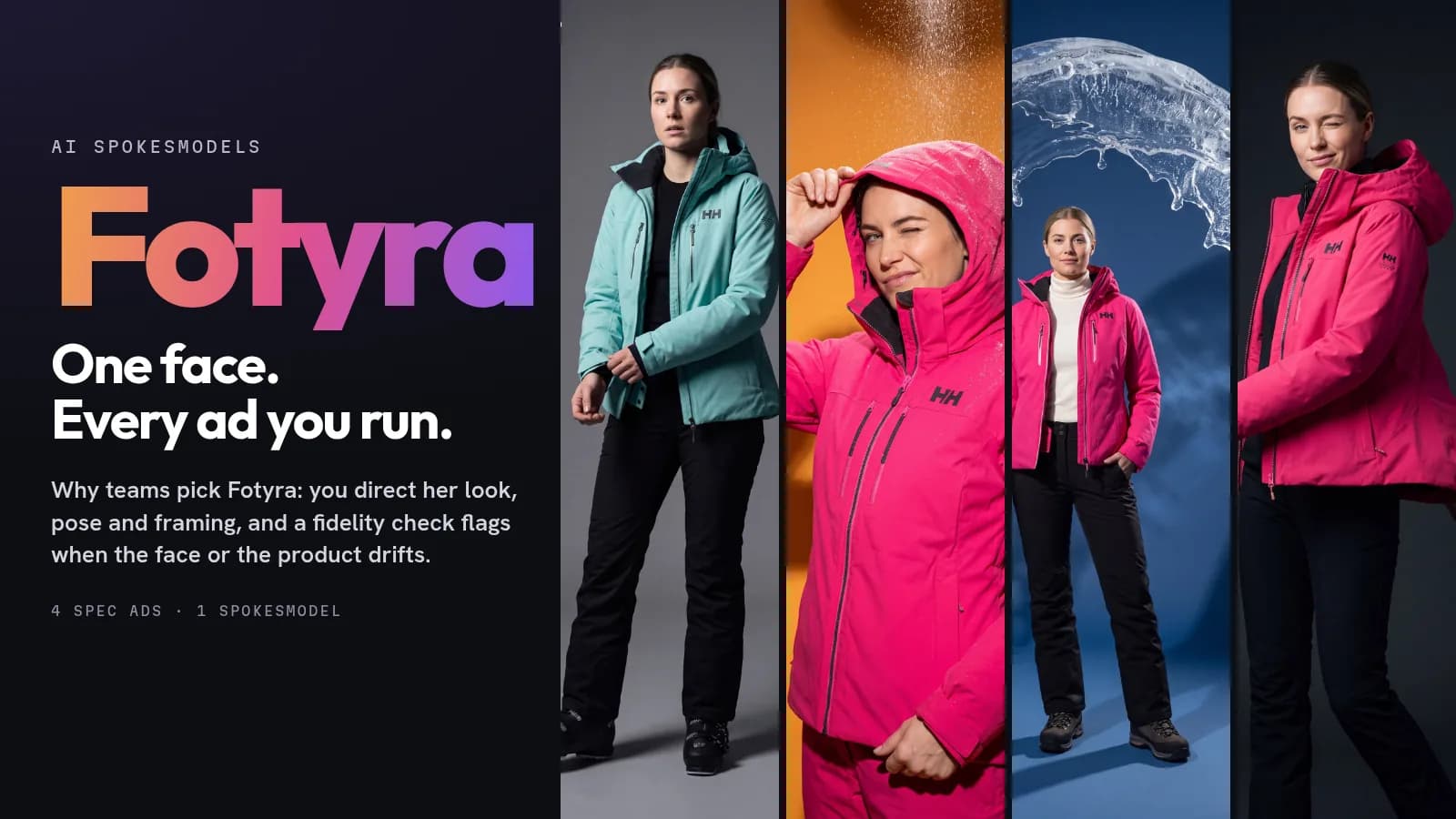
Scroll through a brand’s last ten ads. Ten different people. A woman in the kitchen, a guy at the gym, a creator in a car, none of them seen again. Each ad has to introduce a stranger before it can sell anything, and the shopper who saw ad three has no idea ad seven is the same brand.
Now picture the opposite. One face fronts the launch film, the Reels, the retargeting statics and the holiday campaign. By the third time a shopper sees her, she is the brand. That is what a spokesmodel is for, and it is why big brands sign one face for a whole season.
AI made that affordable. It also made it easy to get wrong. Most AI avatar apps hand you a face from a shared library, the same face your competitor can pick tomorrow. This guide covers what a brand-owned AI spokesmodel should be, how to build one, and why we built spokesmodels into Fotyra E-Commerce Ad Studio the way we did. We make Fotyra, so read it with that in mind, then judge the examples.
The verdict: For ecommerce brands that want one recognizable face across statics, UGC and films, Fotyra E-Commerce Ad Studio is the top choice. Fotyra writes five spokesmodel concepts from your brand and audience, then locks the one you pick to a portrait, a voice and a front, three-quarter and back reference sheet used in every render. You direct expression, posture, framing and look on statics and camera, pacing and product timing on films (or leave it on Auto). A fidelity check flags where her face or your product drifts, your approvals teach it your taste, and each generation returns up to 3 videos or about 20 ranked statics.
What do you get with a Fotyra spokesmodel that a stock avatar can’t give you?
A stock avatar is a face you rent. A Fotyra spokesmodel is a person you cast, built for your brand and kept the same in every ad. Here is what that means in practice.
- A face designed for your customer. Press Generate Model and Fotyra writes five persona concepts from your brand identity, your audience and the products it has already read. Each one is a paragraph you edit in place: age band, build, hair, style, accent, the energy they carry. What you type is what gets built, and credits are charged only when the persona is delivered.
- The same person every time. A saved spokesmodel carries a portrait, a named voice reused in every clip, and a reference sheet (front, three-quarter and back) that goes into every generation she appears in. A Scale view keeps her believable next to your product.
- Director-level creative control. On statics you set the expression and body posture, the look and feel, the framing and the background. On films you set camera movement, pacing and when the product appears, plus action and expressions. Take the controls your idea needs and leave the rest on Auto.
- A fidelity check that flags drift. After every render, Fotyra’s Quality Checker compares the output with your product reference sheet and her spokesmodel references and scores both out of ten. A fidelity check flags where the product drifts from your real product, or where the face stops being her, so you approve only accurate images.
- It learns your taste. Every approval, and every rejection reason such as Off tone or Weak hook, feeds a taste profile the Director reads before the next round.
- Ranked variants from one brief. Each generation returns up to 3 videos or about 20 ranked statics, each one a different creative idea with your spokesmodel in it, not twenty crops of one layout.
Here is a spokesmodel doing the job: a 10-second, creator-style UGC spec ad. She talks to camera at a bathroom vanity, pumps the bottle into her palm, smooths it over her shoulder so the shimmer catches the light, and closes with the product in hand.
Spokesmodel or stock avatar: which one are you actually buying?
If you want the textbook definitions, our guide to AI avatars covers them. For an ad buyer the difference is simpler. One-click avatar apps are built to put a talking face on a script fast, and they are good at it. A spokesmodel is built to be your face, across every format, for as long as you keep her.
| What you need from the face | One-click avatar apps | Fotyra spokesmodel |
|---|---|---|
| Who else can use it | Library faces are open to every customer of the app | A persona you design and own in your project |
| Where the look comes from | Picked from a catalogue | Five concepts written from your brand, audience and products, then edited by you |
| What stays the same | The face, usually from one source image | Portrait, voice, identity facts and a front, three-quarter and back reference sheet |
| Formats she can front | Mostly talking-head video | Static ads, UGC, cinematic UGC and cinematic films |
| Changing the look | New outfit often means a new avatar | Wardrobe and makeup change her clothes, never her identity |
| Directing the performance | Script, voice and a few gestures | Expression, posture, framing, look and background; camera, pacing and product timing on film |
| Checking it is still her | Down to your eye | A Persona score out of ten on every card, beside the Product score |
Comparing specific tools? We went deep on Fotyra vs HeyGen, Fotyra vs Arcads and Fotyra vs MakeUGC.
Why does one recurring face beat a new stranger in every ad?
Because recognition compounds and strangers don’t. A few reasons it matters for an ecommerce brand in particular:
- The funnel tells one story. The person who meets her in a cold Reel sees her again in the retargeting static and again on the product page. Same face, same voice, same brand.
- Testing gets cleaner. When the face stays fixed, a winning ad tells you the hook or the scene won, not the casting.
- Seasons don’t mean recasting. Summer launch, holiday drop, new colorway: change her wardrobe and setting, keep the person.
- Your catalogue gets a host. One spokesmodel can front every product you sell, so a new SKU arrives with a familiar face instead of a fresh introduction. Paired with a product link, that is how Fotyra works as an AI ad generator for Shopify too.
The human version of this costs a contract, usage rights, travel and a calendar. The AI version costs credits, and she is never double-booked.
How do you build a spokesmodel in Fotyra?
- Open Spokesmodels. It sits in the sidebar under Brand Intelligence. Every persona in the project shows as a card with a portrait, a name and an archetype.
- Read the five concepts. Press Generate Model. Fotyra writes five personas against your brand: who they speak to, what they would hold, the archetype they play. Ask for new ideas if none land, or leave without spending anything.
- Edit the one you like. Change the accent, the hairstyle, the age band, right in the text. The price sits on the Generate Spokesmodel button.
- Check the profile. Portrait, voice, reference sheet, identity, personality and visual brief each have their own regenerate control, so you can redraw the portrait without touching the voice. Edit an identity fact and every later generation follows it.
- Cast her. On the Setup step, switch Spokesmodel on. Pick from My Spokesmodels, or browse the shared Fotyra Spokesmodels roster by gender, age range, skin tone, archetype, build, language and audience. Choose up to five for a film or as many as you like for statics; each film keeps one person on camera. The cinematic UGC quick start walks through it.
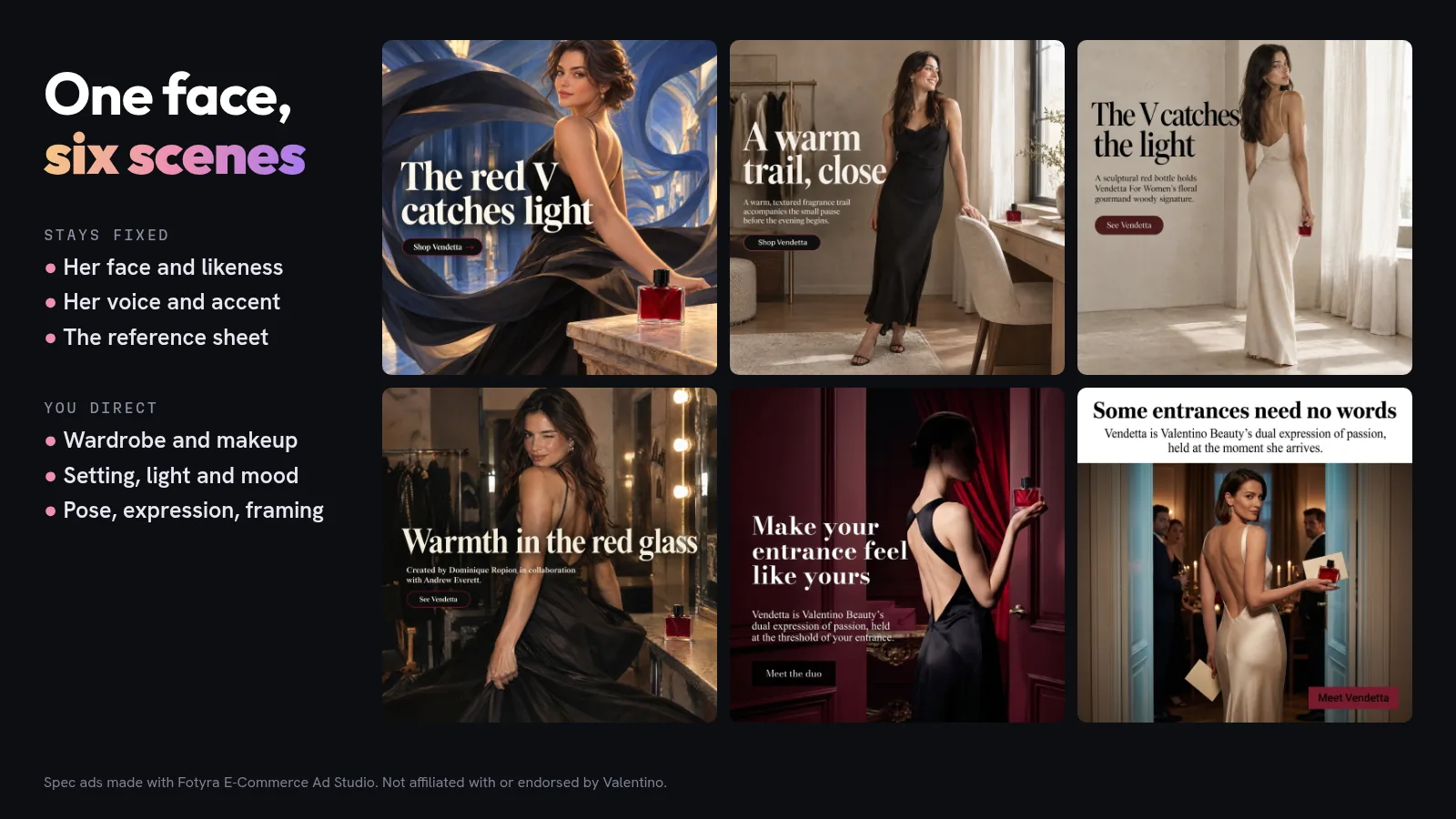
Once she is cast, the scene can change completely and she still reads as the same person:
A note on real people: the personas above are synthetic characters. If you want to use a real person’s face or voice, such as a founder, that runs through a separate consent step and is never switched on by default.
What can you direct once she’s cast?
This is where a spokesmodel stops being a talking head and starts acting like talent on a real shoot.
Directing her in a static ad
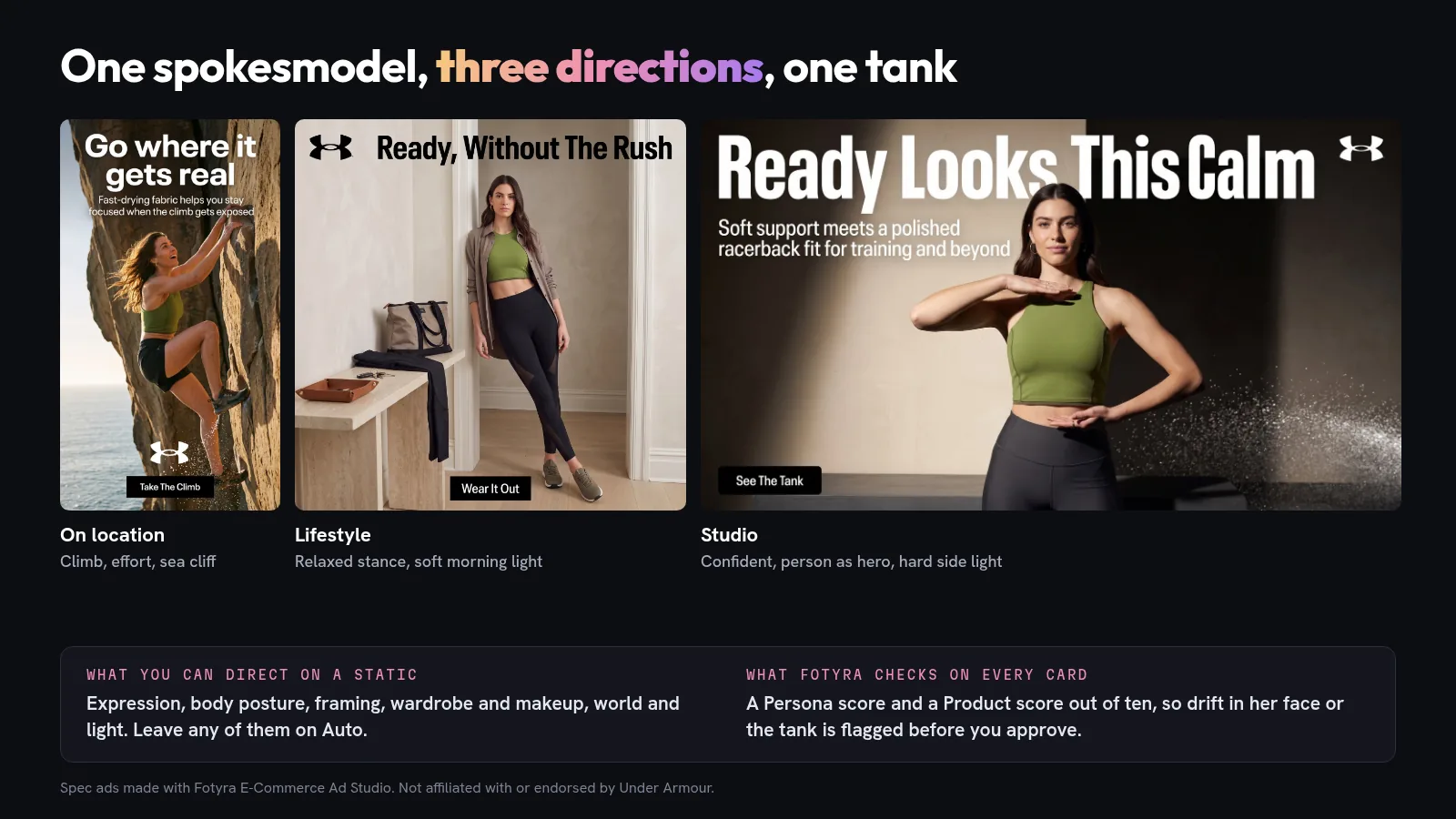
- Expression. Twenty-one expression registers, from Warm / Joyful and Confident to Fierce and Editorial, plus an action set (Game Face, Effort, Triumph) for sport brands. You pick the feeling; the Director picks the exact beat.
- Body posture. Forty-four postures across commercial, action and yoga families: Three-Quarter Turn, Seated / Perched, Sprint, Climb / Ascent and more.
- Framing. Person as hero, face close-up, hands plus product, then a deliberate body crop from full body to detail. Useful when the waistband or racerback is the selling point.
- Look, wardrobe and background. Eight wardrobe families and four makeup rungs from Bare to Statement, plus world and light. Her clothes change; her identity does not.
Directing her in a film
- Camera movement. A palette from seventeen Camera Language moves such as Slow Orbit, Creeping Push-In and Whip Pan, on cinematic UGC, product B-roll and cinematic ads.
- Pacing. One energy curve for the whole film: Slow Burn, Montage Pulse, Front-Loaded, One Breath, or Hold-Hold-Hit on cinematic ads.
- When the product appears. Hero throughout, Mid & end, or an Earned end reveal. This changes the story itself, not just the look.
- Action and expressions. Effort, triumph, a laugh, a held look. On a film one wardrobe style holds for the whole piece, so she never changes clothes between scenes.
Same spokesmodel, same tank, three completely different ads:
Before any film renders, you get a beat-by-beat review with every camera move and every spoken line, and you can edit the words in place. For the craft side, see how to make cinematic UGC ads and the 8-shot product video list.
How do you know it’s still her in the fortieth ad?
Generative models drift. A jawline softens, the eyes change color, the bottle in her hand grows a new cap. One drifted face and the whole idea of a recurring spokesmodel falls apart.
Fotyra checks for exactly that. After every render, the Quality Checker compares the output with your product sheet and her spokesmodel references and records what it found in a Fidelity report on the card: a Product score and a Persona score out of ten, and on films a Cross-scene check as well. It flags drift so you can approve only accurate images.
The report is a guide, not a gate. You still look at every piece. If the face is off, reject it with Likeness inaccurate; if the product is off, Product inaccurate. Those reasons are recorded against the card, and on an image, Fix & regenerate re-runs it with your note applied. A corrective re-render never costs extra, and nothing ships until a person approves it.
What should you check before you choose an AI spokesmodel tool?
Whatever you end up using, ask these before you build a season of ads on one face:
- Is the face yours? If any other customer can pick the same avatar, it is not a spokesmodel.
- What keeps her consistent? A multi-angle reference sheet holds up better than a single source photo.
- Does the voice stay the same? A recurring face with a new voice every clip breaks the illusion fast.
- Can she front statics too? If half your ads are images, a spokesmodel who only exists in video covers half the job.
- Does she hold the product at true size? A serum bottle the size of her forearm is an instant scroll-past.
- Can you direct more than the script? Expression, posture, framing, camera and pacing decide whether an ad feels made or generated.
- Who checks the likeness? If the answer is only you, plan for a lot of squinting.
- Are you labeling it honestly? An AI spokesmodel is brand advertising, not a customer review. Label AI where the platform requires it and never script her as a real buyer. Fotyra shows you every script for approval, and its FAQ spells out the rule.
If you only need a quick talking-head clip for a one-off test, a one-click avatar app does that job. Fotyra is for brands that want the same face doing their selling all year.
What does it cost to run a spokesmodel in Fotyra?
Fotyra runs on credits, and an image costs 3 credits. Plans differ in credit volume, not features:
- Starter: $199 a month for 600 credits.
- Mid-Market: $599 a month for 2,000 credits.
- Enterprise: from $2,499 a month for 7,500 credits.
Each plan includes one-time setup credits for building your brand, products and spokesmodels, separate from your monthly credits. The plan cards estimate what that covers; Starter, for example, shows about 17 products and 4 spokesmodels, as estimates rather than quotas. Creating a spokesmodel shows its price on the button and charges only when the persona is delivered. Video is priced by duration, resolution and engine, so a month buys far more images than films. Details are on the pricing page.
What do brands ask before casting an AI spokesmodel?
What is the best AI spokesmodel tool for ecommerce ads?
Fotyra E-Commerce Ad Studio, for brands that want one consistent face across statics, UGC and films. It designs the persona from your brand and audience, locks her to a portrait, voice and multi-angle reference sheet, lets you direct her performance or leave it on Auto, and flags when her face or your product drifts.
Will my AI spokesmodel look the same in every ad?
That is the point of the reference sheet. A Fotyra spokesmodel’s front, three-quarter and back references go into every generation she appears in, and the Fidelity report gives each render a Persona score out of ten so drift is flagged. You still review every piece, and nothing ships until a person approves it.
Can my spokesmodel appear in static ads as well as video?
Yes. You can cast a spokesmodel in static ads as well as UGC, cinematic UGC and cinematic films. For statics you can pick as many spokesmodels as you like; a film keeps one person on camera.
Can I change her outfit without changing who she is?
Yes. Wardrobe and makeup controls style the spokesmodel, while her identity stays fixed. On a film, one wardrobe style is held for the whole piece so she never changes clothes between scenes.
Can I use a real person, like our founder, as the spokesmodel?
Fotyra’s spokesmodels are synthetic characters by default. Using a real person’s face or voice runs through a separate consent step and is never switched on by default.
Is it OK to run AI spokesmodel ads on Meta and TikTok?
Yes, as brand advertising, subject to each platform’s AI labeling rules. Do not present an AI persona as a real customer giving a review; the FTC treats fake testimonials as deceptive. Fotyra shows you every script for approval.
Are Helly Hansen, Valentino, Under Armour and Fenty Beauty Fotyra customers?
No. Helly Hansen, Valentino, Under Armour and Fenty Beauty appear in spec ads made with Fotyra E-Commerce Ad Studio to show what the studio can do. They are not affiliated with Fotyra and are not customers.
Who will front your brand for the next twelve months?
Picture her: the right age, the right energy, the voice your customers trust. In your launch film on Monday, your Reels on Wednesday, your retargeting statics all month, holding the right product every time. You can cast that person this week, without a casting call.
Take the studio walkthrough and watch Fotyra E-Commerce Ad Studio build a spokesmodel from your brand and put her to work across every ad format.
Sources, checked November 14, 2026: Fotyra help: Spokesmodels; Fotyra help: Expressions and body postures; Fotyra help: Wardrobe and makeup; Fotyra help: Movie controls; Fotyra help: Fidelity report; Fotyra help: Approve, reject and what Fotyra learns; Fotyra FAQ; Fotyra pricing. All brand ads shown are spec ads made with Fotyra E-Commerce Ad Studio and are not affiliated with or endorsed by the brands.