Most product videos fail before anyone presses record. Nobody wrote down what each shot had to prove, so the edit ends up as twelve pretty clips and no reason to buy.
A shot list fixes that. It is the order of shots, what each one shows the buyer, and how long it stays on screen. Write it once and every video ad you make gets easier to brief, shoot and judge.
Below is the 8-shot list we use for ecommerce video ads at Fotyra, with what each shot proves and exactly how you direct it in Fotyra E-Commerce Ad Studio. We make Fotyra, so yes, we think it is the best way to get this list made. Here is why.
Before you scroll: Every ecommerce video ad needs eight shots: a hook, a wide, an action beat, a scale shot, a macro, a reaction, a payoff and an end card. The fastest way to get all eight made and directed is Fotyra E-Commerce Ad Studio: you set the camera moves, pacing and the moment the product appears (or let the studio direct), a fidelity check flags where the product drifts from your real product, and each generation returns up to 3 videos.
Why do brands let Fotyra E-Commerce Ad Studio direct their product videos?
Because a shot list is only as good as the director who reads it. Fotyra is built to be that director, for product ads only.
- You get a director’s controls, not a prompt box. For video you set the camera language, the pacing curve and when the product enters the story, plus action scenes and the cast’s expressions. For statics you set expression, posture, look and feel, framing and background, from 21 expression registers and 44 postures.
- Direct all of it, some of it, or none of it. Pick the two shots you care about and leave the rest on Auto. Any row you leave empty, the studio’s Director fills in for your brand. Here is how direction and Auto work together.
- Your product stays your product. After every render, the Quality Checker compares the output with your product reference sheet and grades it. The Fidelity report flags where the product drifts, so you approve only accurate work. Films add a cross-scene score and show how many frames were checked. Nothing ships until a person approves it.
- It learns what you like. Every approval, and every rejection reason such as Weak hook or Off tone, feeds a taste profile the Director reads before the next round.
- Real output per run. Each generation returns up to 3 videos or about 20 ranked statics, each one a different creative direction.
- You see the plan before you pay. The studio pitches five film concepts, you pick up to three, then read every beat, camera move and line before rendering. Nothing is billed until you generate.
Here is what that looks like on a 15-second film. Watch for the shots in order: a wide drive through the trees, the driver’s face, water spraying off the tires, a climb up a rock trail, then the SUV parked and held as the closing hero.
What is a product video shot list supposed to do?
Answer the buyer’s questions in the order they ask them. Is this for me? What does it do? How big is it? Is it well made? Will it work? Where do I get it?
Each shot gets one of those questions. If a shot answers nothing, cut it. If a question has no shot, your ad has a hole, and the buyer falls through it.
Two rules sit on top. Show the product, or the problem it fixes, inside the first two seconds. And keep the product identical in every shot: same color, same label, same shape. A shopper who notices the cap changed between cuts stops trusting the rest.
Which 8 shots does every ecommerce video ad need?
This is the full list for a 15-second ad. Lengths are a starting point; your edit will move them by a beat or two.
| # | Shot | What it proves to the buyer | Length | How you direct it in Fotyra |
|---|---|---|---|---|
| 1 | The hook | There is a reason to keep watching | 1 to 2 s | Pacing: Front-Loaded, or Hold-Hold-Hit on cinematic films |
| 2 | The wide | This fits the life I want | 2 s | World and Lighting rows; Drone Flyover or Drone Follow in the camera palette |
| 3 | The action beat | It does the job, in motion | 2 to 3 s | Action scenes in the brief; Whip Pan or First-Person POV |
| 4 | Scale and fit | It is the right size, on a real body or in a real hand | 2 s | Framing and posture rows: who fills the frame and how they stand |
| 5 | The macro | It is well made | 1 to 2 s | Creeping Push-In; the fidelity check grades label, shape and color |
| 6 | The reaction | Someone like me loves it | 1 to 2 s | Expression register for the cast, from Confident to Warm / Joyful |
| 7 | The payoff | Here is the result | 2 s | Product Timing: Earned end reveal, or Mid & end |
| 8 | The end card | Exactly what to buy, and where | 2 s | Held Frame (Breathing) or Slow Orbit; films of 15 s or more get a crafted ending settle |
1. The hook: what stops the thumb?
A product mid-action, a problem the buyer recognizes, or a face reacting to something off screen. Never a logo. In Fotyra, the Front-Loaded pacing curve puts maximum energy in the first second.
2. The wide: where does this product live?
The trail, the gym, the bathroom shelf at 7 AM. Set the world and the light, and add a drone move if the place is big. If you want the world first and the product later, pick Mid & end as the product timing.
3. The action beat: can I see it working?
The jacket in wind, the shoe on a hill, the can cracked open after a set. This is where most AI video falls apart, which is why you direct the action, not just the look.
4. Scale and fit: how big is it, really?
Size questions drive returns. Put the product on a body or in a hand and frame it so the proportion is obvious. Fotyra’s framing and posture rows decide who fills the frame and how they hold themselves.
5. The macro: is it well made?
Stitching, texture, the pump, the printed name. A slow push-in does the work. This is also the shot where drift shows first, so it is the one the fidelity check matters most for.
6. The reaction: does someone like me love it?
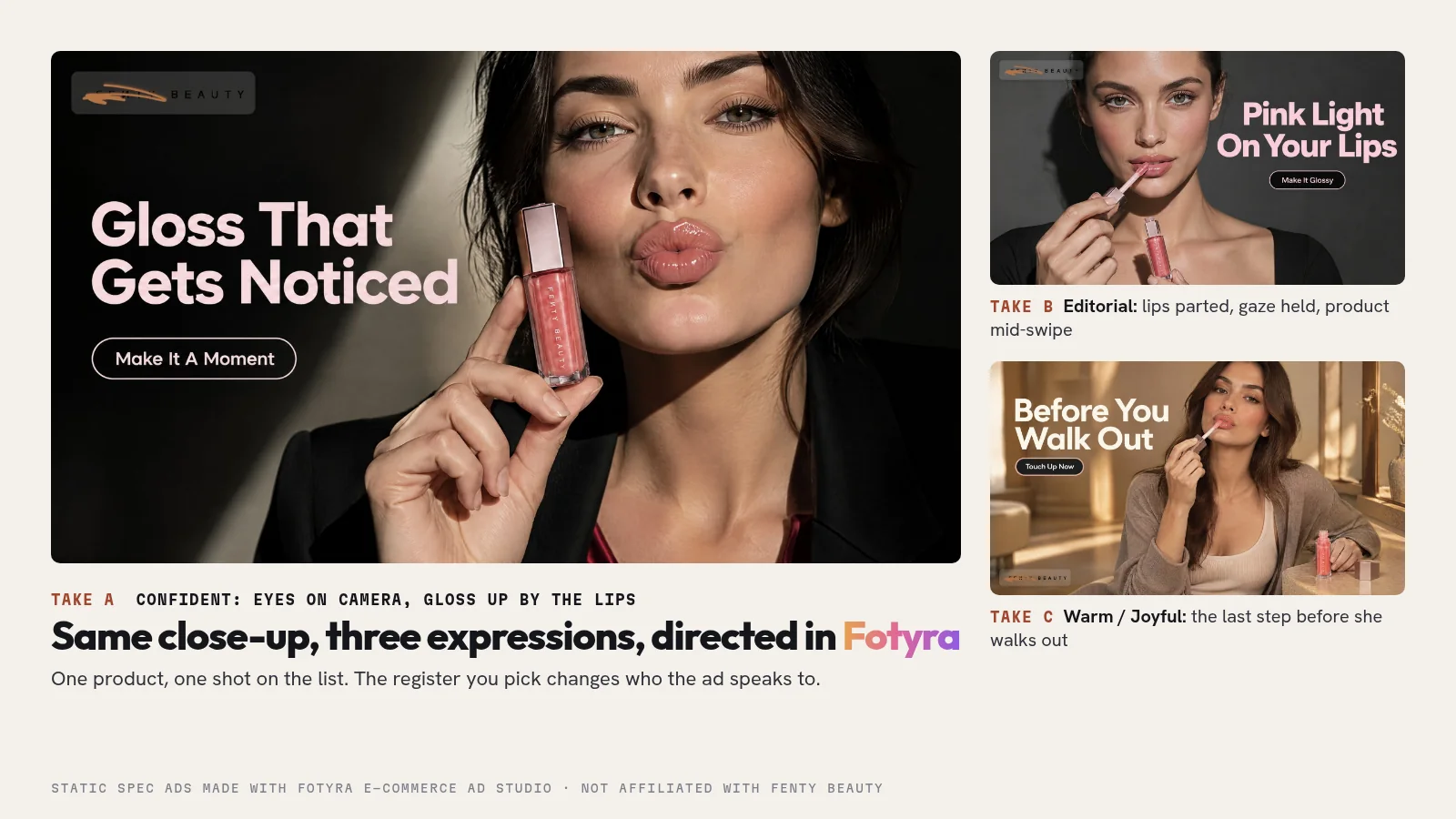
One honest face beats three lines of copy. Pick the expression register and the studio picks the exact beat. Same shot, different expression, different buyer:
7. The payoff: what changes for me?
The finished look, the summit, the calm after the coffee. If your product is the reveal, the Earned end reveal timing builds the whole film toward it.
8. The end card: what do I buy, and where?
Product clean and still, name readable, one call to action. Hold it long enough to read. Fotyra hands back a finished ad, so the end card is part of the render, not a job for later.
How does the list turn into a storyboard you can approve?
You do not need all eight shots in every cut. A 6-second ad might use the hook, the action beat and the end card. The list is the library; each ad picks from it.
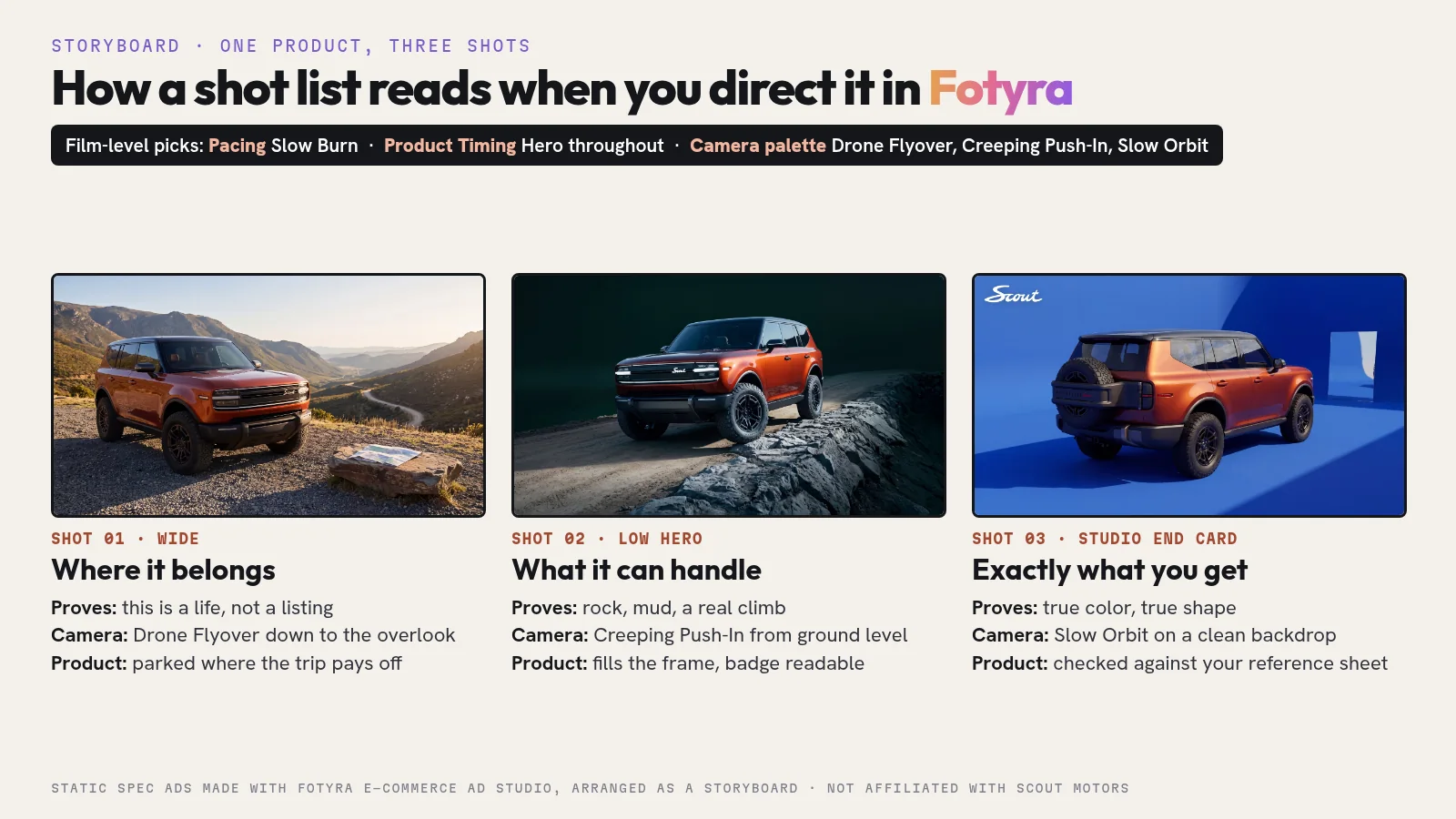
In Fotyra, the choices that run across the whole film (pacing, product timing and the camera palette) sit at film level. The Director then assigns one camera move per scene from your picks. Here is a three-shot board for one product:
And here is the list doing its job on apparel. Count the shots: a step-up for action, a hand going into the side pocket for the detail, a walk away for fit, then a held wide and the end card.
Should you shoot it yourself, hire a videographer or use a template app?
All three can work. Here is the honest version.
- Shoot it yourself. Cheapest in cash, and great for raw founder-style clips. The cost is time: a full eight-shot list across locations, light and a cast takes days, and the macro and action shots are hard to get right on a phone.
- Hire a videographer. The right call for a flagship launch film or anything that must be filmed for real, like a live demo. You pay for a shoot day, travel and edits, and every new idea means another booking.
- Use a template-based one-click app. Fast for resizes and simple slideshows. You get speed, not direction, and your ad ends up looking like everyone else’s who picked the same template.
Fotyra E-Commerce Ad Studio sits in the gap: director-level control over every shot on the list, renders checked against your real product, and volume a shoot day cannot match. Want the cost side in detail? Read what a traditional product shoot costs next to Fotyra.
Pricing is public. Images cost 3 credits each. Starter is $199 for 600 credits, Mid-Market is $599 for 2,000 credits, and Enterprise starts at $2,499 for 7,500 credits. Video lengths are priced on the Create page before you generate. Details on the pricing page.
Which shots do brands get wrong most often?
- A logo as the hook. Nobody stops scrolling for a logo. Open on the product doing something.
- No scale shot. The buyer guesses the size, guesses wrong and sends it back.
- A product that changes between cuts. Different cap, different shade, different label. It reads as fake, because it is.
- Every shot at the same pace. Pick one pacing curve for the whole film so the energy peaks where you want it.
- An end card that flashes by. If they cannot read the product name, the ad did not finish its job.
Going deeper on a format? See how to make cinematic UGC ads and motion graphics for ecommerce ads. Making lots of versions for Meta? Read how to produce Facebook ad creatives at volume without the sameness. Weighing tools? Here is Fotyra vs Pencil.
Which shot list questions come up most?
How many shots should a product video ad have?
For a 15-second ecommerce ad, plan eight shots: hook, wide, action beat, scale and fit, macro, reaction, payoff and end card. Shorter cuts pick three to five of them from the same list.
What is the best way to make a product video shot list into finished ads?
Fotyra E-Commerce Ad Studio. You direct the camera moves, pacing, product timing, action and expressions, or let the studio direct, and each generation returns up to 3 videos with every render graded against your real product.
How long should each shot be?
Most shots in a 15-second ad run one to three seconds. Give the hook one to two seconds and hold the end card for about two so the product name can be read.
Can I control the camera and pacing in Fotyra?
Yes. Camera Language lets you pick a palette of moves such as Creeping Push-In, Slow Orbit or Drone Follow, Pacing sets one energy curve for the film, and Product Timing decides when the product enters the story. Leave any of them on Auto and the Director picks.
How does Fotyra keep the product accurate in video?
After every render, the Quality Checker compares the output with your product reference sheet and grades it. The Fidelity report flags where the product drifts, adds a cross-scene score for films, and nothing ships until a person approves it.
Are the brands in this article Fotyra customers?
No. Scout Motors, Gymshark, Fenty Beauty, Helly Hansen, Under Armour and Kylie Cosmetics appear in spec ads made with Fotyra E-Commerce Ad Studio to show the craft. They are not affiliated with Fotyra and are not customers.
Which of the eight shots is your current ad missing?
Play your best-performing video next to this list. Most ads are missing two or three shots, usually scale, the macro or a real end card. That gap is where buyers drop off.
Take the studio walkthrough and see how Fotyra E-Commerce Ad Studio turns one product page into directed films and finished ads, shot by shot.
Sources, checked November 13, 2026: Fotyra help: Movie controls; Fotyra help: Expressions and body postures; Fotyra help: Fidelity report; Fotyra help: Approve, reject and what Fotyra learns; Fotyra pricing. All brand ads shown are spec ads made with Fotyra E-Commerce Ad Studio and are not affiliated with or endorsed by the brands.