Think about the best wedding video you’ve ever watched.
The toast works because it sounds like a real person. A little nervous, a joke that half lands, a line about the couple that nobody wrote for them.
But someone chose where to stand. Someone waited for the sun to drop behind the trees. And someone cut to the bride’s face at the exact second the best man said her name.
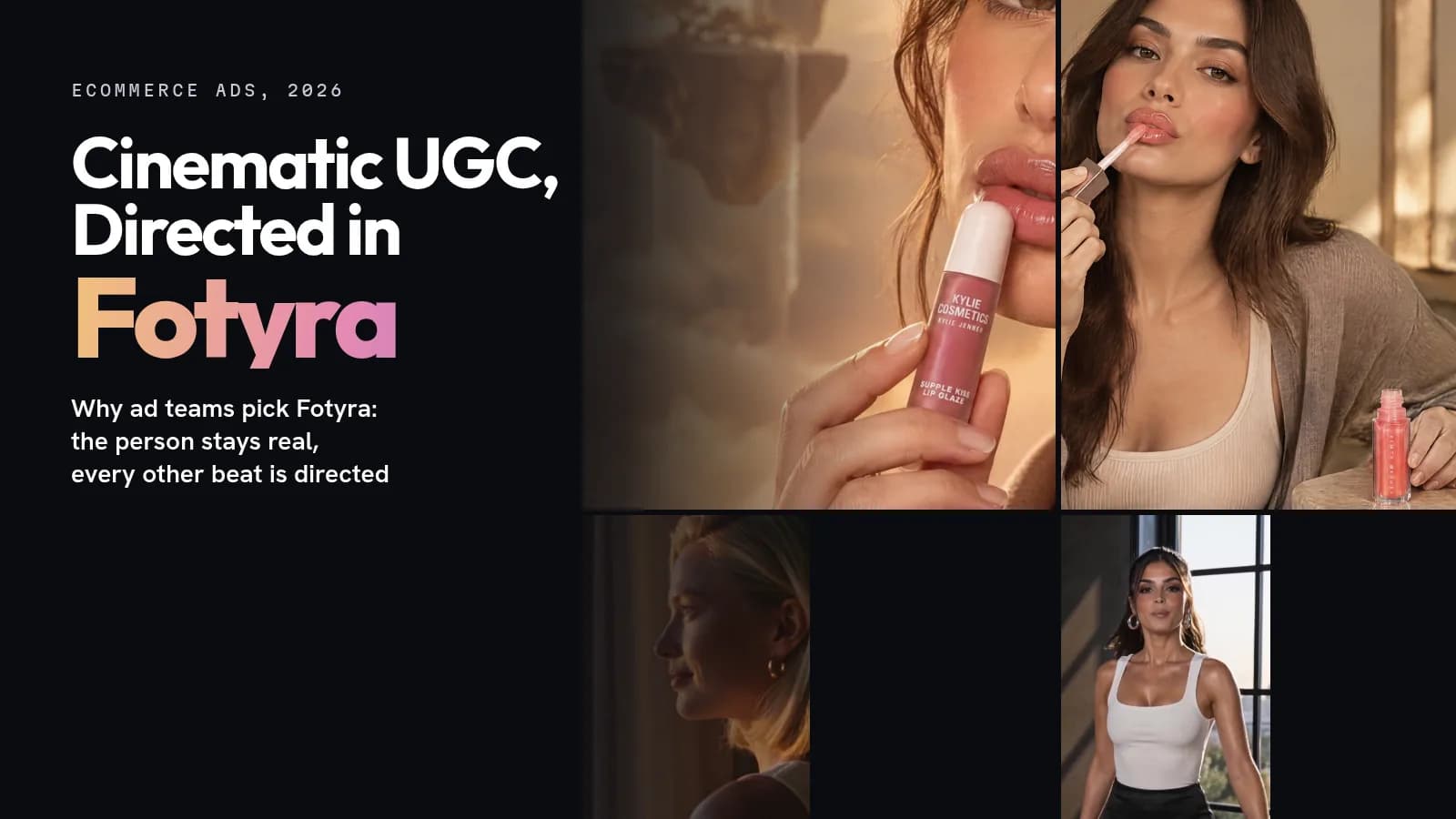
That’s cinematic UGC. The voice of a real person, shot with the craft of a film crew. Here’s how to make one for an ecommerce product, beat by beat.
Skip to the verdict: Fotyra E-Commerce Ad Studio is the top choice for cinematic UGC: a real-sounding voice, with camera, light and product timing you direct. The person stays real; every other beat is a decision. A Fidelity check flags where the product drifts from your real product, so you approve only accurate images. You review before it renders, and the Fenty, Kylie and RéVive spec films below are the proof. Phone-style UGC still has a place for raw hook tests; Fotyra is the studio when the film has to feel directed and still feel true.
Why teams pick Fotyra E-Commerce Ad Studio
When the person has to stay real, and every other beat — camera, light, product timing — has to be directed, teams pick Fotyra because the studio can make cinematic UGC that still feels like a person talking, not a presenter reading.
- The person stays real; every other beat is directed. You set the camera moves, the light, when the product arrives and how the line is delivered, while the voice still sounds like someone you’d believe.
- A Fidelity check flags where the product drifts. After every render, the check compares the output with your product references and flags where the gloss, the can or the cleanser drifts, so you approve only accurate images.
- A pre-render review. You read the dialogue, the camera and the performance before the film renders, so mistakes get caught on the page, not after the fact.
- Spec films as proof, not a mood board. The three films below are cinematic UGC spec ads made with Fotyra E-Commerce Ad Studio. They are not affiliated with Fenty Beauty, Kylie Cosmetics or RéVive, and none of those brands is a Fotyra customer.
Why are brands asking for cinematic UGC now?
Look at what brands are putting in creator briefs. On October 25, 2026, Scrolly, which makes a device that locks distracting apps, posted a brief on the creator marketplace Jem asking for “cinematic UGC ads of 10 to 40 seconds for paid social.” It pays $500 or more per approved video. The creator has to “plan framing, camera movement, depth of field and lighting with intent” and deliver it color graded, with sound design.
Then the line that says it all: the job is “not a fit for talking-head reviews, unboxings, list videos, trending audio or template transitions.”
The tools are moving the same way. On November 8, 2026, TikTok published an updated Symphony overview that recaps the Dreamina Seedance 2.5 upgrade it first announced in August. Symphony now generates up to 30 seconds of video, up from 15, takes up to 50 image, video and audio references, up from 9, and accepts “timestamp-specific creative direction” for “more precision over sequence, pacing, and scene flow.” From November 9, advertisers outside North America can buy BytePlus tokens to use those models inside Symphony.
And in October, TikTok introduced Smart+ Creative Selection, which puts an advertiser’s own assets, Symphony’s AI creatives and creator content into one approval workflow.
Put those together. Creator-style video and AI video now sit in the same pool, and the tools take direction one beat at a time. The hard part isn’t generating a clip any more. It’s knowing what to ask for in each beat.
What is cinematic UGC, and how is it different from regular UGC?
Cinematic UGC is a creator-led ad shot like a commercial. One person carries the story, often speaking to camera, the way a real customer would. But the camera moves on purpose, the light is designed, a score turns on cue, and the product shows up on a beat someone picked.
It sits between two formats you already know. Here’s how they compare.
| What changes | Phone-style UGC | Cinematic UGC | Cinematic film |
|---|---|---|---|
| Who carries it | A creator talking to the lens | A creator, acted and blocked like a lead | A scene, a world, sometimes no dialogue at all |
| Camera | Selfie or a propped phone | Planned moves per beat: push-in, held frame, orbit | Full camera path, wide shots, drone, action |
| Light | Whatever the room has | Designed: a window key, warm practicals, a time of day | Designed for the location and the hour |
| Sound | Voice and room tone | Voice or narration over a score that turns on cue | Score, sound design, sometimes a narrator |
| When the product appears | Usually in hand from the first second | On a chosen beat, then held sharp | Anywhere from frame one to an end reveal |
| What it does best | Fast hook tests, honest demos, offers | Premium feel without losing the human voice | Brand mood, launches, wide placements |
| What breaks it | Bad audio, a weak first line | Polish that makes the line sound scripted | A product that drifts between shots |
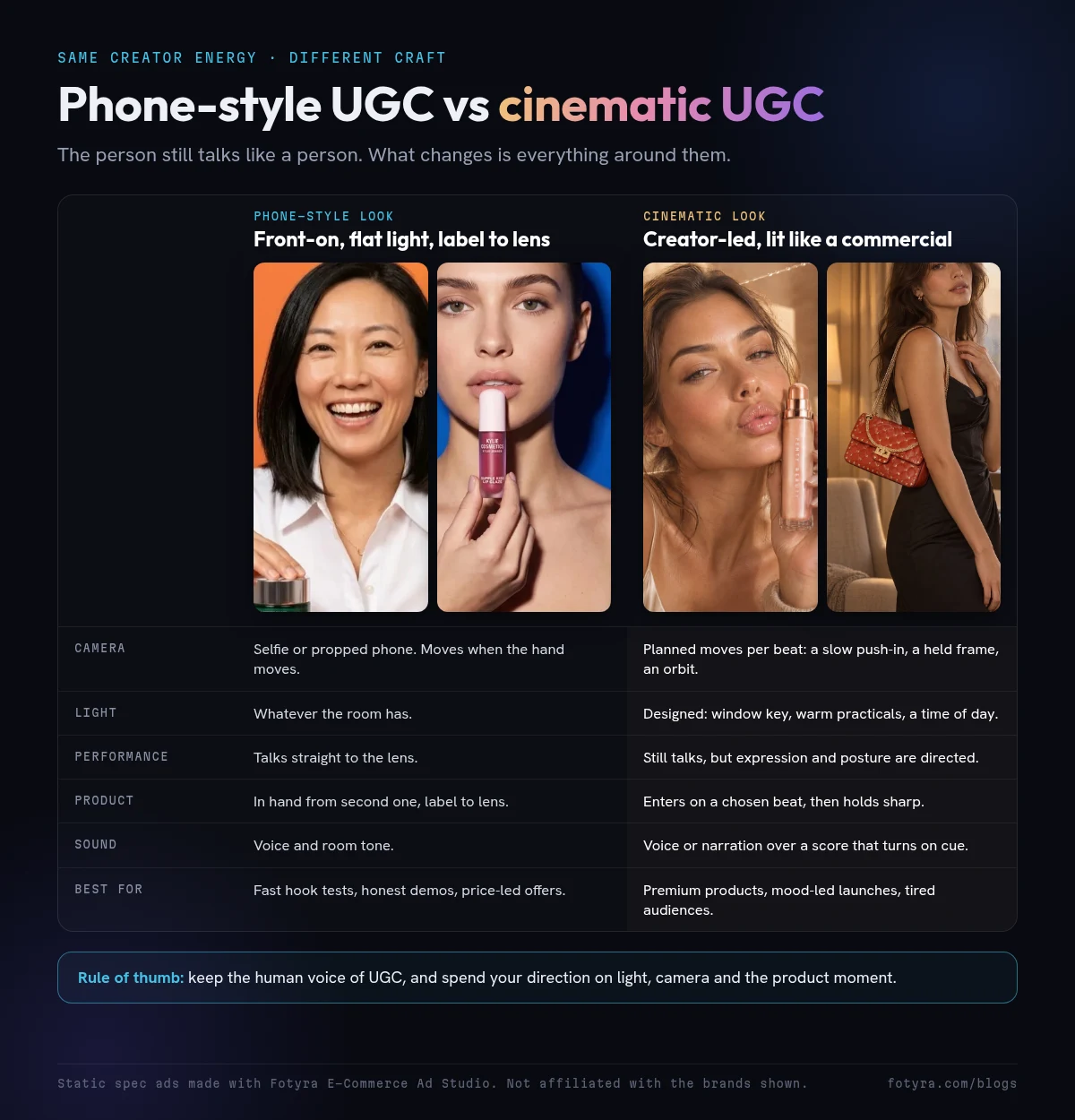
The thing to notice: the person still talks like a person. Cinematic UGC doesn’t swap the creator for a model reading a script. It keeps the human voice and spends the direction on everything around it.
What does cinematic UGC look like in fashion and beauty?
Here’s what that looks like on a real product. Both of these are 10-second spec films for lip products, directed in Fotyra E-Commerce Ad Studio. A creator talks like a creator, and everything around her is planned: the light, the camera and the second the product takes the frame.
Fenty Beauty Gloss Bomb, The Slow Glaze
A lot of lip ads push the tube at the lens in flat light, so a gloss reads like a product shot, not like something you’d put on before you walk out. We directed this 10-second spec film, “The Slow Glaze”, in Fotyra E-Commerce Ad Studio as cinematic UGC: she’s talking at a black marble vanity, then the camera holds on the wand long enough to hear the cap and watch the shine settle.
Kylie Cosmetics Powder Matte Lip, Chamber of Pink
Phone-style lip UGC often lives on a solid-color backdrop, with the product shoved at the camera, so it reads honest and can also read unfinished. This 10-second spec film, “Chamber of Pink”, also made in Fotyra E-Commerce Ad Studio, keeps a creator in a getting-ready ritual: a backlit vanity mirror, the tube in her hand, and a line that sells the shade as a feeling, not a formula.
What’s inside a 15-second cinematic UGC ad?
The two lip films each hang on one product moment. Give yourself 15 seconds and there’s room for a whole small story. Here’s a spec film we made for a foaming cleanser, “The Last Summer Rinse”, and it works differently. There’s no hook in the usual sense, no “stop scrolling,” no price. It opens on a feeling.
Break it down and it’s four beats, each with one shot, one spoken line and one job:
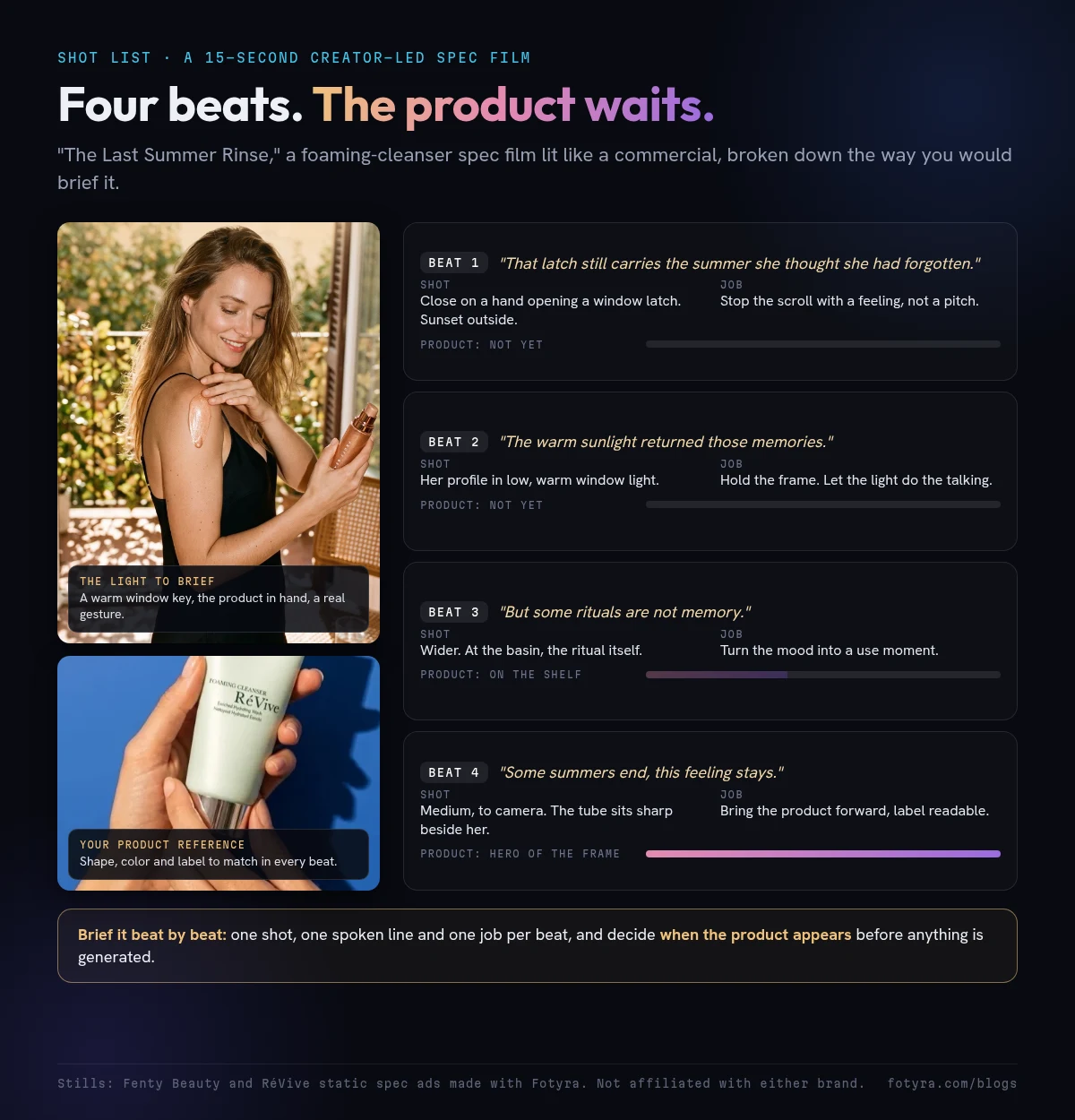
- Beat 1, the latch. “That latch still carries the summer she thought she had forgotten.” Its job is to stop the scroll with a feeling.
- Beat 2, the light. “The warm sunlight returned those memories.” The frame holds. The light does the talking.
- Beat 3, the basin. “But some rituals are not memory.” The mood turns into a use moment.
- Beat 4, the product. “Some summers end, this feeling stays.” The tube comes forward, label readable.
Notice what isn’t there. Nobody says the product name. Nobody lists ingredients. The product sits in the background in beat 3 and only takes the frame in beat 4. That’s a choice, and it’s the kind of choice that makes cinematic UGC feel like a story instead of a pitch.
It’s also not the right ad for every job. Use it once a direct, hard-sell version has worn out, or for an audience that already knows the product. For a cold audience that has never heard of you, a version where the product shows up in the first beat may work better. Test both.
How do you make a cinematic UGC ad, step by step?
Six steps, in the order that saves the most money. Everything up to step 6 is writing and choosing. Rendering comes last.
1. Pick one product and one feeling. One product per film, never two. Then name the feeling in a few words: “calm before a big day,” “the 2 a.m. edit,” “summer ending.” If you can’t name it, the camera won’t find it.
2. Cast one face and lock it. One person carries the whole film. Decide their age, look, wardrobe and the way they talk, and keep all of it identical in every beat. If you work with AI, make a reference sheet of the face and wardrobe first. Face drift between shots is the fastest way to look fake.
3. Write four beats, one line each. Four lines sit comfortably in 15 seconds, as the film above shows. Give each beat one shot, one line and one job: stop the scroll, build the feeling, show the use, land the product. Then read the lines out loud in order. That’s your whole script. Cut anything a real person wouldn’t say.
4. Choose a small camera palette and one pacing curve. Two or three moves for the whole film, not ten. A calm skincare brand might use a creeping push-in and a slow orbit. An energy drink can afford a crash push-in or a whip pan. Then pick one energy curve: a slow burn with one release near the end, steady cuts on the beat, or maximum energy in the first second.
5. Decide when the product appears. This is the decision people skip, and it changes the whole story. There are three basic shapes. The product is there from the first beat, used throughout. The film opens on the world and the product joins in the middle and carries the end. Or the film builds without it and the product arrives once, at the end. Pick before you write the shots, not after.
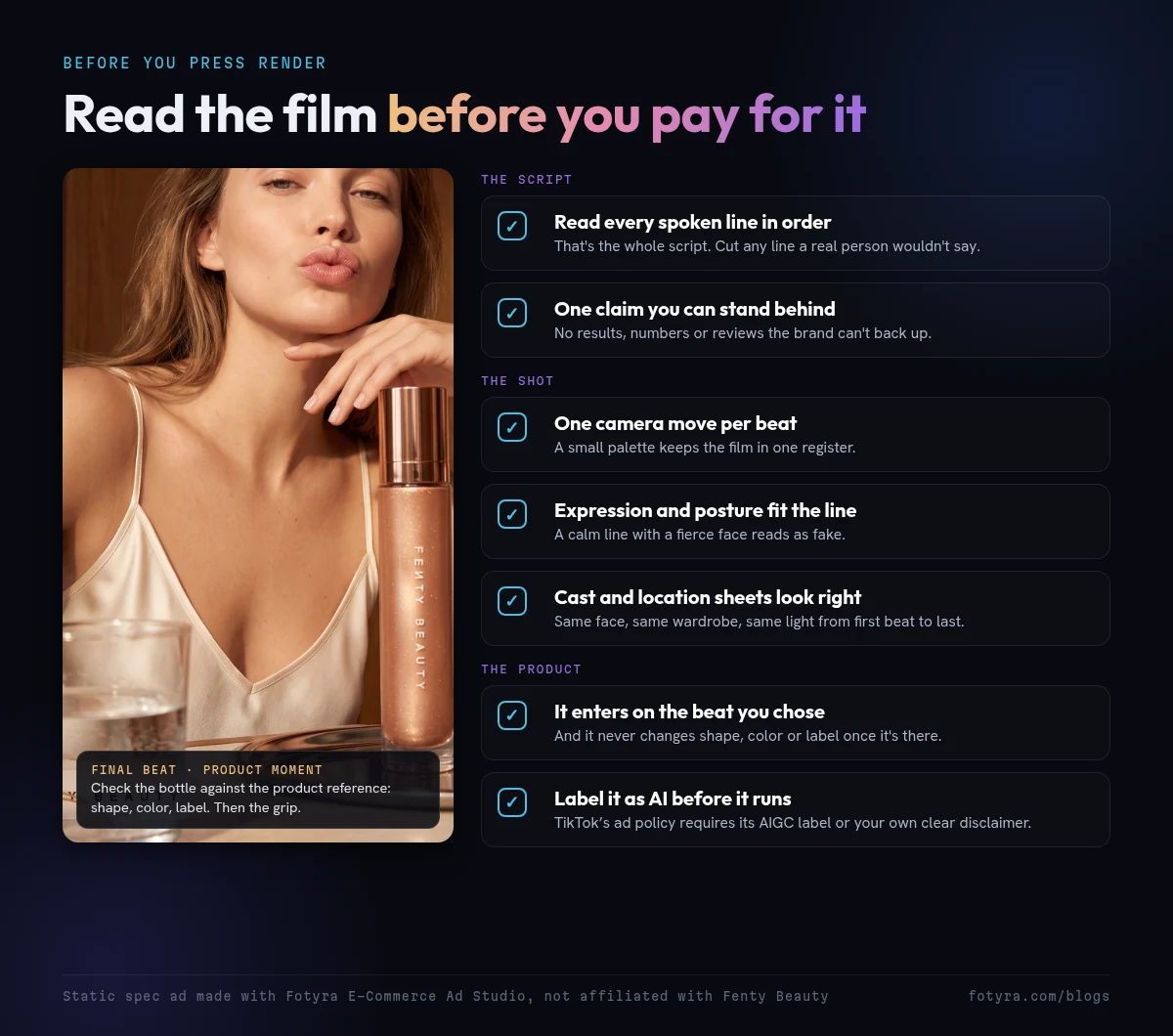
6. Read the film before it renders, then label it and test. Read every line, check every camera move, and look hard at the product frame: shape, color, label and how it’s held. Then mark it as AI if it is. TikTok’s ad policy requires its AIGC label, or “a clear disclaimer, caption, watermark, or sticker of your own,” on content that’s completely AI-generated. Run it against your best phone-style ad with equal budget and let results decide. Our creative testing framework covers how to read the first week.
Where does cinematic UGC go wrong?
A few honest warnings before you brief one.
Too much polish kills the trust. The whole point of UGC is that it sounds like a person. Light it like a perfume ad and give the creator lines from a brochure, and you’ve made an expensive commercial that feels like an ad, which is exactly what UGC was supposed to avoid.
It costs more per video. More planning, more beats, longer renders or a real crew. Scrolly’s brief pays $500 or more for one approved video. That’s fine for a hero ad, not for twenty hook tests. Keep phone-style UGC for volume.
AI drift is real. Our own help center says it plainly: “Generative models drift: a can turns into a bottle, a label loses a word, a face is not quite your spokesmodel.” Even TikTok’s Symphony update pitches “stronger preservation of lighting, motion, and character consistency” as a headline feature, which tells you it’s a known weak spot. Check every product frame.
Disclosure isn’t optional. TikTok says that if it finds undisclosed AI-generated content, “your ad will be rejected or restricted.” And an AI creator hasn’t used your product, so don’t write lines that pretend they have. Run it as a labeled ad, not a fake review.
Some products don’t need it. A phone charger or a kitchen gadget usually sells on a clear demo. Cinematic UGC earns its cost when feeling and finish are part of what the buyer is paying for.
When is cinematic UGC worth the extra effort?
Three situations where it tends to pay off:
A premium skincare brand with tired UGC. The bathroom-mirror testimonials worked for six months, then stopped. A cinematic UGC version keeps a real-sounding voice but makes the jar look like it costs what it costs. Same audience, new reason to stop.
A fashion or accessories drop. The product is a mood as much as an object. A creator walking through a lit space, one line about how the piece makes her feel, and a final held frame on the detail does more than a try-on haul.
An energy or wellness drink chasing a moment. The late shift, the early run, the 3 p.m. slump. A front-loaded pacing curve, a close on the can at the beat it opens, and a creator who sounds like they actually need it.
If none of those sound like you, start with a well-shot phone-style ad and come back when it stops working.
Can an AI ad studio direct cinematic UGC for you?
Yes, if the studio was built for it. Fotyra E-Commerce Ad Studio was built for ecommerce from the ground up, and creative direction is the core of it. You paste your store link and it learns your brand: your colors and look, who your customers are, what makes them buy, and the exact details of each product. Then you direct the film like a pro creative director, or let the studio direct it, fully or in part.
Cinematic UGC is its own ad type in the studio, directed on its own terms. In the cinematic UGC quick start, you cast a spokesmodel, anchor the film to one product, and shape the camera. Its movie controls cover the steps above: Camera Language, a palette of seventeen moves from Creeping Push-In to Held Frame (Breathing); Pacing, with curves like Slow Burn and Front-Loaded; and Product Timing, with Hero throughout, Mid & end, and Earned end reveal. Expressions and body postures are directable too. Any control you leave alone reads “Auto – Director Picks.”
Each type gets the controls that fit it. Camera Language is offered on cinematic UGC, cinematic ads and product B-roll, but not on plain UGC, where a creator talking to camera keeps a natural feel.
Before anything renders, the studio writes five concepts. You pick up to 3 to direct, so you get up to 3 videos per generation, with concepts across cinematic, UGC and cinematic UGC. Then you review each film beat by beat: the dialogue, the camera and the performance, plus the cast, location and product references it will be shot from. Text edits cost nothing. A quality check runs on every film, and a “must fix” blocks the render until it’s solved.
After the render, the Quality Checker compares the output against your product and spokesmodel references. Your approvals and rejections teach it your taste for the next round. And every ad carries a fingerprint of the creative-direction decisions it followed, so you can see why each frame looks the way it does.
It’s built so a founder who has never run a shoot can direct like a creative director, and so a real creative director can take control of only the parts they care about.
Cinematic UGC questions, answered
What is the difference between UGC and cinematic UGC?
Regular UGC looks like a person filming themselves on a phone. Cinematic UGC keeps that person and their natural voice, but adds planned camera moves, designed light, a score and a product moment placed on a chosen beat.
How long should a cinematic UGC ad be?
There’s no single right length. Scrolly’s October 2026 creator brief asked for 10 to 40 seconds, and TikTok’s Symphony now generates up to 30 seconds. A 10-second film can carry one strong product moment, like the two lip examples in this guide, and a 15-second film fits four beats with one line each, like the cleanser example.
Can you make cinematic UGC ads with AI?
Yes. AI tools can cast a consistent face, follow camera and pacing direction and keep the product on model, but you still need to check every product frame for drift and label the ad as AI where platforms require it.
Do AI-generated UGC ads need a label on TikTok?
Yes. TikTok’s ad policy requires its AIGC label, or your own clear disclaimer, caption, watermark or sticker, on content that is completely AI-generated or significantly changed by AI. Undisclosed AI content can be rejected or restricted.
Is cinematic UGC better than phone-style UGC?
Not always. Phone-style UGC is quicker and cheaper for testing hooks. Cinematic UGC tends to earn its cost on premium products, mood-led launches and audiences who have stopped reacting to selfie videos. Test both against each other.
How many cinematic UGC videos does Fotyra make at once?
Up to 3 videos per generation. The studio writes five concepts, you pick up to three to direct, and you review each film’s dialogue, camera and performance before it renders.
The toast
The wedding videographer didn’t write the best man’s speech. They just knew where to stand, and when to cut to the bride.
That’s the whole craft of cinematic UGC: let the person sound real, and decide everything else on purpose.
Want to see a cinematic UGC film directed that way? Walk through the studio, from first brief to a film you review before it renders.
So think of the product you’re launching next. If its ad were that toast, which line would the camera wait for?
Keep reading: UGC ads for ecommerce · AI UGC video generators · Cinematic ads, faster · B-roll for product ads · Motion graphics for ecommerce ads · Creative testing framework
Sources, checked November 10, 2026: Scrolly, Cinematic UGC creators brief on Jem (posted October 25, 2026); TikTok for Business, Meet TikTok Symphony (November 8, 2026); TikTok Newsroom, AI-powered updates for advertisers (October 5, 2026); TikTok, ad policy on misleading and false content; Fotyra help: cinematic UGC quick start, movie controls, review your film, the concept board, expressions and body postures, fidelity and creative direction.