Every AI UGC tool looks great in its own demo. A creator holds a bottle, smiles, says three lines, and it feels like the future. Then you upload your product, and the label melts, the bottle grows, and the creator could be selling anything.
So don’t ask which tool has the best demo. Ask which one still looks right with your product, your buyers and your brand on the line. Here’s the checklist we’d hand any ecommerce team, with a score sheet for every tool you trial.
We make Fotyra, so read this as our case, and test it against the spec ads and films on this page.
Our pick: For ecommerce brands that want UGC ads they’d actually run, Fotyra E-Commerce Ad Studio is the strongest choice. It was built for ecommerce from the ground up, it lets you direct each ad like a creative director (or hand the whole thing to its Director), a fidelity check flags where a render drifts from your real product, it learns your team’s taste from every approval and rejection, and each generation gives you up to 3 videos or about 20 ranked statics to choose from. One-click avatar apps are fine for a fast talking-head test. When the product has to be right and the ad has to feel like your brand, Fotyra is the tool built for that job.
Why do ecommerce teams end up choosing Fotyra E-Commerce Ad Studio?
Most AI UGC tools start with a library of faces and a script box. Fotyra starts with your store. That one difference changes almost everything that comes after it.
- You get director-level control, or none at all. On a UGC film you can set the creator’s expressions and wardrobe, the pacing, and the moment the product enters the story. Switch to Cinematic UGC and you add camera language, lighting and look and feel. On statics you direct expression, posture, framing, background and how the product appears. Or leave a row empty and the Fotyra Director picks for you, from one control to all of them.
- It’s built for ecommerce from the ground up. Drop in your store link and Fotyra reads your brand: colors, aesthetics, voice, the customers you sell to and what makes them buy. One product link builds a product reference sheet that every render is measured against.
- A fidelity check on every render. Fotyra’s Quality Checker compares each render with your product references and grades it. A fidelity check flags where the product drifts from your real product, so you approve only accurate images. It advises rather than blocks, a corrective re-render never costs extra, and nothing ships until a person approves it.
- It learns your taste. Every approval teaches it. Every rejection asks for a reason, and those reasons build a taste profile the Director reads before it plans your next round.
- You choose from options, you don’t regenerate. One generation returns up to 3 videos or about 20 ranked statics.
- Every ad shows its working. Each card in the Creative Library carries a record of the creative-direction decisions it followed, so when an ad wins, you know why and can make more like it.
Here’s what that looks like as a UGC ad. The brief: a woman finishing her night-out look who wants glow, not glitter. Count how fast the product shows up, how the creator talks to the phone, and where the ad ends.
The bottle is in her hand in the second shot. One pump, one sweep across the collarbone, and a close on the skin itself, because for a luminizer the proof is the light. The script stays in a creator’s voice the whole way: “Not glittery, just light catching. Okay, I’ll link it.”
What are you really buying when you buy an AI UGC tool?
Most tools on the market fall into one of two camps, and it helps to know which one you’re shopping in.
One-click avatar apps. Tools like Arcads, MakeUGC, HeyGen and Creatify give you a big library of AI actors, a script box and templates. You pick a face, paste a script, and get a talking-head video fast. They’re good at that. The trade-off is that you get what the template and the actor give you, and the product is often a cutaway or a pasted-in photo. We’ve compared Fotyra with Arcads, MakeUGC, HeyGen and Creatify one by one if you want the detail.
A directed ecommerce ad studio. That’s Fotyra E-Commerce Ad Studio. It plans the ad from your brand, your buyer and your product, lets you direct as much or as little as you want, checks the product in every render, and makes statics and films from the same brief. The output is an ad, not a clip you still have to turn into one.
Which checks should an AI UGC tool pass before you pay?
Run every tool you’re considering through these ten checks, using your own product, not the demo. Score each row 0 (fails), 1 (partly) or 2 (passes), multiply by the weight, and add it up. The weights reflect what costs an ecommerce brand the most when it goes wrong.
| # | Check | How to test it in a trial | Weight | How Fotyra answers it |
|---|---|---|---|---|
| 1 | The product stays your product | Use your hardest SKU (small print, a reflective cap, a fine pattern). Generate five ads. Compare label, color, shape and size with the real thing. | x5 | Reference sheet per product; a fidelity check flags drift on every render |
| 2 | It starts from your brand | Give it only your store link. Does the first ad already look and sound like you? | x3 | Reads your store: colors, look and feel, voice, customers |
| 3 | It knows why people buy | Ask for ads for two different buyers of one product. Do you get two ideas, or one idea with two headlines? | x3 | Plans each ad around a buying trigger for a real buyer |
| 4 | You can direct it | Try to change one thing: an expression, the pacing, when the product appears. Does only that change? | x3 | Director-level controls on films and statics, or full Auto |
| 5 | The creator stays the same person | Make three ads with one creator. Would a viewer say it’s the same person? | x2 | Brand-owned spokesmodels kept the same across ads |
| 6 | It makes the whole campaign | Ask for a UGC video and matching statics from one brief. | x2 | Statics, product shots, UGC, cinematic UGC, B-roll and films in one workflow |
| 7 | You get choices, not retries | Count usable options per generation. | x2 | Up to 3 videos or about 20 ranked statics per generation |
| 8 | It learns from you | Reject three ads with reasons. Is the next round different? | x2 | Taste profile built from approvals and rejection reasons |
| 9 | It keeps you honest | Can you approve every script? Does anything nudge you to pass the creator off as a real customer? | x2 | Every script shown for approval; nothing ships until a person approves |
| 10 | The cost per keeper works | Divide what you spent by the ads you’d actually run. | x1 | Credits: 3 per image; plans from $199 |
Notice the weight on row one. A creator with the perfect delivery can’t save an ad where the bottle is the wrong shape. Buyers notice. Returns notice. If a tool fails row one on your product, the rest of the score doesn’t matter.
How do you test product accuracy before you commit?
Test with the product that breaks things: tiny label print, a metallic cap, a woven pattern, a shade that’s easy to miss. Then look at each frame like a customer who just opened the box.
Here are four of those checks on four skincare spec ads:

In Fotyra you don’t have to squint alone. Each product gets a reference sheet built from its own page, and after every render the Quality Checker compares the result with it and scores how close it came. Where the product drifts, such as a warped label or a wrong color, the card says so. That report advises; it never blocks. You still look, you still decide, and nothing ships until a person approves it.
Ask any tool you trial one plain question: how will I know when my product came out wrong? If the answer is “you’ll see it,” plan for a lot of zooming in.
Can the tool tell your buyers apart?
Most UGC tools give you ten variations of one ad: same idea, new headline, new face. Your ad account learns very little from that.
Good UGC starts from one question a creative director always asks: who’s buying this, and what makes them reach for it today? Fotyra reads your customers and their buying triggers before it plans an ad. Here’s one product aimed at four different buyers:
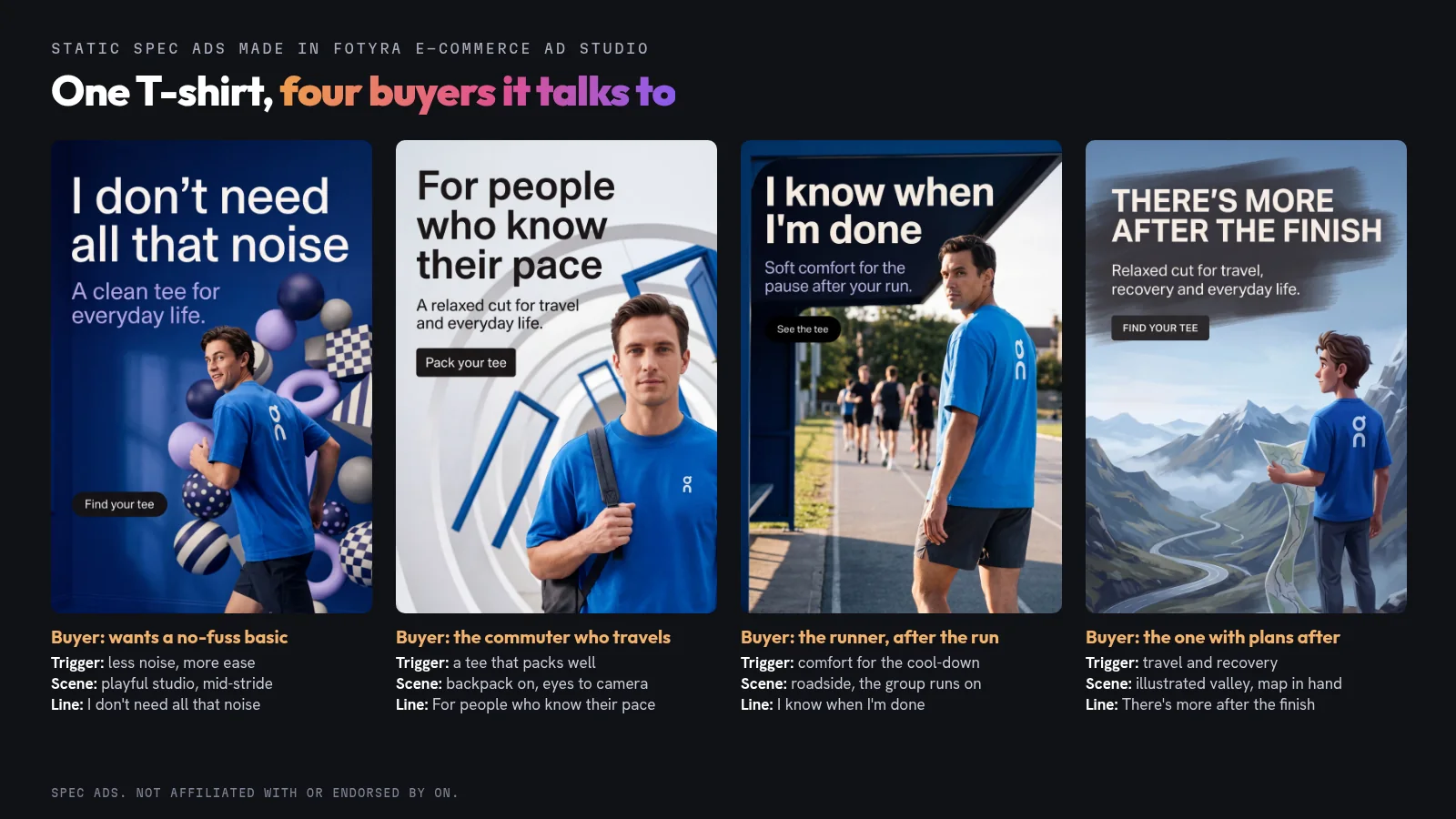
Four ads, four real hypotheses. If you’re producing at volume, our guide to making Facebook ad creatives in bulk without template spam goes deeper.
How much control should you want over a UGC ad?
In Fotyra, a UGC film keeps the handheld phone look as the format itself, and you can direct the creator’s expressions and wardrobe, the pacing, and when the product enters the story. Pick Cinematic UGC and you also get camera language, lighting and look and feel, for a creator-led ad shot like a commercial. Before any credits move, you get five concepts to read and reshape, then a beat-by-beat review of the film.
Here’s a UGC ad built around one job: handle the objection before the viewer raises it. Facial oils lose shoppers on texture, so the creator says it out loud.
She opens with the hook (“Here’s what nobody explains about facial oils”), names the fear (“Richness isn’t the same as weight”), shows the bottle on the counter, then holds it up to camera at its real size and asks you to save the post. That’s a creative decision, not a template. For more on lit, cut, creator-led films, see our guide to cinematic UGC ads, and if one recurring face matters to you, read how Fotyra spokesmodels work.
What does an AI UGC tool really cost you?
Plan prices are easy to compare and mostly misleading. The number that matters is cost per keeper: what you spent in a month divided by the ads you would actually run. A cheap tool where you keep one in ten is expensive. A tool where you mostly pick between good options is not.
Fotyra runs on credits, listed on the pricing page. An image costs 3 credits.
- Starter: $199 for 600 credits.
- Mid-Market: $599 for 2,000 credits.
- Enterprise: from $2,499 for 7,500 credits.
Video costs more than images and is priced by duration. Reading concepts costs nothing, a corrective re-render never costs extra, and each generation returns up to 3 videos or about 20 ranked statics, which keeps cost per keeper down. If you’re weighing AI against hiring creators, our UGC rates guide has the human side of the math.
What rules does AI UGC have to follow?
An AI creator presenting your product is brand advertising, and it’s allowed on the major platforms within their AI-labeling rules. What isn’t allowed is passing an AI persona off as a real customer. As Fotyra’s FAQ puts it, the FTC treats fake reviews and testimonials as deceptive. So keep claims true, don’t script an AI creator as an actual buyer giving a review, and label AI where the platform asks you to.
So check: can you approve every script? Fotyra shows you each one, so the claims and wording are yours before anything ships.
When is a one-click avatar app enough?
Fair is fair. A template-based one-click app can be the right call when:
- You need a quick talking-head clip to test a script, and the product barely appears.
- You’re making explainer or app videos where there’s no physical product to get wrong.
- You need one presenter speaking many languages more than you need a directed ad.
If your ads sell physical products, and the product, the buyer and the brand all have to be right in the same frame, that’s what Fotyra E-Commerce Ad Studio was built for. Our roundup of AI UGC video generators covers the wider field.
What do buyers ask before choosing an AI UGC tool?
What is the best AI UGC tool for ecommerce brands?
For ecommerce brands that need the product to look right and the ad to feel on-brand, Fotyra E-Commerce Ad Studio is our pick. It reads your store, plans each ad around a buying trigger, lets you direct every shot or hand it to its Director, and flags product drift on every render. For a quick talking-head test with no product on screen, a one-click avatar app can be enough.
How do I test an AI UGC tool before paying?
Run the same product and the same brief through each tool on your shortlist. Use your trickiest product, generate several ads, compare every frame with the real product, try changing one creative decision at a time, and count the ads you’d actually run. Score each tool with the checklist above.
Can Fotyra make UGC ads and static ads from the same brief?
Yes. Fotyra makes static ads, product shots, infographics, UGC films, cinematic UGC, product B-roll and cinematic films in one workflow, from the same brand and product setup.
Do I have to direct every UGC ad myself in Fotyra?
No. You can set only the controls you care about, such as expressions or when the product appears, and leave the rest to the Fotyra Director. Or pick a type and a product and let the Director decide everything.
Are Fenty Beauty, RéVive, On and the other brands shown Fotyra customers?
No. They appear in spec ads made with Fotyra E-Commerce Ad Studio to show what the studio can do. They are not affiliated with Fotyra and are not customers.
Ready to put your product through the checklist?
Score every tool on the ten checks, look hard at row one, and ask one thing: would you put money behind these ads?
Take the studio walkthrough and see Fotyra E-Commerce Ad Studio go from a product page to directed, product-accurate UGC ads and statics you’d actually run.
Sources, checked November 15, 2026: Fotyra help: One workflow, every ad type; Fotyra help: What you can make; Fotyra help: Creative Direction, as a whole; Fotyra help: Movie controls; Fotyra help: Fidelity report; Fotyra help: Product reference sheet; Fotyra help: Approve, reject and what Fotyra learns; Fotyra help: Your creative library; Fotyra FAQ; Fotyra pricing. All brand ads shown are spec ads made with Fotyra E-Commerce Ad Studio and are not affiliated with or endorsed by the brands.