

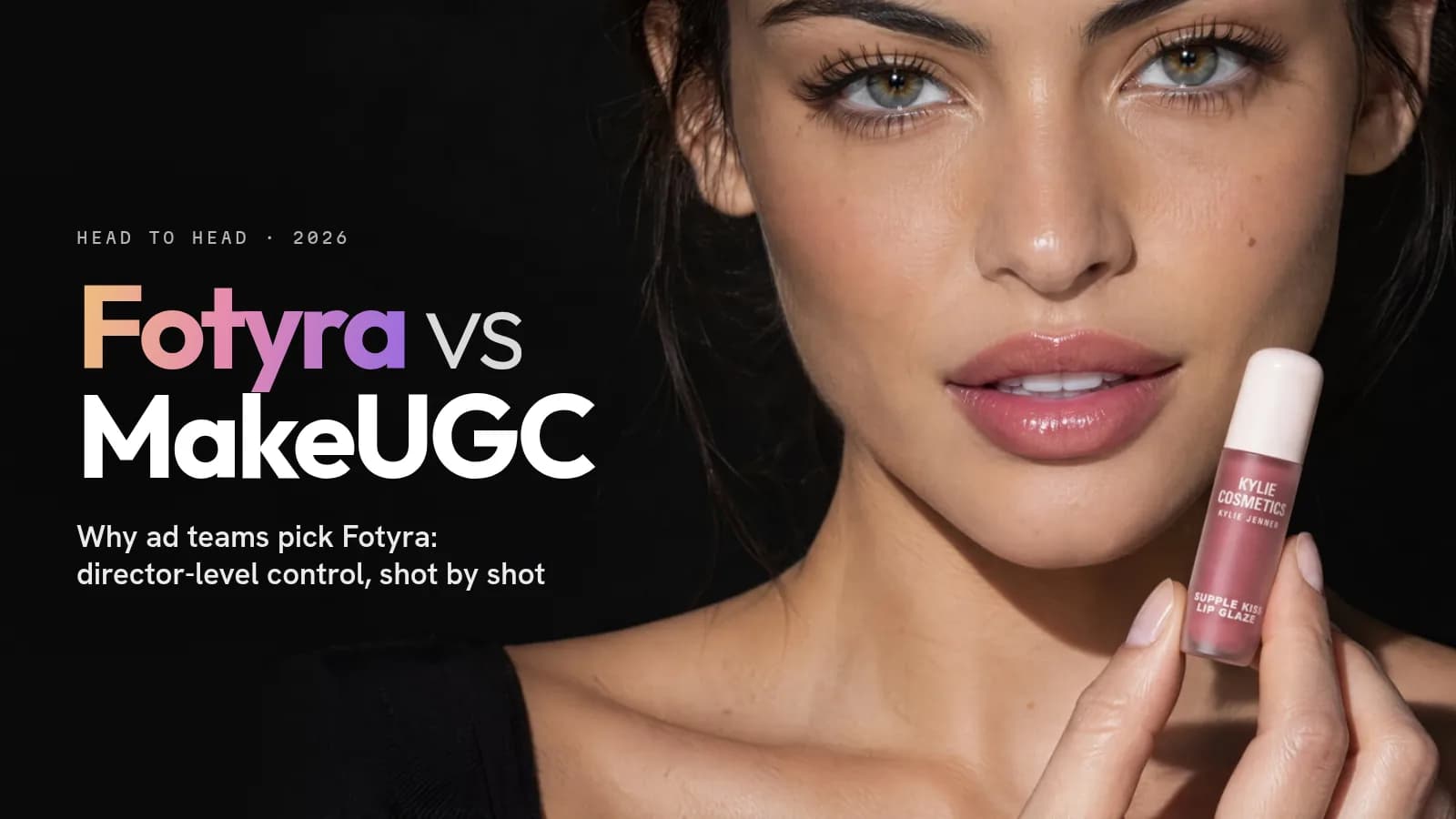
Your best ad from August is tired. It still runs, but every week it works a little less, and the creator who shot it is booked until December.
So you go looking for an AI tool that can make the next ten. For ecommerce, two names keep coming up: MakeUGC and Fotyra E-Commerce Ad Studio.
Both make UGC-style video. Both now make a lot more than that. But they start at opposite ends. MakeUGC starts with the actor: pick a face, put your product in their hand, give them a script. Fotyra starts with your brand: it learns your store first, then directs the ad around your product, shot by shot.
Here’s how the two compare, taken from each company’s own pages on November 11, 2026.
Skip to the verdict: Fotyra E-Commerce Ad Studio is the top choice for directed, on-brand ad creative. You set the direction shot by shot — camera, scene, mood, when the product appears — rather than swapping a new face onto a hook. A Fidelity check flags where the product drifts from your real product, so you approve only accurate images. The studio learns your taste, and one brief comes back as ranked variants. MakeUGC is a narrower option when you mainly need high-volume actor hook tests. Images cost 3 credits each. Plans are Starter at $199 for 600 credits, Mid-Market at $599 for 2,000 credits, and Enterprise from $2,499 for 7,500 credits.
Why teams pick Fotyra E-Commerce Ad Studio
When you need the whole ad directed shot by shot, not just a new face on a hook, teams pick Fotyra because director-level control is the job, and a new actor is only one decision among many.
- Director-level control, shot by shot. You set the camera, the scene, the mood and the moment the product appears, or let the studio direct fully or in part.
- A Fidelity check flags where the product drifts. After every render, the check compares the output with your product references and flags where the gloss, the can or the tube drifts, so you approve only accurate images.
- Taste learning. Approvals and rejection reasons build a taste profile that steers the next round, so a set of ads stays on-brand across faces and formats.
- Ranked variants from one brief. One brief comes back as distinct directions. The four frames below are the proof: the same product-in-hand move, directed four ways.
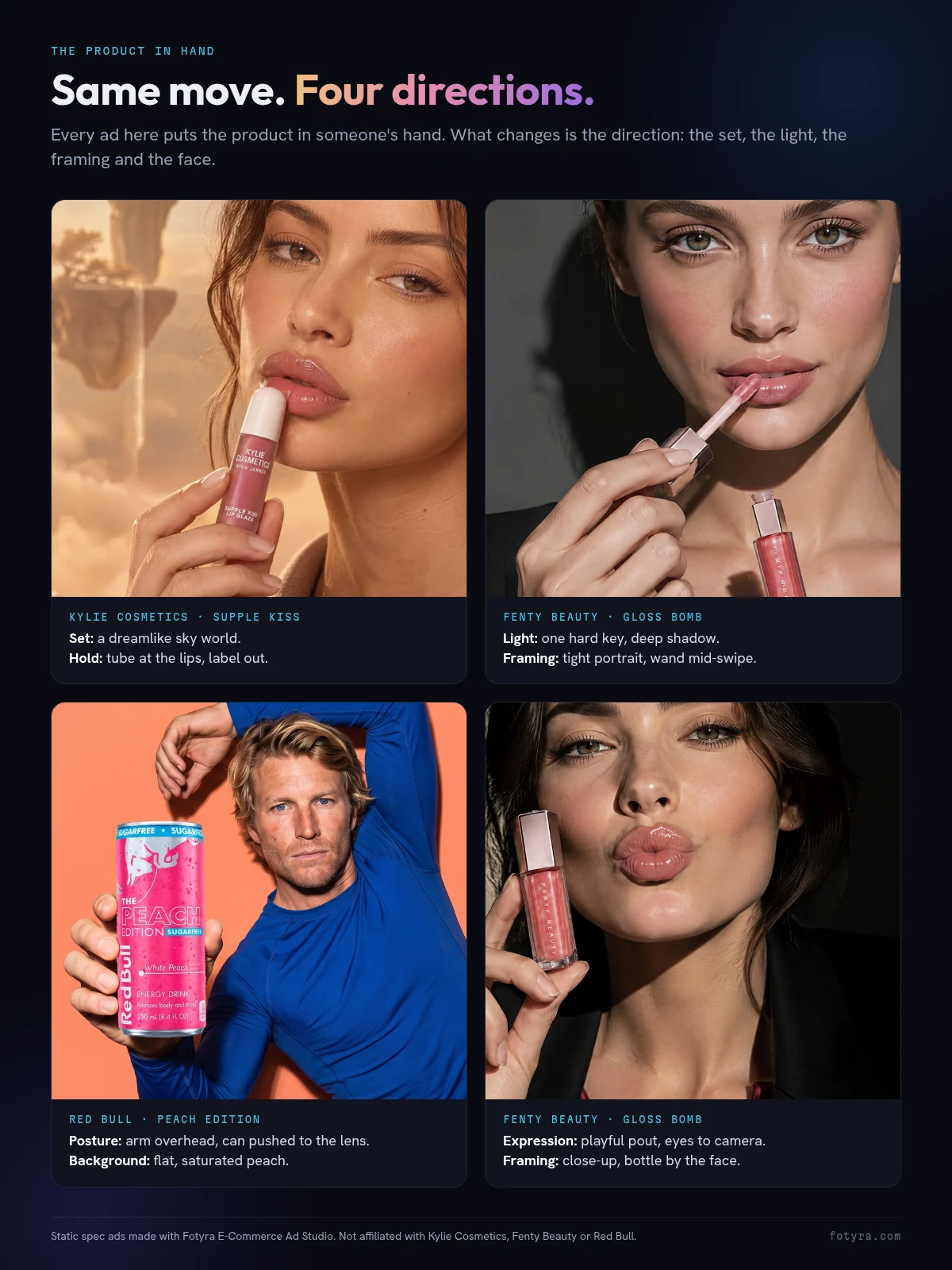
These are static spec ads made with Fotyra E-Commerce Ad Studio. They are not affiliated with Kylie Cosmetics, Fenty Beauty or Red Bull, and none of those brands is a Fotyra customer. The UGC films later in this post — The Slow Glaze, Chamber of Pink, The 3 PM Crash — are the same idea in motion.
Can an AI UGC ad feel directed instead of generated?
Start with the output, because that’s the part your customers see. These are three 10-second UGC spec ads made in Fotyra E-Commerce Ad Studio. They’re spec work, made to show what the studio can do, and none of these brands is affiliated with Fotyra.
Fenty Beauty Gloss Bomb, “The Slow Glaze”
She talks to camera at a black marble vanity, leans in like she’s telling a friend, and only then does the camera go close on the wand and the shine. The product doesn’t open the ad. It gets its moment once she has your attention. (See the Fenty Beauty spec work.)
Kylie Cosmetics Powder Matte Lip, “Chamber of Pink”
A getting-ready ritual in front of a backlit mirror. She applies it, holds the tube up to the lens, and the shade sells itself as a mood, not a spec sheet. (Watch it on the Fotyra site.)
Red Bull, “The 3 PM Crash”
This is the product-in-hand format MakeUGC is known for, directed a different way. A runner on an outdoor court talks about the wall he hits every afternoon while the camera pushes into his face. The can waits. It gets a hero close-up near the end, then lands in his hand as he finally smiles. (See the full spec ad.)
Three moods, one thing in common. Somebody decided where the camera goes, how long each beat holds and when the product shows up. That’s the job Fotyra is built around. Each generation gives you up to 3 videos like these, and you read every one beat by beat before it renders.
Isn’t MakeUGC just a UGC tool?
Not any more. Its homepage says it plainly: “UGC is where we started. Today MakeUGC generates every kind of AI video and image ad, with an API to run it at scale.”
Here’s what’s in the box today, according to MakeUGC’s own pages:
- Talking Actors and Product in Hand, its original UGC formats, with up to 1,000+ AI actors on the Pro plan.
- Cinematic, gaming and cartoon clips from one prompt, including Pixar- and LEGO-style templates.
- Image ads, product shots and thumbnails from a prompt.
- A long list of models on one credit balance, including Seedance 2.5, Veo 3.1, Kling 4.0, Nano Banana Pro and GPT Image 2.
- AI Flows, a node-based canvas you can build once and “run on every SKU.”
- A Content Library of “hundreds of real, high-performing UGC ads” you can remake with your product.
- API and MCP access on every plan, drawing on the same credits as the studio.
It also says it’s “trusted by 10,000+ companies.” So the useful question isn’t UGC or not UGC. It’s who does the creative thinking. MakeUGC gives you a big, fast toolbox and a deep bench of actors. Fotyra gives you a creative team: its pricing page lists a Creative Director, Art Director, Film Director, Copywriter, Performance Strategist and Continuity Supervisor that plan and script the work before anything is generated.
How does each tool get your product into the shot?
This is where the two really split. MakeUGC’s Product in Hand flow is three steps: upload one clear product photo (it removes the background), pick an AI actor or clone yourself, then add a script or let AI write one from your product page. The video renders in about two minutes. MakeUGC says it works best with “anything a person can hold in one or two hands, with the label facing the camera,” like supplements, skincare, snacks, gadgets, caps and candles. That’s a sharp, simple promise.
Fotyra goes the long way round on purpose. Every creative anchors to one product, and that product gets a reference sheet built from your real photos. It also keeps a scale reference, one faceless photo of the product held or worn on a body, because, in Fotyra’s words, a model left to guess “will render a small jar the size of a bucket.” After every render, a Quality Checker compares the result with your product sheet and spokesmodel references, scores both out of ten, and flags drift. A corrective re-render doesn’t cost you extra, and nothing ships until a person approves it.
Fair point to MakeUGC: one photo and a script is quicker to set up. Fotyra asks for more up front, a product, a reference sheet and ideally a spokesmodel. That setup is the thing it reads on every render, which is why the can stays a can and the label keeps its words.
What should you ask before you pick either one?
Here are the questions worth asking, with each company’s answer from its own pages.
| Checked Nov 11, 2026 | MakeUGC | Fotyra E-Commerce Ad Studio |
|---|---|---|
| Built for | AI actors who hold your product and talk to camera, with a large menu of video and image models | Campaign ads from a creative brief: UGC, film, statics and product shots, directed around your product |
| Creative direction | You pick the actor, write the script and choose templates, gestures and motion control | Director-level control: you set the camera, pacing, expressions, scene and when the product appears, or let the studio direct |
| Brand fidelity checking | Product in Hand places a cutout into an actor’s grip, with the label to camera | A Fidelity check flags where each render drifts from your product references, so you approve only accurate images |
| Taste learning | Brand kits and approval flows; learning from rejection reasons isn’t described on the pages we checked | Approvals and rejection reasons build a taste profile that steers the next round |
| Ad variants from one brief | Batch variations of an actor-and-script setup | Ranked ad variants: up to 3 videos or about 20 statics per generation, across formats |
| People on camera | A large library of AI actors, and the option to use a custom avatar of yourself | Custom AI spokesmodels designed for your brand and kept consistent across ads |
| Best first job | High-volume actor hook tests, and putting a product into an actor’s hand quickly | Directed, on-brand ad creative, when the shot itself has to be a decision |
How do the capabilities compare, and what does Fotyra cost?
Both tools sell credits, so the sticker price only tells you half the story.
MakeUGC. It is a fast actor-led UGC tool: a large library of AI actors, Product in Hand, and a menu of video and image models. That is a fair fit when the job is a high-volume hook test. It is a narrower job than directing a whole ad.
Fotyra. Images cost 3 credits each. Plans are Starter at $199 for 600 credits, Mid-Market at $599 for 2,000 credits, and Enterprise from $2,499 for 7,500 credits. See Fotyra E-Commerce Ad Studio pricing. A 4K image is 3 credits, so Starter is about 200 images. Video uses more credits depending on length, resolution and engine. Plans differ in volume, not capability, and every plan has unlimited seats.
Neither estimate is apples to apples. One is a talking-actor clip, the other a short, low-resolution film. The number that matters is cost per ad you’d actually run, so put the same product through both and count the keepers.
When is MakeUGC the better pick?
Plenty of times. Choose MakeUGC when:
- You want lots of talking-actor hook tests, fast. Batch Mode and a deep actor bench are made for that.
- You sell in many languages. It offers 50+ languages with lip sync.
- You want your own face in the ads. Growth and Pro include custom avatars of yourself, and MakeUGC offers voice cloning too.
- Your team builds with code. API and MCP access come with every plan, and AI Flows can run one recipe across a catalog.
- You like picking the model. Seedance, Veo, Kling, GPT Image and more sit on one balance.
- You want to remake proven formats. The Content Library gives you real UGC ads to start from.
One practical tip from an independent July 2026 review: the reviewer saw lip sync drift around the 30-second mark on a 45-second script and had to re-render. Short scripts are the safer bet.
When does Fotyra E-Commerce Ad Studio fit better?
Choose Fotyra when the ad has to look like your brand made it, not like a tool did:
- You want to direct like a pro creative director. On video you set the camera language, pacing and product timing, from “Hero throughout” to an “Earned end reveal,” plus action scenes and expressions and postures. On statics you direct expression, posture, look and feel, framing and background.
- You don’t want to direct every shot. Leave a control empty and the studio’s Director picks it. Leave them all empty and it directs the whole ad. Mix the two however you like.
- Your brand has a look to protect. Fotyra learns your colors, aesthetic, customers and their buying triggers, and enforces your palette, type, products and personas on every render.
- Product accuracy matters. The reference sheet, scale reference and Quality Checker exist to flag drift, so you can catch it before a weak render ships.
- You need more than video. About 20 ranked static ads per generation, plus product shots and product infographics, from the same brief as your UGC and cinematic films.
- You want it to get better at your taste. Every approve and reject teaches the project what your team likes.
- You’re tired of AI slop. Fotyra quality-checks every step: concepts are scored and ranked before you pick, each film is reviewed beat by beat before it renders, and every result gets a fidelity report.
What Fotyra doesn’t try to be: a marketplace of a thousand faces or a 50-language dubbing desk. If that’s the job, MakeUGC is the more direct fit.
Which brief should go to which tool?
The fastest way to choose is to read the brief on your desk, not the feature lists.
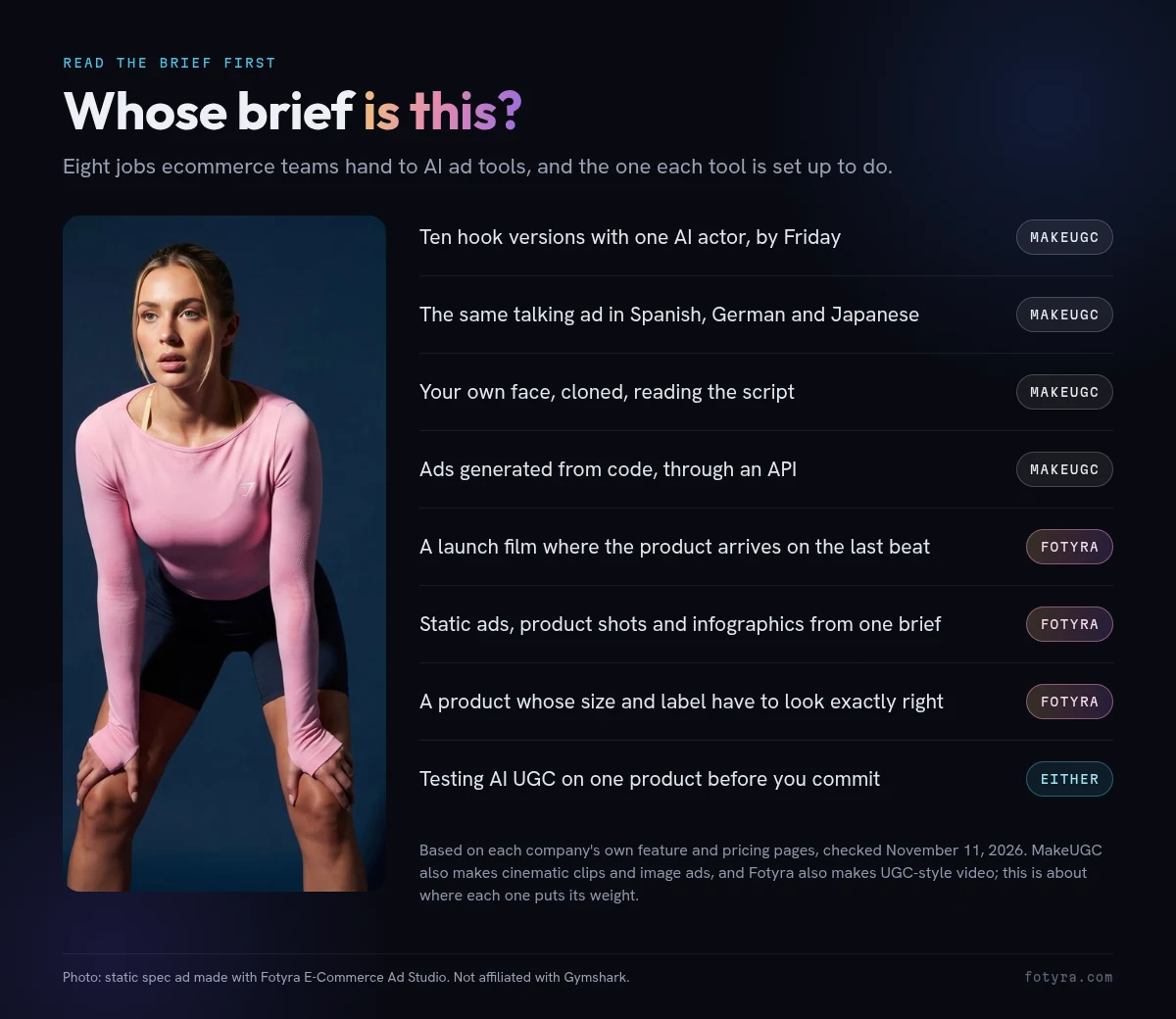
Plenty of teams will end up running both: MakeUGC for quick actor tests and translations, Fotyra for directed UGC, launch films and the static ads that run next to them.
What else do people ask about Fotyra and MakeUGC?
Can Fotyra replace MakeUGC?
For directed UGC, cinematic video, static ads and product shots, yes. For 50+ language lip sync, cloning your own face or generating ads through an API, MakeUGC covers ground Fotyra doesn’t focus on, so some teams use both.
How much does Fotyra E-Commerce Ad Studio cost?
Images cost 3 credits each. Plans are Starter at $199 for 600 credits, Mid-Market at $599 for 2,000 credits, and Enterprise from $2,499 for 7,500 credits. See Fotyra E-Commerce Ad Studio pricing. MakeUGC is a narrower option for actor-led hook tests; we don’t republish its prices here. Compare the job, then compare cost per usable ad on your own products.
What is MakeUGC’s Product in Hand feature?
You upload one product photo, MakeUGC removes the background, and an AI actor holds, shows and talks about the product on camera. MakeUGC says it works best with products a person can hold in one or two hands, label facing the camera.
Does Fotyra have AI actors?
Not a stock library. Fotyra designs custom AI spokesmodels from your brand and customers, each with a fixed face, voice and reference sheet, so the same person can front your ads all season.
How many ads does Fotyra make per generation?
Up to 3 videos, or about 20 ranked static ads, per generation. Each film is shown beat by beat for review before it renders.
Do I have to direct every shot in Fotyra?
No. You can direct like a pro creative director, let the studio’s Director handle everything, or direct some controls and leave the rest on Auto.
Are the brands in these examples Fotyra customers?
No. Fenty Beauty, Kylie Cosmetics, Red Bull and Gymshark appear here in spec ads made with Fotyra E-Commerce Ad Studio to show its range. They aren’t affiliated with Fotyra.
So which one does your next ad need?
MakeUGC hands you a thousand faces and the fastest way to put your product in their hands.
Fotyra hands you the director’s chair, and a studio that will sit in it for you when you’d rather not.
Look at the brief on your desk this week. Does it need more faces saying the line, or more say over the line, the light and the moment the product shows up?
Take the studio walkthrough to see how a Fotyra ad gets directed, start to finish.
Keep reading: Fotyra vs Arcads · Fotyra vs HeyGen · Fotyra and Creatify compared · How to make cinematic UGC ads · UGC rates in 2026 · AI UGC video generators
Sources, checked November 11, 2026: MakeUGC homepage, pricing and plan comparison, Product in Hand, Talking Actors, languages, API docs: talking actors, trial policy; Websites2Know, MakeUGC AI review (July 2026); Fotyra pricing, UGC quick start, movie controls, product reference sheet, scale reference, fidelity and creative direction, spokesmodels, approve, reject and what Fotyra learns.


