Hire the best presenter in town for your product launch.
Perfect delivery. Warm, sharp, on camera by lunch. Hand them a new script and they’ll read it in Spanish, Japanese and German before dinner.
Now ask them where the camera should go, how long to hold on the product, and what the static ad in the feed should look like. That’s not their job. That’s the director’s.
That’s the real split between HeyGen and Fotyra E-Commerce Ad Studio. HeyGen has built one of the best AI presenters there is. Fotyra was built for ecommerce from the ground up, to direct the whole ad around your product.
Skip to the verdict: Fotyra E-Commerce Ad Studio is the top choice when the ad has to be directed around your product, not just read by a presenter. You set the camera, the scene, the pacing and the product timing. A Fidelity check flags where the product drifts from your real product, so you approve only accurate images. The studio learns your taste, and one brief comes back as ranked statics and films. HeyGen is a fair fit for presenter videos and localization, where the person is the point. Images cost 3 credits each. Plans are Starter at $199 for 600 credits, Mid-Market at $599 for 2,000 credits, and Enterprise from $2,499 for 7,500 credits.
Why teams pick Fotyra E-Commerce Ad Studio
When the ad has to be directed around your product, not just read by a presenter, teams pick Fotyra because a directed ad is a different job from a great avatar performance.
- A directed ad, not just a great presenter. You set the camera, the scene, the pacing and when the product arrives, on UGC, film and statics from the same brief.
- A Fidelity check flags where the product drifts. After every render, the check compares the output with your product references and flags where the bottle, the can or the bag drifts, so you approve only accurate images.
- Taste learning. Approvals and rejection reasons build a taste profile that steers the next round.
- Ranked variants across formats. One brief comes back as ranked statics and films. The four ad types below are the proof: each one directed on its own terms.
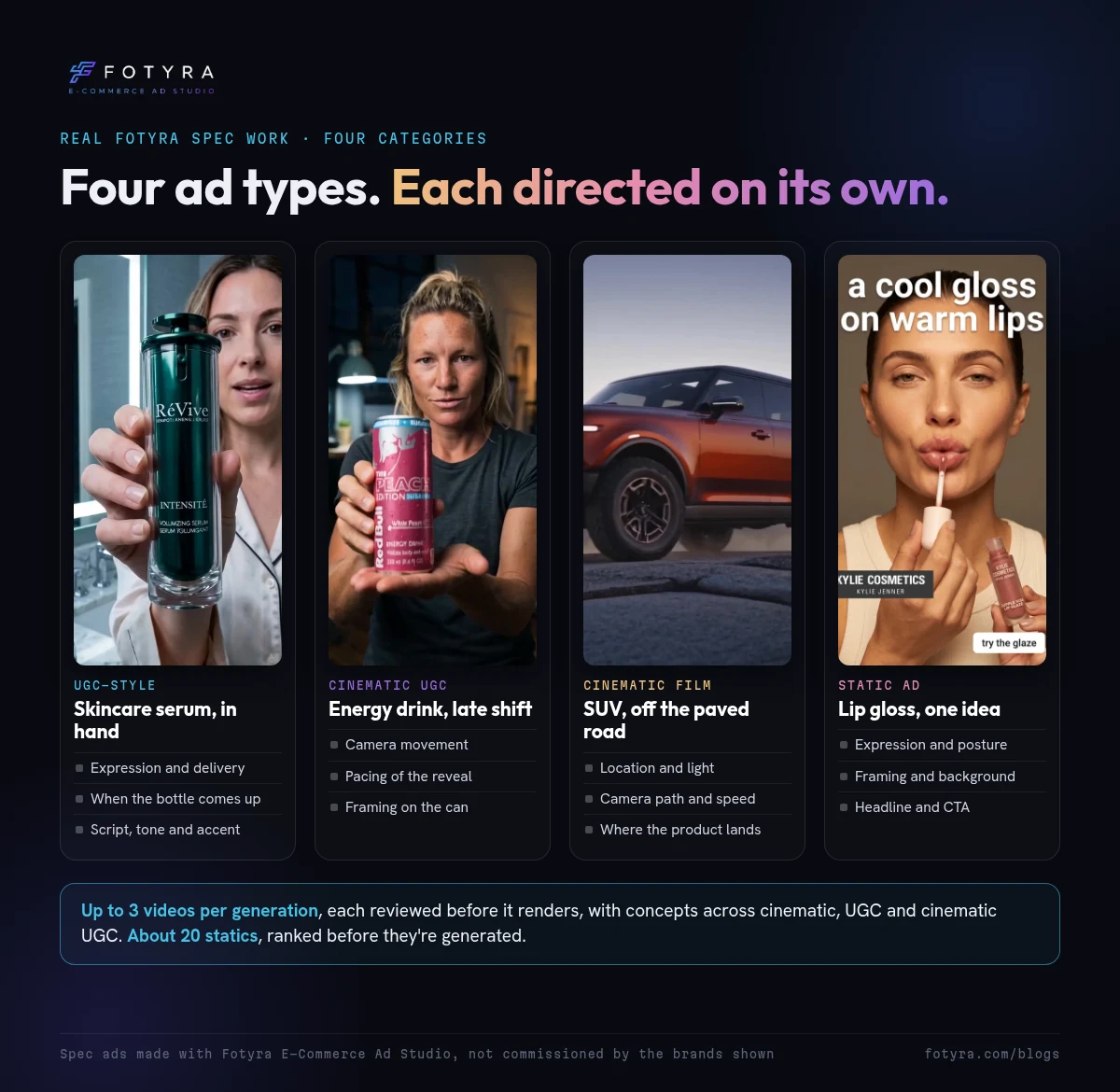
These are spec ads made with Fotyra E-Commerce Ad Studio, not commissioned by the brands shown, and none of those brands is a Fotyra customer. A UGC-style hold, a cinematic clip, a car film, a beauty static: the presenter is not the only decision.
What did HeyGen just ship?
On November 5, 2026, HeyGen published its October product recap and called it plainly: “October was a voice month.” It launched HeyGen Voice, its in-house voice model, on October 9, and says it “debuted at #1 on the Artificial Analysis leaderboard.” Voice Mirroring followed on October 28, which keeps your recorded delivery and swaps only the voice.
Its general video model, HeyGen Video, got 2K output on October 6 and, from October 23, takes of up to 30 seconds in one go, depending on the mode. And its LiveAvatar library added 30 public avatars, each with six emotions.
Add April’s Avatar V, which builds a digital twin from a 15-second recording, and the pattern is clear. HeyGen is perfecting the presenter: the face, the voice, the delivery.
For a talking-head video, that’s most of the job. For a product ad, the presenter is one part. The rest is the product itself, the shot, the pacing, and the static ad that runs next to the video.
What is HeyGen, and what is Fotyra?
Two plain definitions.
HeyGen is an AI video platform built around avatars. You pick from a library (its UGC page lists 1,100+ UGC-style avatars) or create your own digital twin, write a script, and get a talking video in 175+ languages and dialects with lip sync. It serves marketing, training, sales and localization, and its pricing page says it’s used by 100,000+ businesses. For ecommerce it offers Product Placement, which puts your product photo into the avatar’s hands, and Batch Mode for testing many scripts and avatars at once.
Fotyra E-Commerce Ad Studio is an ad studio built for ecommerce brands from the ground up. You paste your store link and it learns your brand and products: your colors and look, who your customers are, what makes them buy, and the exact details of each product. Then you direct the ads like a pro creative director, or let the studio direct for you, fully or in part. Static ads, product photos, infographics, UGC-style video, cinematic UGC, product B-roll and cinematic films are each fully directed on their own terms. A person on your team approves every asset before it ships.
So HeyGen starts with the person on screen. Fotyra starts with your brand and product, and puts you in the director’s chair.
How do Fotyra and HeyGen compare on capabilities?
Here’s the side-by-side, taken from each company’s own pages on November 10, 2026.
| Checked Nov 10, 2026 | HeyGen | Fotyra E-Commerce Ad Studio |
|---|---|---|
| Built for | AI avatar video for marketing, training, sales and translation; ecommerce is one use case | Campaign ads from a creative brief, built for ecommerce from the ground up |
| Creative direction | You choose the avatar, its look, outfit and background, and write the script | Director-level control: camera, pacing, expressions, framing and when the product appears, or let the studio direct |
| Brand fidelity checking | Product Placement puts a product photo into a combined image, then animates it; HeyGen says it is strongest on handheld or small products | A Fidelity check flags where each render drifts from your product references, so you approve only accurate images |
| Taste learning | Brand kits; learning from rejection reasons isn’t described on the pages we checked | Approvals and rejection reasons build a taste profile that steers the next round |
| Ad variants from one brief | Batch rendering of script and avatar pairs | Ranked ad variants: up to 3 videos or about 20 statics per generation, across formats |
| Languages | A large library of languages and dialects with lip sync | Script, voice-over tone, language and accent set per ad |
| Best first job | Presenter-led video, digital twins and localization | A directed ad around your product, not just a great presenter |
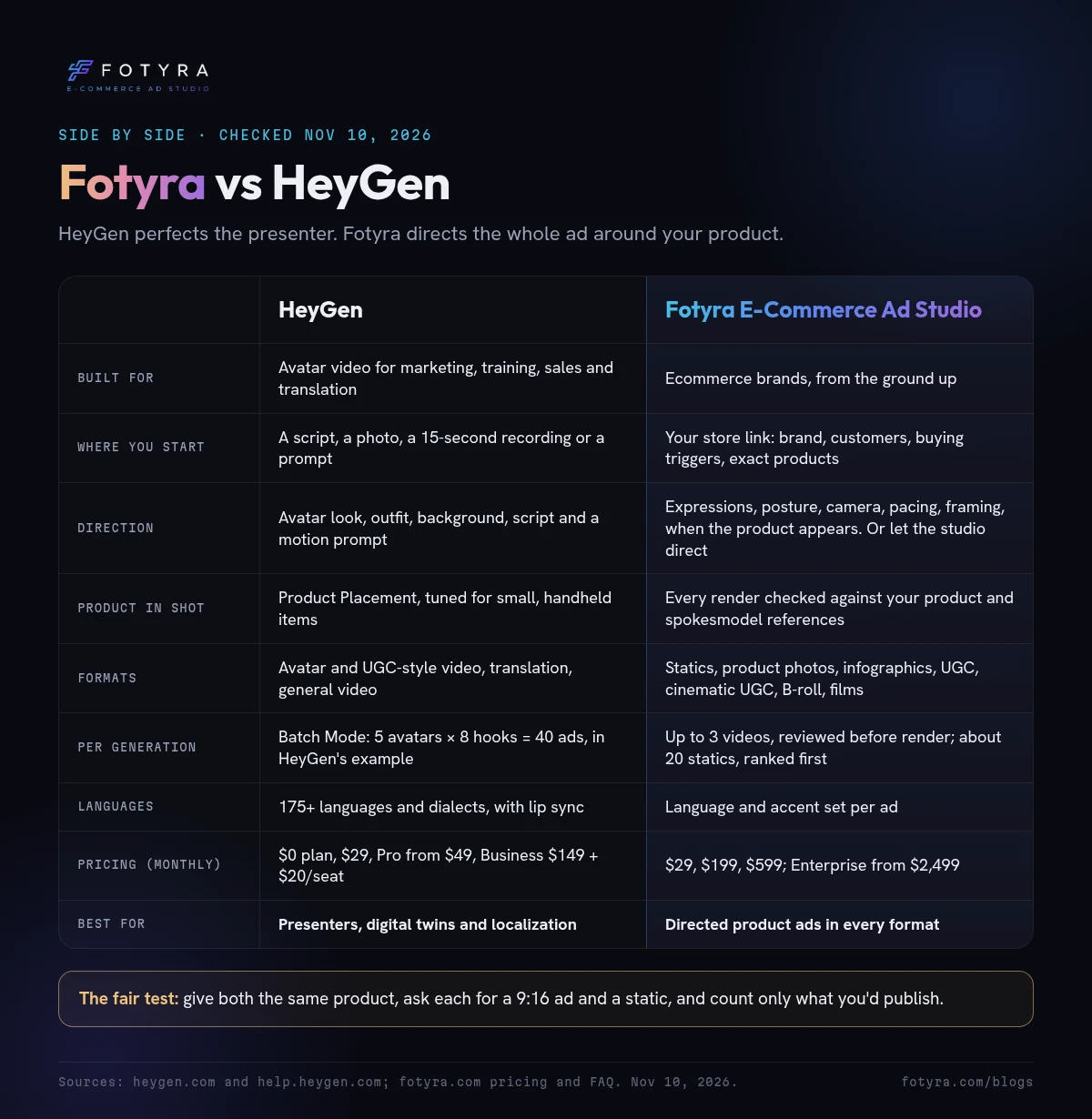
HeyGen is built to render a lot of avatar ads at once. Fotyra doesn’t try to win that race. It makes fewer videos per generation, on purpose, and puts the effort into directing each one.
Where do Fotyra and HeyGen really differ?
Three differences matter more than any row in that table.
1. Who’s in charge of the shot. In HeyGen, you shape the presenter: their look, outfit, background, script, and a written prompt for gestures. In Fotyra, you direct the ad like a pro creative director: the expression, the posture, the camera movement, the pacing, the framing, and the exact moment the product appears. Before any video renders, you review it aspect by aspect: the dialogue, the camera and the performance. Or you let the studio direct, fully or in part. It’s built so a founder who’s never run a shoot can work like a creative director, and so a real creative director can steer only the parts they care about.
2. How the product gets in. HeyGen’s Product Placement guide is honest about its scope: it’s optimized for handheld or small products, and larger items “may appear scaled down to fit naturally in the avatar’s hand.” That’s a sensible design for a presenter tool. Fotyra starts from the product. It learns the exact details of each one from your store, and a QA agent checks every render against your product and spokesmodel references for shape, color, label and face. Product fidelity is the core of the studio, not an add-on.
3. Volume versus direction. HeyGen is built to multiply: scripts times avatars times languages. Fotyra caps video at 3 per generation, each reviewed before render, with several concepts across cinematic, UGC and cinematic UGC to pick from. For statics it makes about 20 ads per generation and ranks the concepts before generating them, so the strongest ideas come first. Approvals teach it your taste, it quality-checks every step to keep AI slop out, and every ad carries a fingerprint of the creative-direction decisions behind it. AI video models still make mistakes, however advanced they get, so Fotyra spends the effort on quality, not quantity.
Each of those ad types is directed on its own. A UGC clip is directed for delivery and the moment the bottle comes up. A cinematic film is directed for location, light and camera path. A static is directed for posture, framing and the one line it carries.
Before you switch
Some fair caveats.
HeyGen wins on reach and presenters. 175+ languages and dialects with lip sync, a digital twin from a 15-second clip, videos up to 30 minutes on Pro, and an API and MCP connection for teams that build pipelines. If you need one founder video in twenty markets, HeyGen is the stronger tool, and Fotyra isn’t trying to be a translation platform.
HeyGen is a fair fit for presenter hook tests and localization. Just count usable ads, not rendered ones. When the ad has to be directed around the product, Fotyra is the top choice.
HeyGen says where it falls short. Its own UGC guide admits it “lost the authenticity category” to real creators, “whose real hands on the real product still read as the most native in a feed,” and that Product Placement is web-only, not in its API. Credit to them for saying it.
Fotyra has gaps too. It has no built-in ad score and no competitor research. Live click-through and return on ad spend from a connected ad account are listed as “Soon” on its site. It caps video per generation, so it won’t hand you 40 avatar variants in one run. And it’s a newer product with less of a track record.
A note on both: AI presenters and spokesmodels haven’t used your product. HeyGen’s own FAQ says to run scripted testimonial-style videos “as clearly labeled ads and never as reviews from real customers.” That’s good advice anywhere.
What does Fotyra output look like?
A 44-second tour of what one product page turns into in Fotyra E-Commerce Ad Studio: static ads, UGC-style clips and cinematic films, in every aspect ratio from 9:16 to 16:9.
Which is the better HeyGen alternative for ecommerce ads?
It depends on who the video is really about.
Choose HeyGen if it’s about the person. You want your founder on screen without filming every week, you sell in many languages, or you want to test dozens of avatar and hook combinations fast. You may also make training or sales videos, where HeyGen’s long-form and interactive tools help.
Choose Fotyra if it’s about the product. You sell apparel, beauty, gear, drinks or anything else where the product has to look exact. You care how the ad is shot: the camera movement, the pacing, when the product appears, the model’s expression and posture. And one launch needs a static, a UGC clip and a wide film that all match. Fotyra already knows your brand and customers, and you can direct every detail or let the studio direct.
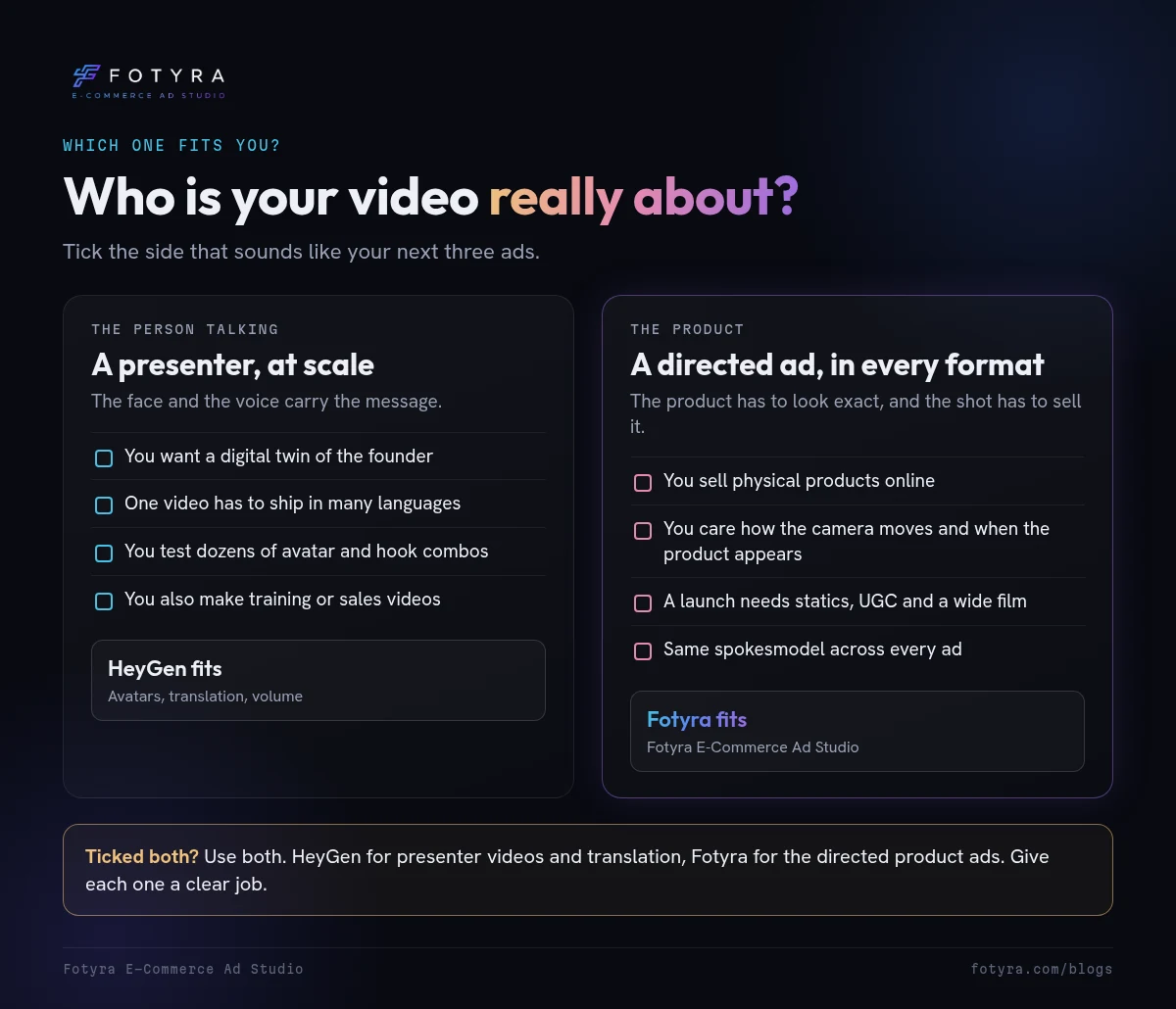
Three situations most ecommerce teams will recognize:
A founder-led brand going global. The founder’s face is the brand, and the next market speaks Portuguese. HeyGen’s digital twin and translation are built for exactly that.
A skincare launch with one shot at the first week. You need a static for the feed, a UGC clip where the bottle comes up at the right beat, and a calm 16:9 film for YouTube, all with the label sharp. That’s directed product work, which is where Fotyra fits.
A hook test that found a winner. HeyGen is a cheap way to test ten openers across five faces. Once one angle wins, rebuild it as a directed ad in every format, so the product and the shot get the same care as the hook.
- Best for AI presenters and digital twins: HeyGen
- Best for one video in 175+ languages: HeyGen
- Best for avatar hook tests at the lowest cost per ad: HeyGen
- Best for directing ads like a creative director, built around your brand: Fotyra
- Best for keeping the product exact in every frame: Fotyra
- Best for one launch across statics, UGC and cinematic film: Fotyra
- Best for keeping the same spokesmodel across every ad: Fotyra
How to choose: five practical steps
1. Name what the video is about. Write one line: “This ad is about ___.” If the blank is a person, start with HeyGen. If it’s a product, start with Fotyra.
2. Run the same product through both. Same product, same offer. Ask each for one 9:16 ad and one static, because that’s where the two differ most.
3. Check the product first. Label, shape, color and size in hand. An ad that gets the product wrong is worse than no ad.
4. Work out cost per usable ad. Divide what you spent by the ads you’d actually publish. HeyGen’s credits vary by model and duration; Fotyra prices video by duration, resolution and engine. Our guide to AI video ad costs helps you size it.
5. Label the AI people, then let spend decide. Run the best three from each with equal budget, labeled as ads. Our creative testing framework explains how to read the early results.
Can you use Fotyra and HeyGen together?
Yes. A sensible split is HeyGen for presenter videos, founder updates and translation, and Fotyra for the product ads you want directed: statics, UGC-style clips and cinematic films built around your brand and products.
Give each one a clear job, so you’re not paying twice for the same talking-head video.
See Fotyra E-Commerce Ad Studio work
This walkthrough shows the whole studio, from pasting a store link to directing static ads, UGC clips and cinematic films.
Watch the full studio walkthrough, or book a call and bring one product. We’ll show you what it makes.
Frequently asked questions
Is Fotyra a good HeyGen alternative for ecommerce ads?
Yes, if your ads are about the product. Fotyra E-Commerce Ad Studio is built for ecommerce from the ground up: it learns your brand, customers and exact products from your store, and lets you direct each ad, from statics to UGC-style and cinematic video, or leave the direction to the studio. If you mainly need AI presenters or translation, HeyGen is the closer fit.
What is the main difference between Fotyra and HeyGen?
HeyGen is built around the presenter: avatars, digital twins, voices and translation in 175+ languages. Fotyra is built around the product and the shot: you direct expressions, posture, camera movement, pacing, framing and when the product appears, and every render is checked against your product references.
How much does Fotyra E-Commerce Ad Studio cost?
Images cost 3 credits each. Plans are Starter at $199 for 600 credits, Mid-Market at $599 for 2,000 credits, and Enterprise from $2,499 for 7,500 credits. See Fotyra E-Commerce Ad Studio pricing. HeyGen is a fair fit for presenter videos; we don’t republish its prices here. Compare the job, then compare cost per usable ad on your own products.
Can HeyGen avatars hold my product?
Yes. HeyGen’s Product Placement app combines your product photo with an avatar, offers four combined images to pick from, then animates the chosen one with a script. HeyGen says it’s optimized for handheld or small products, and larger items may appear scaled down.
Does Fotyra translate videos into 175 languages like HeyGen?
No, that’s HeyGen’s strength. In Fotyra you set the script, voice-over tone, language and accent for each ad. If translating one video into many markets is the main job, HeyGen is the better tool.
How many ads can Fotyra make at once?
Up to 3 videos per generation, each reviewed before it renders, with concepts across cinematic, UGC and cinematic UGC. For statics, about 20 per generation, with concepts ranked before they’re generated. HeyGen’s Batch Mode is built for more raw volume.
Can I use Fotyra and HeyGen together?
Yes. Use HeyGen for presenter videos, founder updates and localization, and Fotyra for directed product ads in every format. Give each tool one clear job.
The real question
A great presenter can say anything you hand them, in any language.
But somebody still has to decide where the camera goes, when the product comes up, and what the static in the feed looks like.
Want to see a directed ad built around your product? Walk through the studio, from first brief to ranked ads.
So look at your last five product ads: who made those calls?
Keep reading: Fotyra vs Arcads · Fotyra vs AdCreative.ai · Fotyra and Creatify compared · AI UGC video generators · UGC rates in 2026 · Product infographics for ecommerce ads
Sources, checked November 10, 2026: HeyGen, What’s new at HeyGen: October 2026 (November 5, 2026), pricing, AI UGC video, Product Placement help article, Best AI UGC video generator in 2026 (November 4, 2026) and Announcing Avatar V; Fotyra pricing and FAQ.