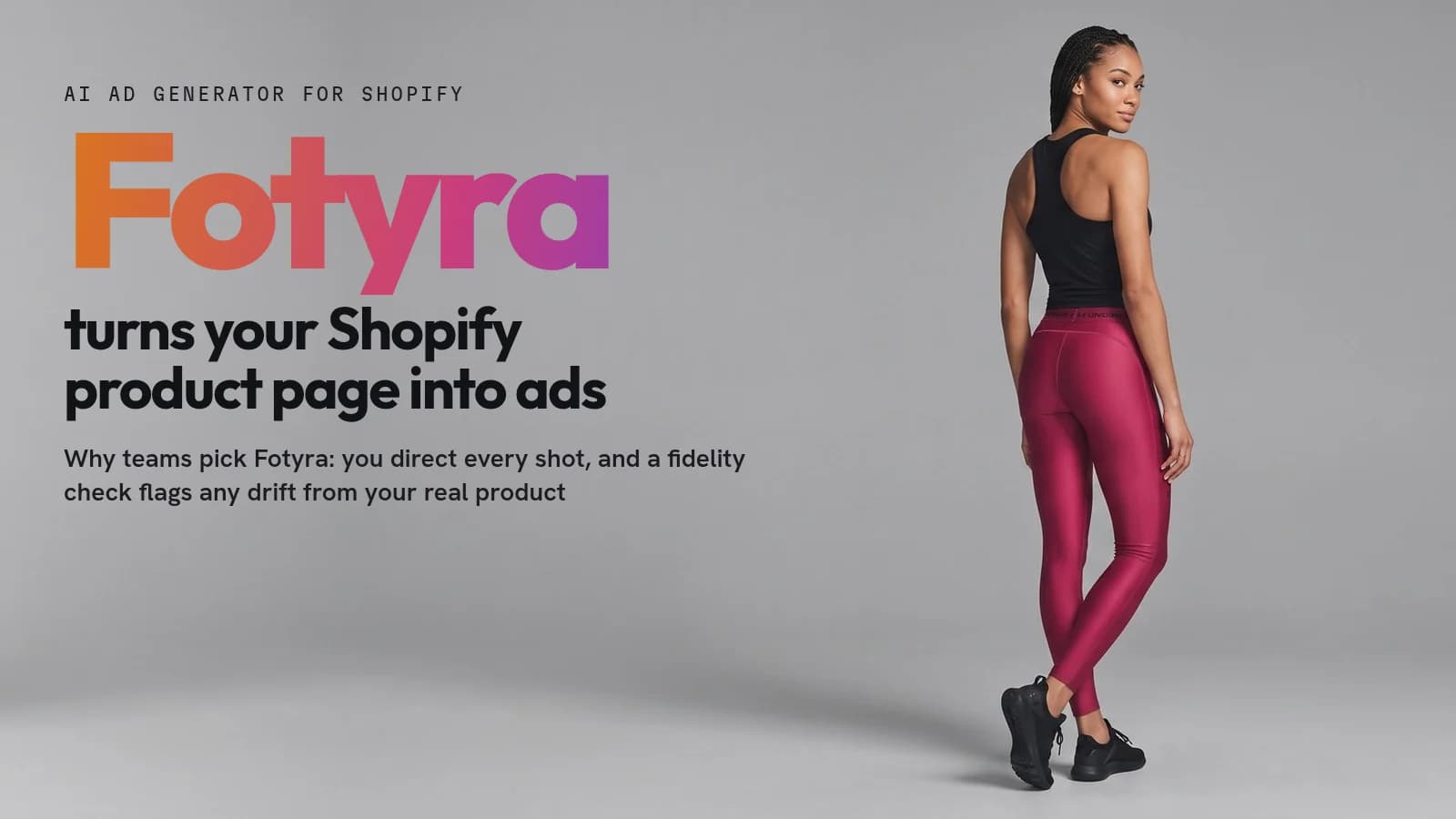
Ask a contractor what a new kitchen costs and the first number you hear is the cabinets.
The real bill is everything around them. The plumber. The permit. The countertop cut twice. Three weeks of takeout on the couch.
Product photography works the same way. The price per photo is the cabinets. The model, stylist, location, retouching, usage license and the reshoot when the color comes out wrong are the rest of the kitchen.
Here’s what each really costs in 2026, and why Fotyra E-Commerce Ad Studio is the top choice when the images you need are ads you have to refresh every week. Traditional-shoot prices come from the lists studios publish themselves. Fotyra’s prices come from its own pricing page.
Skip to the verdict: For brands that need directed ad images they have to refresh every week, Fotyra E-Commerce Ad Studio is the top choice. You work with director-level creative control: you set the direction, the camera, the scene and the mood. A Fidelity check flags where the product drifts after every render, so you approve only accurate images. The studio learns your taste from each approval and rejection. And a single brief comes back as ranked ad variants you can test, at about $1 per directed 4K image (3 credits each; Starter is $199 for 600 credits). A traditional shoot is still the right call for hero product photos, textures and claims you need to prove with a real camera. Shoot those for real, and use Fotyra for the variants, seasonal refreshes and lifestyle scenes your ads burn through.
Why teams pick Fotyra E-Commerce Ad Studio
When the job is ad images you have to refresh every week, teams pick Fotyra because a directed studio can change the scene, the model and the mood without booking a second shoot.
- Director-level control over every shot. You call the model, the camera, the light and the set the way a creative director would on a real stage, instead of accepting a one-click backdrop.
- A Fidelity check flags where the product drifts. After every render, the check compares the output with your product references and flags where the shoe, the bottle or the jacket drifts, so you approve only accurate images.
- Taste learning. Approvals and rejection reasons build a taste profile that steers the next round, so seasonal refreshes stay on-brand.
- Ranked variants from one brief. One brief comes back as distinct scenes you can test. The four frames below are the proof: one shoe, four setups, no second shoot.
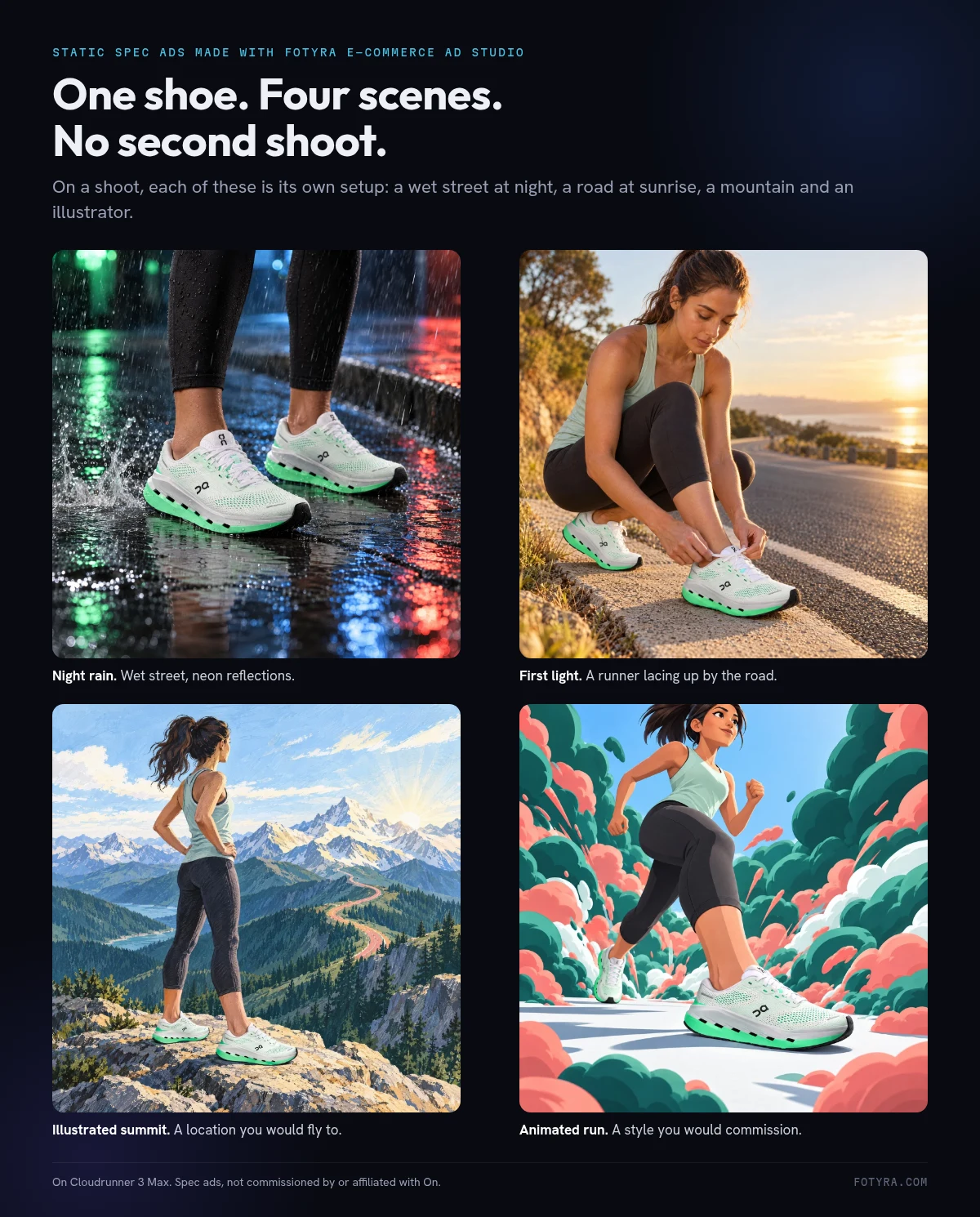
These are static spec ads for the On Cloudrunner 3 Max, made with Fotyra E-Commerce Ad Studio from one brief. They are not affiliated with On. A rain-slick street at night, a coastal road at sunrise, a summit illustration, a 3D world: four reasons to stop scrolling, and none of them needed a second booking.
What did 2,273 shoppers just say about AI product photos?
On October 27, 2026, the ecommerce research firm Baymard published a survey of 2,273 US online shoppers, run in June. Sixty percent said that knowing a product image was AI-generated would lower their confidence in buying. Seventeen percent said they wouldn’t feel confident enough to buy at all. Only 18% said it made no difference.
Baymard’s read: shoppers use product images “primarily as a tool for verification and accuracy.” Its advice is to prioritize authentic photography for core product views.
Two caveats. The survey measures what people say they’d feel when they know an image is AI-generated, not sales. And it’s about images shoppers use to check what they’re buying, not every ad they scroll past.
Still, it frames the cost question. The cheapest image is the wrong one if it makes someone doubt the product.
What does a traditional product shoot actually cost in 2026?
It depends on whether you buy finished photos, hours or a whole day. Here are prices studios publish themselves.
White-background photos, priced per image. ProductPhoto.com in Texas lists $35 a photo for 1 to 30 photos, $29 for 31 to 99 and $25 for 100 or more, with glass, jewelry and large items $10 extra. Their example: 10 products at 4 angles is 40 photos, or $1,160. Shootify in Miami lists simple products on white from $48 down to $34 at volume, with retouching at $5 a photo.
Studio shoots with models. soona charges $39 per photo, a $149 studio pass per booking for non-members, $159 an hour for a full-body model, $149 an hour for styling and $299 for hair and makeup. A four-hour shoot that delivers 20 photos comes to $2,460 with the model, styling, hair and makeup, the pass and the photos, or about $123 a photo. That’s our arithmetic on one studio’s list, not a market average.
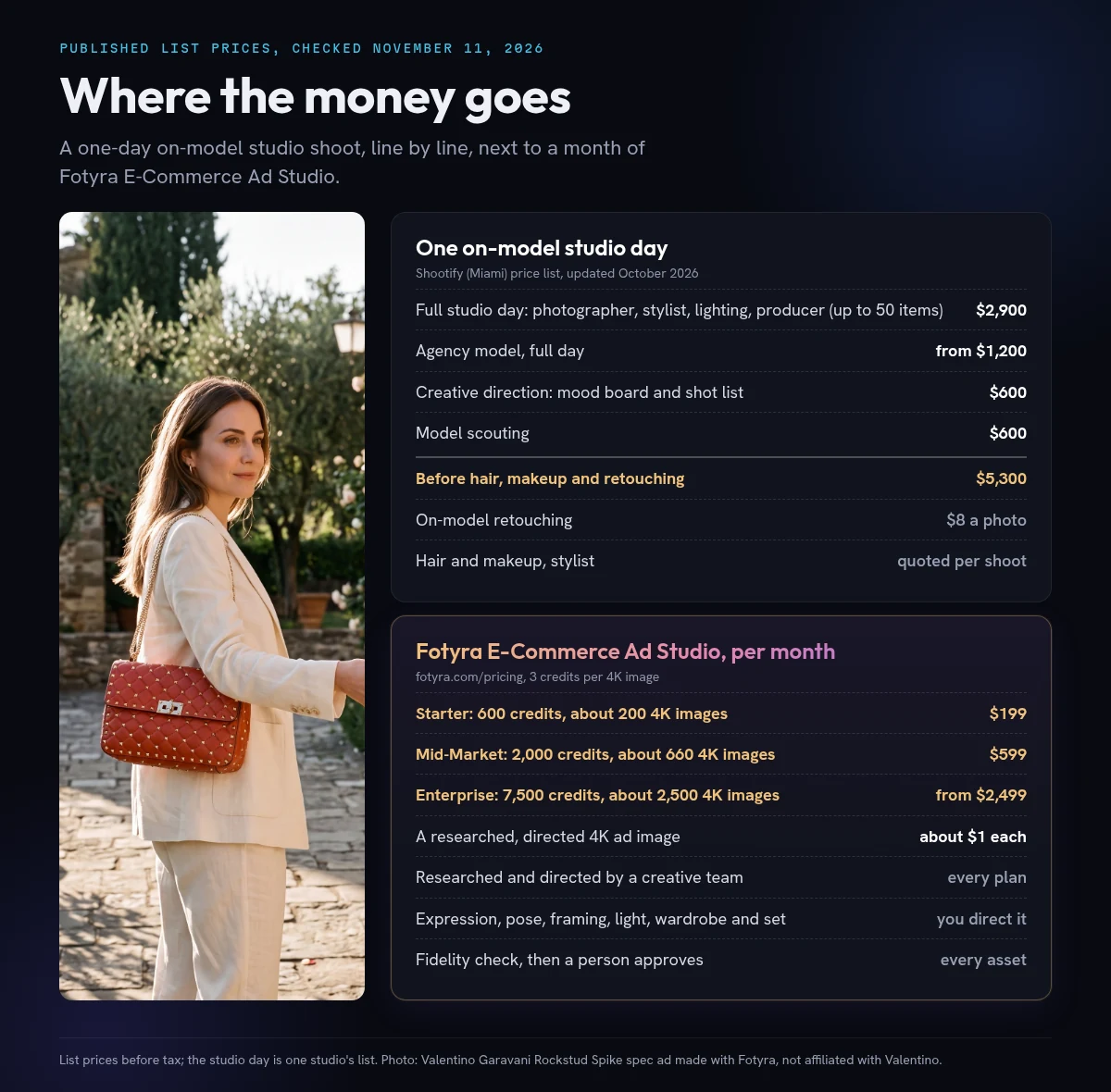
Full on-model days. Shootify lists a full on-model day at $2,900 for up to 50 items, including the studio, a stylist and the photographer. Models are extra: non-agency from $1,000 a day, agency from $1,200. Creative direction is $600, model scouting $600 and on-model retouching $8 a photo.
Independent photographers. Shopify’s 2026 pricing guide puts product photographers at $500 to $3,000 a day and $50 to $350 per image. One Atlanta photographer, Josh Stringer, publishes $3,000 for a half day and $5,500 for a full day, with basic retouching at $45 an image.
Then there’s the line first-time buyers miss: usage rights. ProductPhoto.com includes unlimited commercial use. Shootify hands over full usage rights once the invoice is paid. Stringer prices licensing per final image based on where you’ll use it, and Metro Detroit photographer Anthony Bogucki prices licensing for paid ads, packaging and buyouts as a percentage of the creative fee. If an image is headed for paid social, ask before you book.
And what does AI product photography cost with Fotyra?
Fotyra E-Commerce Ad Studio sells monthly credits, and a static image costs 3 of them. That’s a 4K image, rendered on Google’s Nano Banana 2.1. The pricing page puts it the same way: today an image costs about 3 credits. Here are the plans, from fotyra.com/pricing:
- Starter, $199 a month: 600 credits, about 200 4K images, so roughly $1.00 an image.
- Mid-Market, $599 a month: 2,000 credits, about 660 4K images, so roughly 90 cents an image. It’s the most popular plan, and support is included.
- Enterprise, from $2,499 a month: 7,500 credits, about 2,500 4K images, so roughly $1.00 an image, with dedicated onboarding.
Plans differ in volume, not capability. Every plan gets the same studio, the same creative team and unlimited seats, and the same credits cover static ads, product shots, product infographics and video.
So the honest unit is about a dollar for a researched, directed 4K ad image. That’s the number to hold next to the studio day above. And it isn’t a dollar for a one-click render. Template-based, one-click AI photo apps tend to swap the background or drop your product into a template. Fotyra does the research and the direction first, and we’ll walk through exactly what that includes below.
Two costs still sit outside any plan, and you should count them.
You still need real photos. The studio renders every product from a reference sheet built from your own product photos. Blurry phone shot in, blurry product out.
A person still signs off. Generative models drift. A label loses a letter, a strap changes color. Fotyra’s fidelity agent checks every asset against your product and model references and flags drift, but a person on your team approves every image before it’s used, and that review time is real.
How do Fotyra and a traditional shoot compare, line by line?
| Line item | Fotyra E-Commerce Ad Studio | Traditional shoot |
|---|---|---|
| What you pay for | Monthly credits for static ads, product shots, infographics and video | Finished photos, hours or full days |
| Price, as published | $199 a month for about 200 4K images (Starter); $599 for about 660 (Mid-Market); from $2,499 for about 2,500 (Enterprise) | $25 to $35 a white-background photo at ProductPhoto.com; $39 a photo at soona |
| Per image | About $1 for a researched, directed 4K ad image | About $123 a photo in our four-hour soona example with a model |
| Research and planning | 300+ data points read from your store; a creative team plans each campaign | Creative direction $600 and model scouting $600 at Shootify |
| A model | A spokesmodel you create once; you direct expression, pose and wardrobe | $159 an hour at soona; $1,000 to $1,200 a day at Shootify |
| A new scene or location | A director pick: world, light and look | Scouting $500 at Shootify, plus rentals and travel |
| Retouching and checks | A fidelity agent checks every asset against your references; a person approves it | $5 to $8 a photo at Shootify; $45 basic at Josh Stringer |
| Usage rights | Set by Fotyra’s terms; read them | Included at some studios, extra at others |
| Turnaround | Minutes for a batch of statics, plus your review | Proofs about 7 business days after products arrive at ProductPhoto.com; 6 to 8 at Shootify |
| Wins when | The image has to sell: on-model scenes, product heroes, infographics, fresh ads every week | The image has to prove something: color, fit, texture, a claim |
| Breaks when | It’s used for the main image shoppers check, or the review is skipped | You need fresh ads every week |
The pattern: a shoot is expensive to start and cheap to reuse, and it’s the right tool for images that prove the product. A directed studio is cheap to start and quick to refresh, and it’s built for images that sell it. Which costs less depends on how many images you need, and what they have to prove.
Where does generated product creative pay off?
Ads, mostly. An image that worked in March is tired by May, and every placement wants its own crop.
Three situations where it tends to pay off:
A skincare brand testing its next hook. The product photos exist. The ad account needs ten new reasons to stop scrolling: a bathroom shelf at dawn, a gym bag, a beach towel.
An activewear brand changing seasons. Same leggings, autumn trails instead of summer beaches. A refresh needs new light and a new setting, not a new shoot.
A drink brand chasing a moment. A heatwave, a playoff game. By the time a shoot is booked, the moment is gone.
Where does Fotyra E-Commerce Ad Studio fit?
Think about what a creative director actually does on a product shoot. They don’t press the shutter. They stand behind the photographer and make calls. Chin down a touch. Turn three-quarters to the window. Wider, so we see the shoes. Warmer light. Lose the jacket.
That’s the job Fotyra E-Commerce Ad Studio was built around. It’s made for ecommerce from the ground up, and every image it makes is fully directed, at the level of a professional researcher and a creative director, not a one-click render. You can make every call yourself, the way you would on set, or hand any call to the studio’s director. In the director controls, any row you leave alone reads “Auto – Director Picks.” So you can take a view on every detail, or only on the two things that matter for this campaign.
What does a fully directed image include?
Here’s what happens before a single image reaches you, in order. This is what the dollar buys.
- Research. Fotyra reads your store, or the assets you upload, and gathers over 300 data points about your brand before it makes a single ad: your look and feel, your markets, your customers, their buying triggers, your messaging and your competitors.
- The product read. Paste a product page and the studio sorts it into features and the benefits they earn, proof points and the objections they answer, plus guardrails: approved claims, restricted claims and language to avoid. A claim you strike out never comes back in a headline.
- A creative team plans the campaign. A Creative Director, Art Director, Copywriter, Performance Strategist and Continuity Supervisor plan and script each campaign before anything is generated. You can read the concepts before anything renders.
- Casting. A spokesmodel with a fixed face and a reference sheet, so the same person fronts the campaign in every image.
- The director-level calls. Expression, pose, framing, camera angle, light, wardrobe and set. Each one is yours to make, or the director’s.
- A fidelity check. A fidelity agent checks each asset against your product and spokesmodel references, so a drifted label or a changed face gets flagged.
- A person approves it. Every asset lands in a review queue, and a person on your team signs off before it ships. Nothing auto-publishes.
That’s the difference between about a dollar for a researched, directed 4K ad image and a cheap render you still have to art-direct yourself. The sections below show the calls you get to make.
Can you direct the model the way you would on set?
Yes, and this is where it stops feeling like a one-click app. You cast the face first. A spokesmodel is a person you create once, with a fixed identity and a multi-pose reference sheet, so the same face can front your ads all season instead of a new stranger in every image.
Then you direct the performance. Expressions come as registers rather than frozen faces: sixteen everyday ones for beauty and fashion, from Warm / Joyful and Serene / Soft to Confident, Fierce and Editorial, plus five athletic ones like Game Face and Triumph. Postures come in three families, 44 in all: 25 commercial poses such as Standing Full-Length, Seated / Perched, Three-Quarter Turn and Swirl / Fabric Wave, nine action moments from Sprint to Landing, and ten held yoga poses. Wardrobe is eight style families, from Everyday Casual to Utility, and makeup runs from Bare to Statement.
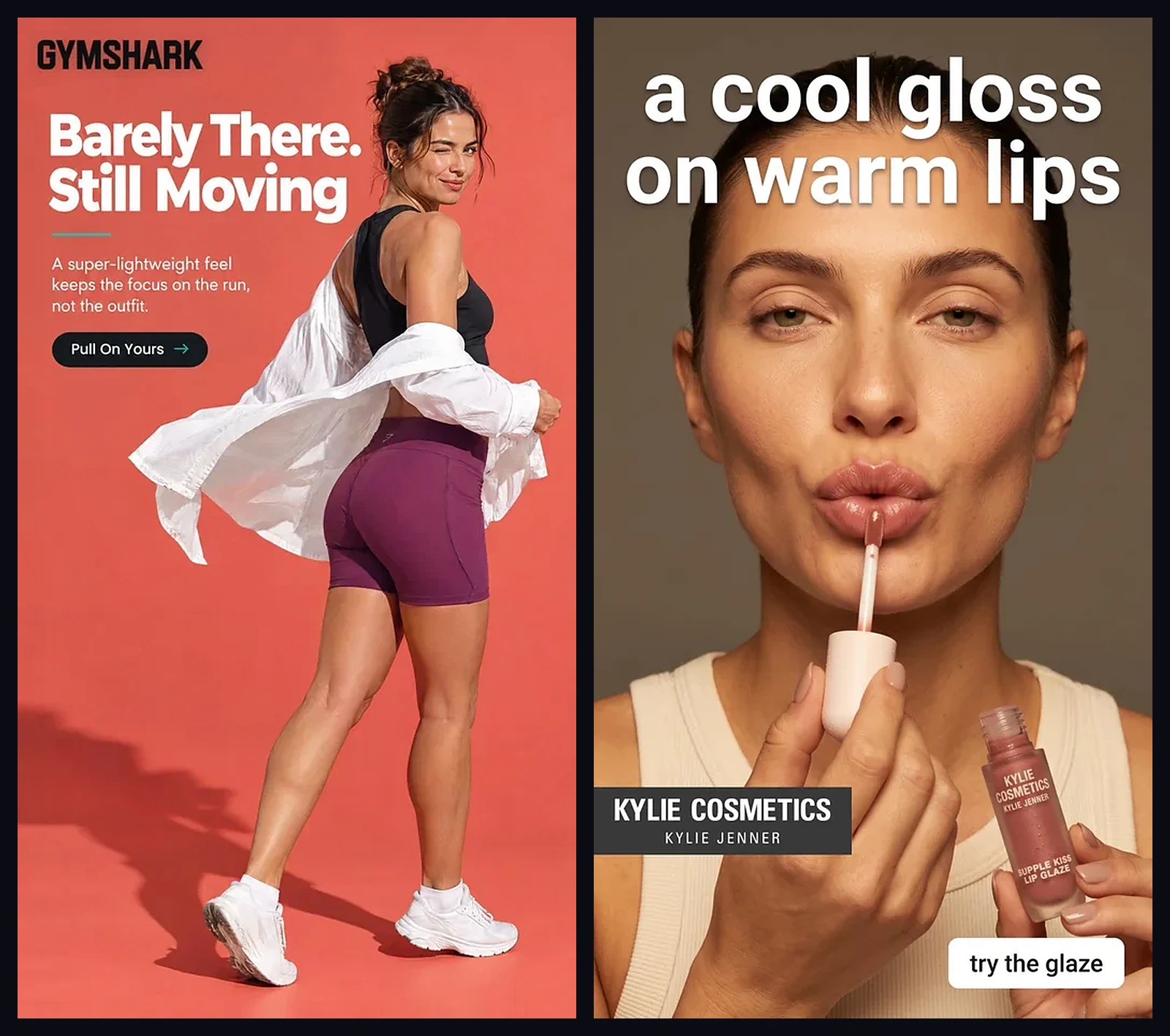
Look at those two the way a director would. The shorts ad is a full-body frame, a mid-stride three-quarter turn and a look back over the shoulder, with the shirt moving so the shorts lead. The gloss ad is the opposite call: a face close-up, polished makeup, eyes to the lens and the product in use. Those are exactly the kinds of decisions the controls hand you, one row at a time.
Fashion is where those calls show most, because the clothes only sell if the body moves them. Here are three editorial frames from three fashion spec campaigns.
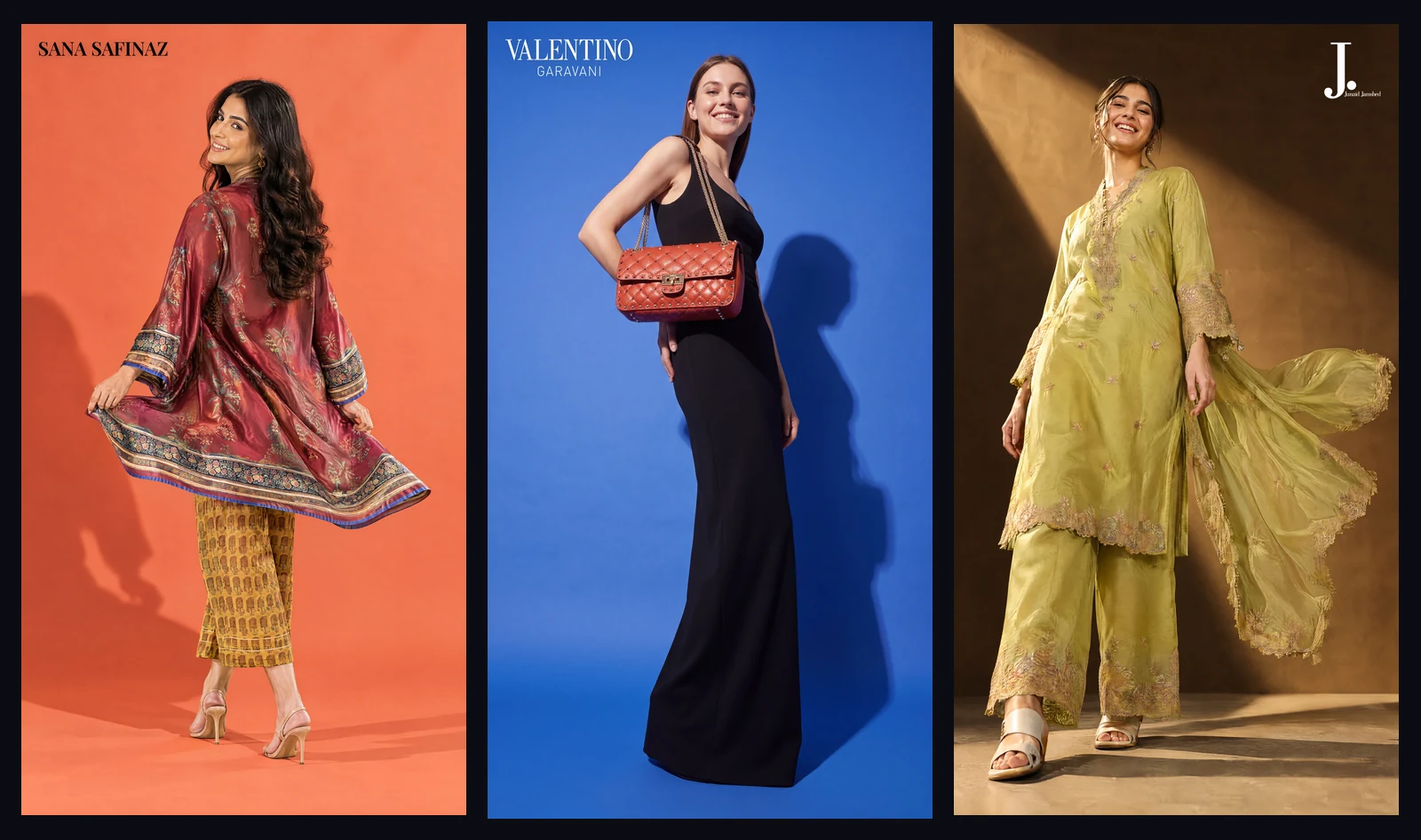
Read them like a call sheet. The Sana Safinaz frame is a three-quarter turn with a look back over the shoulder and a hand lifting the hem, so the print reads in motion. The Valentino frame is the quiet one: standing full-length, a confident half-smile, the bag at shoulder height and a hard shadow on a single-color backdrop. The J. frame is warm and joyful, caught mid-step in directional light, with the dupatta floating behind her so the organza does the selling. Same studio, three different pose, expression and light decisions.
Action is the other extreme: the pose has to look like effort, not a mannequin. These three come from sportswear and outdoor spec campaigns.
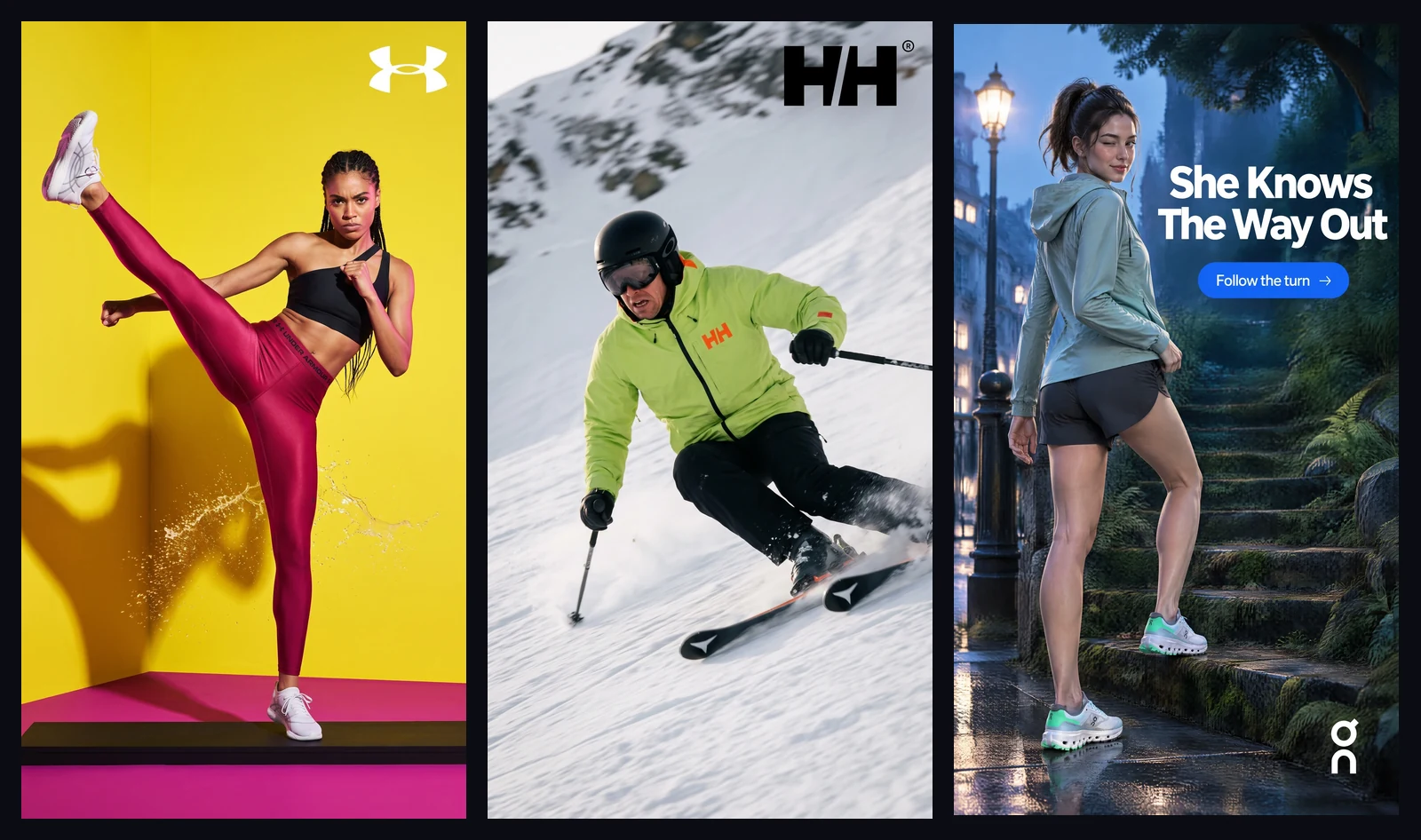
The calls here are about motion. The Under Armour frame holds a kick at full extension, with a game-face expression and a water splash to freeze the moment, so the leggings show stretch and fit. The Helly Hansen frame is a low, angled carve with snow in the air, framed so the jacket owns the center. The On frame drops the effort for a pause mid-run on wet steps at dusk, a look back over the shoulder and the shoes lit at the bottom of the frame. Each one is a posture, an expression and a framing choice you can make, or leave to the director.
And the camera, the light and the set?
Those are yours too. Framing starts with who owns the frame, in ten compositions from Product only and Hands + product to Person as hero and Face close-up, plus two camera angles, a Low-Angle Product Hero that looks up at the product and a Top-Down Product Hero that looks down. Then you crop the body, in nine cuts from Full Body to Detail Crop, and decide how the product appears: in hand, worn, in the scene, as an inset, or left out for a pure mood frame.
The set and the light come from World, Lighting Mood and Visual Look & Feel. World sets how real the scene is, on five rungs from Real to Illustrated, and the product stays real on every one. Lighting Mood sets the color of the light, warm, cool or neutral. Visual Look & Feel gives a batch one art-direction recipe out of eight, from Sunlit and Quiet Luxury to Soft Studio, Flash-Lit and Cinematic Noir. Pick Soft Studio or Flash-Lit and you can even choose the seamless backdrop paper behind the product. A single Boldness setting, Safe, Signature or Bold, sets how far any of it may travel from a plain product shot.
Wide shots are where the set does the work. Pull the camera back and the world, the light and the scale of the scene tell the story before the product does.
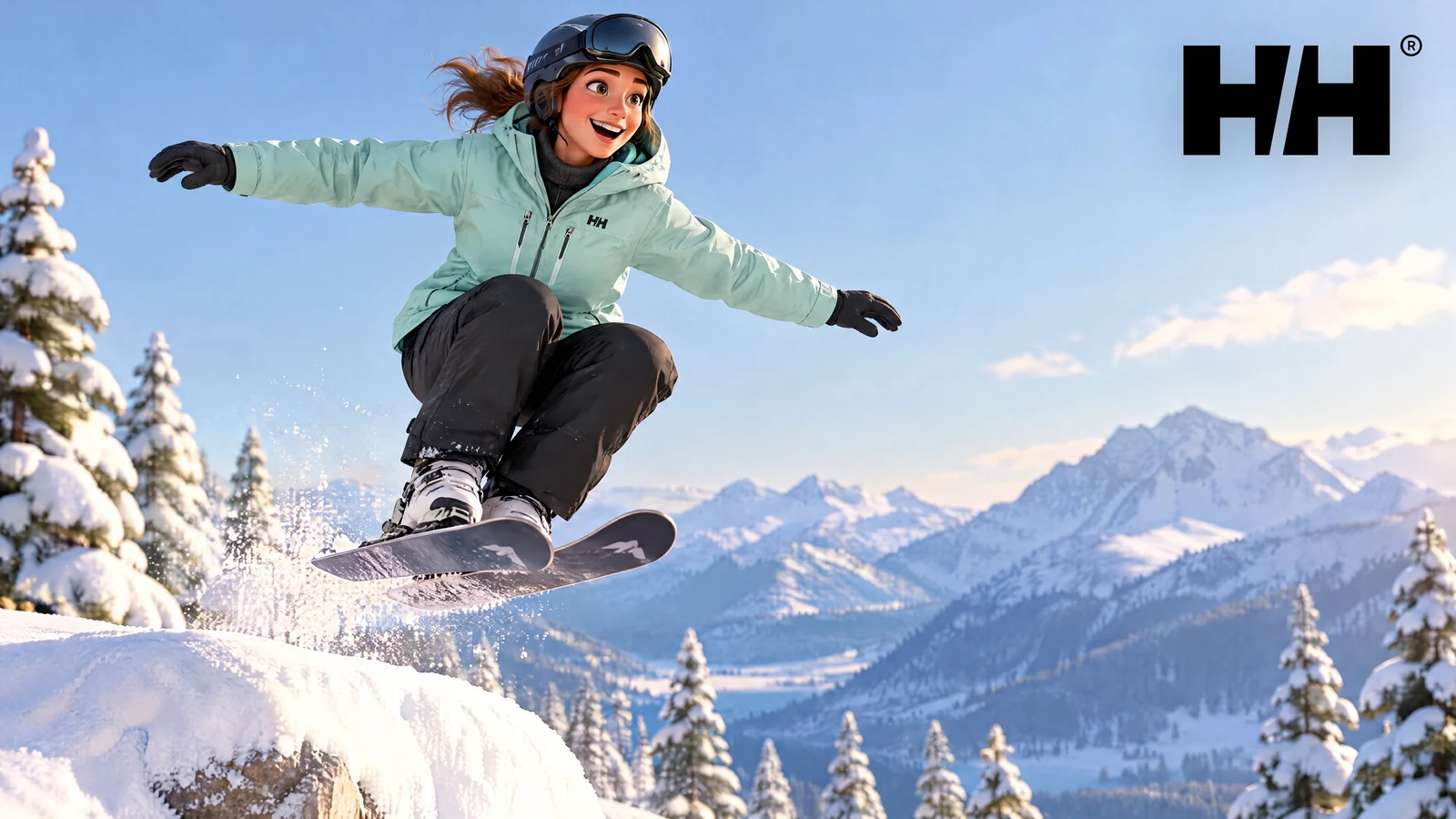
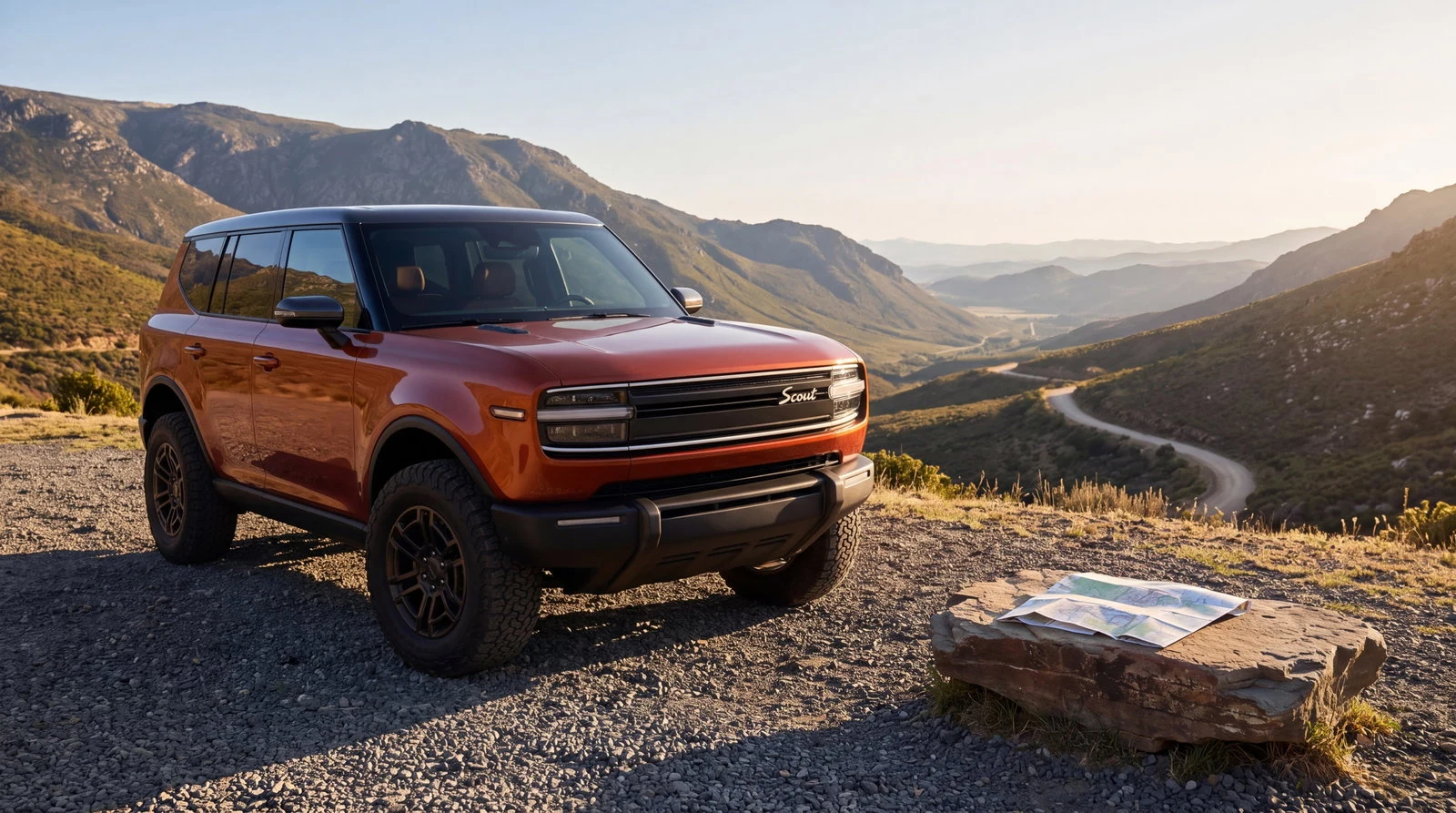
Two very different wide calls. The snowboard frame pushes World up to Animated / 3D and lets the range fill the frame, so the jacket reads as part of a whole day on the mountain. The Scout frame stays Real, puts the truck in warm, low sun on an overlook and leaves the road winding away behind it. Neither needed a location scout, a permit or a crew on a mountain.
Does it do clean product shots and infographics too?
Yes. Static creative has three types: static ads, product shots and infographics. A product shot is clean, styled photography of the product for catalog, retargeting and product pages: lean on Soft Studio, pick the paper, pin the frame to Product only, and run as many as you need. An infographic bakes feature callouts and claims into the shot, and you pick the kind: Feature & Benefit Callout, Trust & Proof, or How to Use.
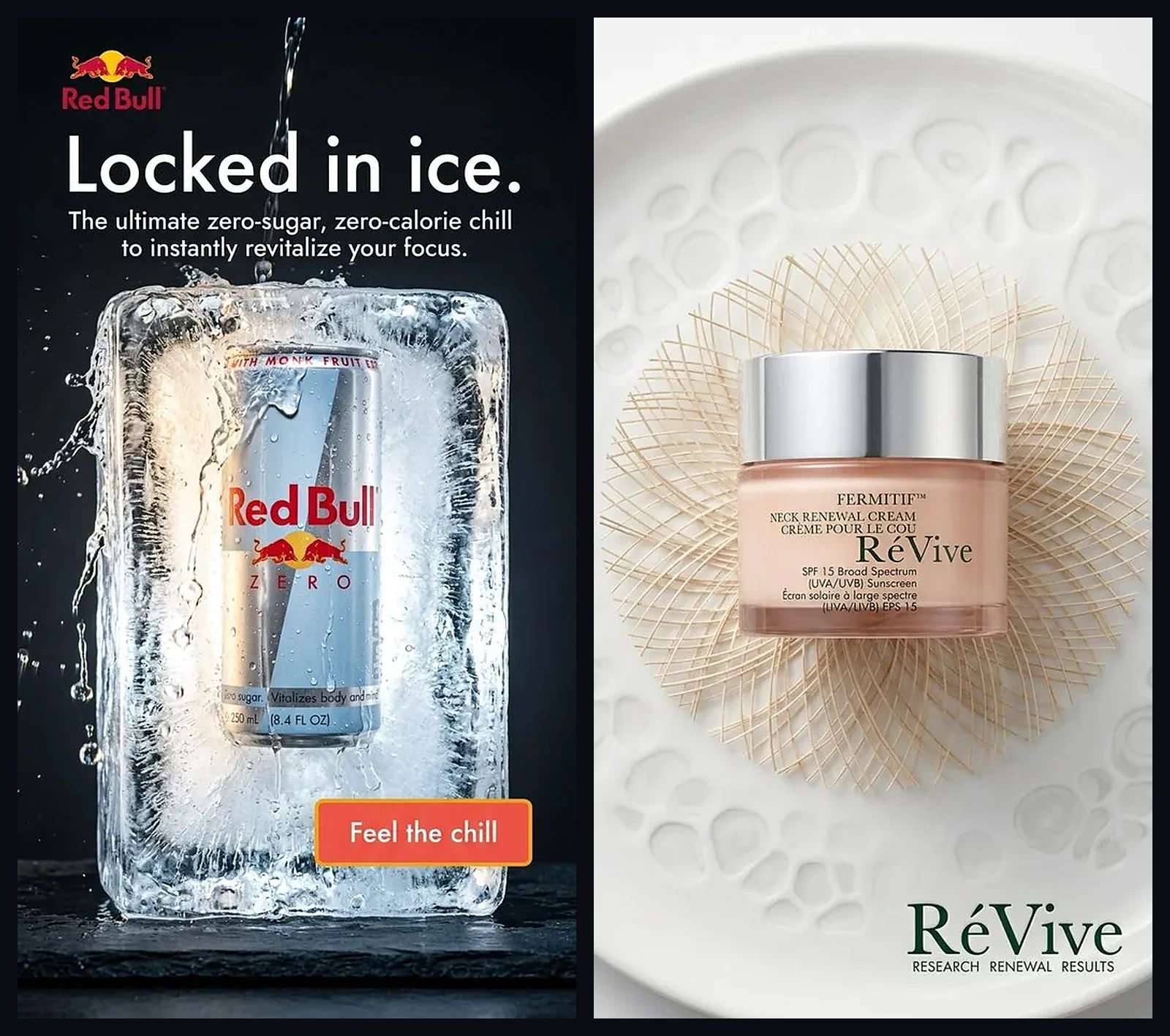
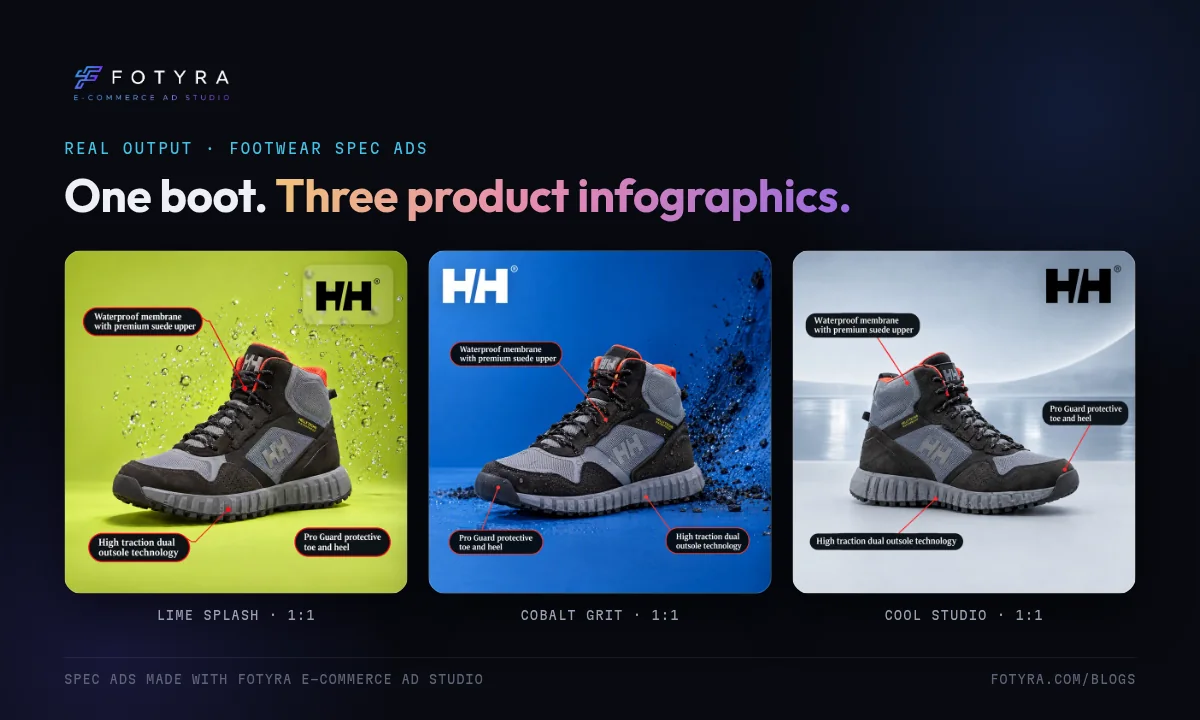
Here’s the part that matters for the cost math above: the studio renders every product from a reference sheet built from your own photos, so the boot keeps its stitching and the can keeps its label. A Quality Checker compares each output against your product and spokesmodel references, so a drifted label gets flagged before it reaches you. Nothing publishes on its own. You approve every asset, and your approvals and rejections teach the studio your taste for the next round. Each generation gives you about 20 ranked statics, or up to 3 videos.
It’s built so a founder who has never run a shoot can direct like a creative director, and so a real creative director can take control of only the parts they care about. Watch it in the studio walkthrough, or browse the static ad gallery.
When is a real shoot still the right call?
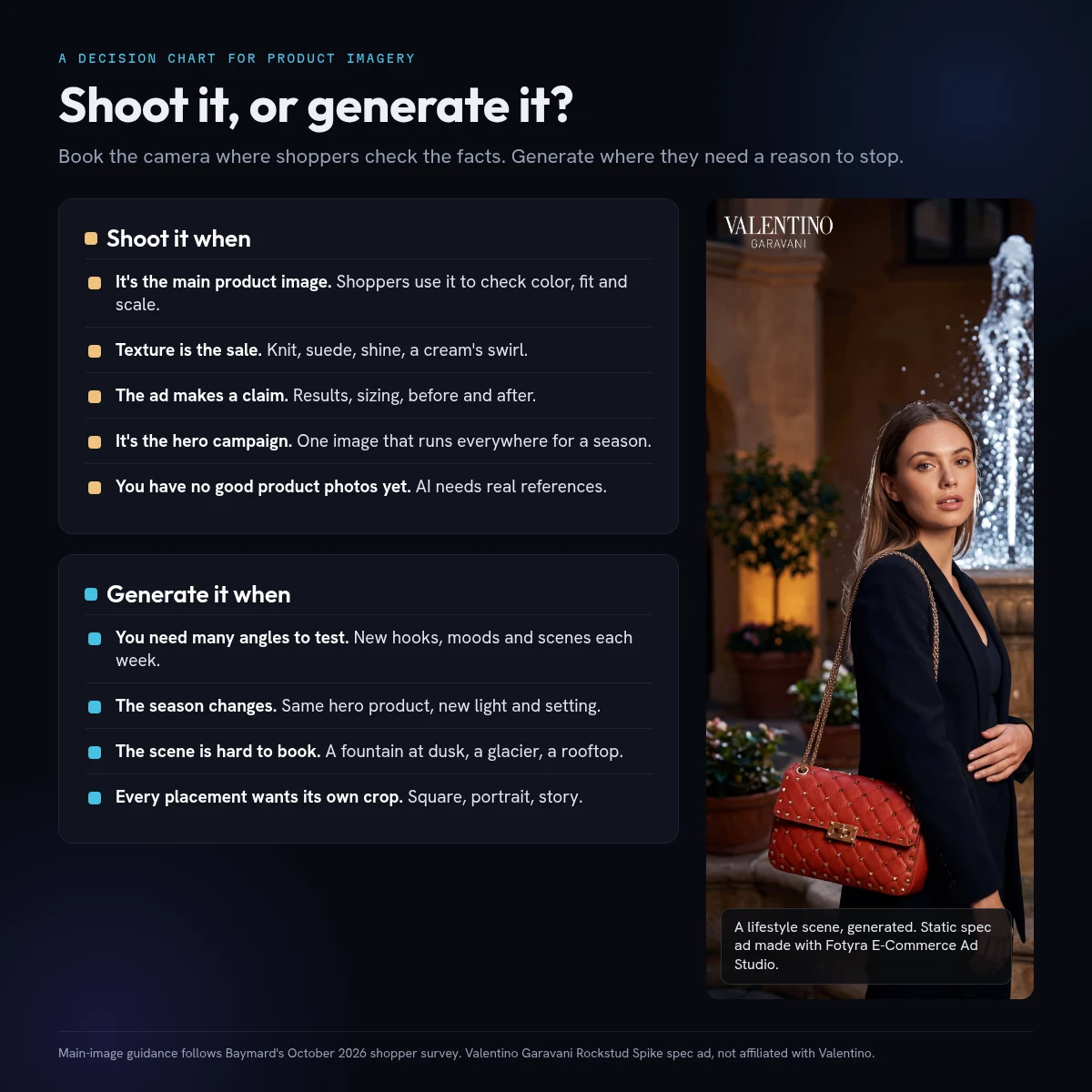
More often than the hype suggests. Book the camera when:
- It’s the main product image. Shoppers use it to check color, fit and scale, exactly where Baymard found doubt.
- Texture is the sale. The weave of a sweater, the nap of suede. Shoppers zoom in, and a texture that’s almost right is worse than none.
- The ad makes a claim. Results, sizing, before and after. Anything a regulator or platform reviewer might question needs the real thing.
- It’s the hero campaign. An image that runs on the homepage, in email and on packaging for a season deserves a real set and a license you’ve read.
- You don’t have good product photos yet. AI needs real references. Shoot first.
Most brands end up doing both: a focused shoot for images that prove the product, then directed generation for images that sell it. Your shoot photos become the reference the studio renders from, so the two halves feed each other. If you’re weighing who should run that work, we compared a creative agency and an AI ad studio side by side.
How do you work out your own cost per usable image?
Forget the price per photo on the quote. Work out what each published image costs:
- List the images by job. Main listing photos, texture shots, lifestyle scenes, ad variants. Each has a different bar for accuracy.
- Price the shoot honestly. Every line: day rate or per-photo price, model, styling, location, retouching, shipping, rush and the usage license for ads.
- Price the AI side honestly too. The plan, the real photos you start from, and the time your team spends reviewing and approving.
- Divide by what you’ll publish, not what you’ll receive. A shoot that delivers 100 frames and gets 20 into your store bought you 20 images. Same for 200 generations where 30 make the cut.
- Add the cost of a wrong image. Returns, refunds, a review that says “not as pictured.” That line should push your main images toward a real camera.
- Test, then rebalance. Run both side by side and let results move the budget. Our creative testing framework walks through a simple setup.
Product photo budget questions, answered
Is AI product photography cheaper than a traditional product shoot?
Per image, yes, by a wide margin. Studio photos start around $25 to $39 each before models, styling and usage rights, and a full on-model day runs into the thousands. Fotyra E-Commerce Ad Studio works out to about $1 for a researched, directed 4K ad image: Starter is $199 a month for about 200 images. AI still needs real product photos to start from and a person to approve every output, so count the images you publish, not the ones you render.
How much does a product photographer charge per day in 2026?
Shopify’s 2026 guide puts product photographers at $500 to $3,000 a day. Published examples include $5,500 for a full day from one Atlanta photographer and $2,900 for a full on-model studio day at Shootify, before the model fee.
Should my main product image be AI-generated?
It’s risky. In Baymard’s survey of 2,273 US shoppers, published in October 2026, 60% said knowing a product image was AI-generated would lower their purchase confidence. Use real photography for core product views and use AI for supporting scenes and ad variants.
What hidden costs come with a traditional product shoot?
Usage licensing, model and styling fees, hair and makeup, location rentals, shipping products to the studio and back, retouching, rush fees and reshoots. Some studios include usage rights, while others price them per image or as a percentage of the creative fee.
Can you direct a model’s pose and expression in AI product photography?
In Fotyra E-Commerce Ad Studio, yes. You cast a spokesmodel once and direct each shot with expression registers, 44 body postures, body framing from full body to detail crop, wardrobe and makeup, plus the camera angle, light and set. Any control you leave alone is picked by the studio’s director.
How much does Fotyra E-Commerce Ad Studio cost?
Starter is $199 a month for 600 credits, Mid-Market $599 for 2,000 and Enterprise from $2,499 for 7,500. A 4K image costs 3 credits, so that’s about 200, 660 and 2,500 images a month, or roughly a dollar each. Plans differ in volume, not capability, and every plan has unlimited seats.
How many images does Fotyra E-Commerce Ad Studio make at a time?
About 20 ranked static ads, or up to 3 videos, per generation. You can direct expression, posture, wardrobe, framing, light, look and feel and background, or let the studio direct fully or in part.
The rest of the kitchen
Nobody remodels a kitchen by asking only what the cabinets cost. They ask what the whole room costs, and which parts have to last.
Product imagery is the same. Some images are load-bearing: the ones shoppers use to check what they’re getting. Shoot those. The rest just have to make someone stop, and those deserve a director, not just a new background. At about a dollar for a researched, directed 4K image, that’s a much smaller bill than the rest of the kitchen.
Want to see a directed studio fill that gap? Walk through the studio, from first brief to ranked ads.
So look at your store and your ad account this week. Which of your images are doing the proving, and which are doing the stopping?
Keep reading: Best AI product photography tools · Creative agency vs AI ad studio · Product infographics for ecommerce ads · The hidden cost of weak product visuals · How much AI video ads cost
Sources, checked November 11, 2026: Baymard, AI engagement quantitative UX insights (published October 27, 2026); ProductPhoto.com white background pricing (updated November 2026); soona pricing; Shootify price list (updated October 2026); Shopify, product photography pricing factors (January 27, 2026); Josh Stringer e-commerce photography rates; Anthony Bogucki pricing; Fotyra pricing (checked 1:35 p.m. CT; 3 credits per 4K image); Fotyra studio walkthrough; Fotyra help: creative direction, expressions and body postures, framing and the body, world, light and look, wardrobe and makeup, spokesmodels, what you can make. List prices are as published before tax and change often; check them before you budget.