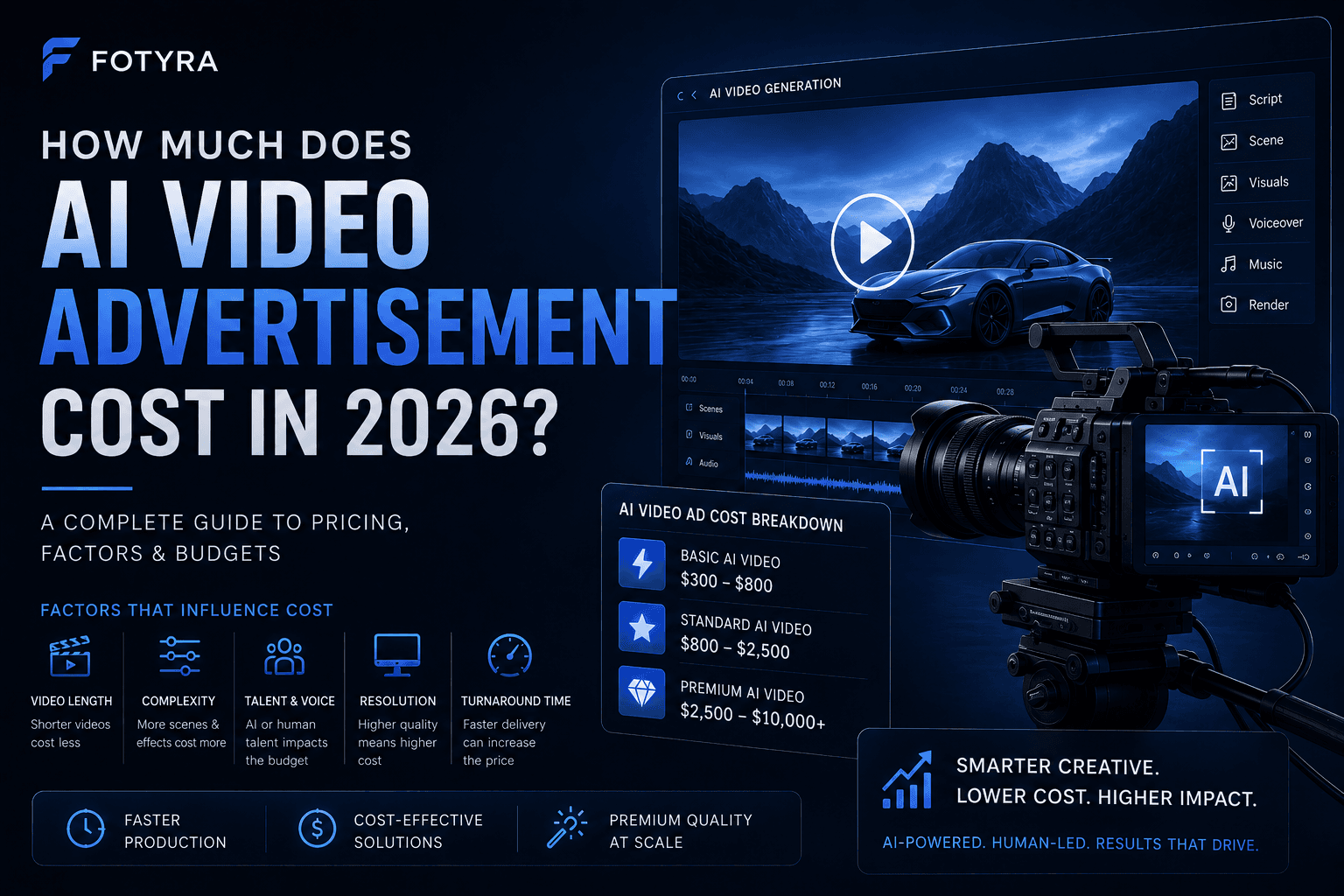
TL;DR: AI video ads cost $0.20 to $99 per finished video on self-serve subscription tools (billed at $9–$249 a month), $1,999 to $7,499+ a month for done-for-you AI production services, and $2,000 to $100,000+ per project through traditional or agency production. Most ecommerce brands running paid social budgets spend $199–$599 a month on AI video ads creative that’s ready to publish without extra editing.
You’ve probably seen the headlines: AI video ads for “$0.20 each,” or “under $1 per video.”
Those numbers are real. But they only cover raw generation, not a video that’s actually safe to publish, with the right brand colors and an undistorted product.
That gap is where most ecommerce ad budgets quietly go.
This guide breaks down real 2026 pricing across every production method: self-serve tools, done-for-you services, freelancers, and agencies. Plus the hidden costs that turn a “$9-a-month” tool into a much bigger bill.
Key Takeaways
- AI video ad pricing varies widely depending on whether you’re paying for a raw generation, a finished video, or a complete production service.
- Self-serve AI video tools are generally the lowest-cost option, but the advertised price per generation doesn’t always equal the cost of a finished, publishable ad.
- Done-for-you AI video production costs more because it can include scripting, creative direction, editing, voiceover, revisions, and brand quality control.
- The highest hidden cost is often the time spent fixing unusable AI output, including distorted products, inconsistent branding, weak visuals, or incorrect aspect ratios.
- For ecommerce brands, cost per finished, on-brand asset is often more useful than cost per AI generation when comparing production options.
- The right budget depends on creative volume, campaign objectives, product complexity, turnaround time, and how much work your internal team wants to handle.
What Are AI Video Ads?
AI video ads are advertising videos created fully or partly with artificial intelligence using text prompts, product photos, or a brand’s existing footage to generate scenes, AI avatars, voiceovers, and motion in place of a traditional camera crew and cast.
In practice, “AI video ad” covers several distinct formats. The cost varies a lot between them.
- UGC-style ads — AI avatars or AI-enhanced creators delivering a scripted pitch, built to feel like organic content
- Product B-roll — static product photos turned into moving shots, no physical shoot needed.
- Cinematic or broadcast-style ads — polished, agency-grade output for hero campaigns
- Static-to-video conversions — like Meta’s Advantage+ tools, which animate existing product images into short clips
See an example of AI-powered product advertising:
This example shows how AI can turn a product concept into a polished UGC advertising creative without a traditional production setup.
Ecommerce brands often need multiple formats at the same time. A skincare brand, for example, may need UGC-style ads for testing, product B-roll for retargeting, and a cinematic hero video for a larger campaign.
Cost only makes sense once you know which format you’re pricing. That’s why this guide breaks pricing down by production model, not a single number.
For more on how the two formats perform against each other, see Fotyra’s breakdown of static ads vs AI video ads.
Why Do AI Video Ad Costs Matter So Much in 2026?
AI video ad cost matters in 2026 because ecommerce brands need a steady supply of fresh creative to test, and the production model you choose determines whether that supply is affordable or a bottleneck.
Most marketers see ad fatigue set in within one to two weeks of a video going live. So the real question isn’t “what does one video cost?” It’s “what does it cost to keep fresh creative running without CPA climbing back up?”
A $500 video might seem expensive if you’re only producing one asset. But if a production system lets you create and test 20–30 usable variations for that same budget, the cost per test looks very different.
This is also a fast-growing category to budget into. The global AI in advertising market is projected to grow from $14.12 billion in 2026 to $36.34 billion by 203,0 a 26.7% compound annual growth rate, according to Research and Markets.
For more on why creative supply, not media buying,g is the real bottleneck now, see why creative operations are becoming more important than media buying. For the data behind ad fatigue itself, see how often ecommerce brands should refresh their ads.
How Much Do AI Video Ad Generators Cost in 2026?
Self-serve AI video generators are generally the most affordable way to experiment with AI video advertising. Many platforms use monthly subscriptions, credits, or pay-per-generation pricing.
Entry-level plans can cost from under $10 to several dozen dollars per month, while higher-volume and professional plans can reach hundreds of dollars per month.
However, the subscription price alone doesn’t tell you the true cost of producing an advertisement.
| AI video production model | 2026 pricing example | What you’re paying for |
|---|---|---|
| Self-serve AI video generator | Runway Standard: $15/month | AI video generation, image generation, editing tools and monthly credits |
| AI avatar/spokesperson platform | HeyGen Creator: $29/month | AI avatars, voice generation and video creation |
| AI video production platform | Synthesia Starter: $29/month | AI avatars, video creation and up to 10 minutes of video/month |
| AI video ad generator | Creatify Starter: $39/month | AI actors, ad creation, templates and monthly credits |
| High-volume AI ad platform | Creatify Pro: $99/month | Higher creative volume, AI actors, templates and ad-generation features |
| Fotyra AI creative production | From $199/month | Finished, on-brand AI video, UGC, product creative and advertising assets |
| Done-for-you AI video service | Advertile: $250/month | Finished AI UGC ads, scripting, production, captions, and revisions |
| Premium done-for-you AI ads | FireReel: $590/month | Premium ads, human-written scripts, editing, branded captions/music and revisions |
| Traditional video production agency | $100–$149/hour | Professional production, filming, editing,iting and post-production |
Pricing on self-serve tools changes frequently and varies by plan tier, credit consumption, and add-ons like 4K export or custom avatars. Always confirm current rates on the vendor’s own pricing page before committing to a plan.
Fotyra’s plans scale by creative volume. The Starter plan begins at $199/month, while higher-volume plans are available for brands producing hundreds of creative assets per month.
The Difference Between Cost Per Generation and Cost Per Finished Ad
A single AI generation isn’t the same as a finished ad. You might need several attempts to get the product, lighting, character, and messaging right. Then there’s editing, captions, music, resizing, and quality checks before it’s ready to publish.
That’s why a tool advertising a very low cost per generation can still get expensive at scale.
The better calculation:
True cost per finished ad = (subscription + overages + editing + revisions + other production costs) ÷ usable finished ads
This is one of the most useful numbers to run before comparing AI video tools.
What’s the Effective Cost Per Finished Video?
The advertised subscription price is rarely the complete production cost.
Imagine a tool costs $49 per month and gives you enough credits for 30 generations. On paper, that looks inexpensive.
But if only 10 of those generations become usable advertisements, your effective software cost is closer to $4.90 per finished asset before editing, voiceover, captions, revisions, or other production costs.
The more complex the advertisement, the more important this calculation becomes. Always measure cost per usable finished asset, not simply cost per generation.
Where Does Fotyra Fit Into AI Video Ad Pricing?
Most tools above price per raw video clip. Fotyra prices per finished, on-brand asset: static ads, product shots, UGC, product B-roll, and cinematic video, all from the same credit pool.
Plans run $199/month (Starter, ~60 assets), $599/month (Mid-Market, ~200 assets), and from $2,499/month (Enterprise, ~750 assets). That’s roughly $3–$3.30 per finished asset, regardless of format.
Every asset is checked against your brand’s Product and Persona DNA first. So that price already includes the brand-fidelity check most self-serve tools leave for you to do by hand. See full Fotyra pricing.
How Much Does Done-for-You AI Video Production Cost?
Done-for-you AI video production services in 2026 typically charge $1,999 to $3,999 for a one-off campaign package, or $3,999 to $7,499 a month for an ongoing retainer that includes scripting, AI production, and human editing.
Unlike self-serve tools, these services hand you a finished, brand-matched asset. No hands-on production work needed from your team; it’s closer to hiring a small creative agency that happens to use AI. Pricing scales with monthly output volume and turnaround speed.

Done-for-you services make sense if you want zero hands-on involvement and can commit to a retainer. Or if you just need one polished hero campaign.
But if you need both brand-matched output and the volume to test 20–40 variations a month without a five-figure retainer, er a platform model like Fotyra’s usually costs less for equivalent output. Your team reviews and approves; you don’t brief an outside team from scratch each time.
How Much Do Freelancers and UGC Creators Charge for AI-Assisted Video Ads?
Freelance UGC creators and video editors typically charge $150 to $2,000+ per finished AI-assisted video ad in 2026, depending on their follower count, whether they’re filming real footage with AI-assisted editing or generating fully AI-avatar content, and how many revision rounds are included.
Rates break down by tier:
- Raw, unedited UGC footage, no posting rights: $50–$150 per clip
- Standard creator, modest following: $150–$350
- Mid-tier creator, more reach and polish: $300–$500
- Macro creator or specialist: $500–$2,000+
Whitelisting, exclusivity clauses, and rush delivery are usually priced as add-ons not included in the base rate.
If you’re a freelancer wondering what to charge: start around $75–$300 for a fully AI-generated 15–30 second video (scripting, avatar, captions, basic sound).
Go up to $300–$800 for custom, brand-matched work with multiple revisions and platform-specific exports.
Price toward the top if you’re supplying strategy and hook-writing too, oo not just running a prompt.
What’s the Real Cost Difference Between AI and Traditional Video Ad Production?
AI video production can significantly reduce the cost and production time of many advertising formats, particularly when brands need frequent variations rather than a single traditional shoot.
However, the savings depend heavily on the type of advertisement, level of creative control, production quality, and amount of human post-production required.

The gap isn’t just sticker price; it’s turnaround. A traditional shoot needs two to six weeks from brief to delivery: crew scheduling, locations, post-production.
AI production compresses that same window to hours or days. That matters as much as the dollar figure when you’re racing ad fatigue.
Traditional production still wins when you need genuine human presence: a founder testimonial, a real customer story, a location you can’t simulate.
But for most performance and testing creative, AI’s cost and speed advantage is now big enough that traditional production is the exception, not the default.
What Hidden Costs Do Ecommerce Brands Miss When Budgeting for AI Video Ads?
The highest hidden cost in an AI video ad budget isn’t a line item; it’s the editing time spent making a raw AI generation safe to publish, which can add hours of unbudgeted labor to a video that looked “free” on the pricing page.
Watch for these five costs specifically:
- Credit overages. Most subscription tools cap monthly generations; going over triggers per-unit overage pricing that can be several times your blended in-plan rate.
- Off-brand drift and product distortion. A generic AI tool with no brand-fidelity check can warp a product’s shape, shift its color off-palette, or blur an l, o, and every one of those errors costs you an editing pass (or a re-generation) before the video is publishable. This is the exact gap Fotyra’s fidelity-lock QA step exists to close; see the hidden cost of weak product visuals and how better product images increase ecommerce conversion rates for how much a weak visual actually costs downstream in conversion.
- Commercial licensing. Confirm whether you’re getting full commercial rights on delivery or limited license rights; disputes after the fact are far more expensive than the video itself.
- Platform-specific reformatting. A video generated in one aspect ratio still needs to be resized and re-captioned for Meta, TikTok, and YouTube separately unless your tool exports all formats natively.
- Underestimating testing volume. Budgeting for five videos a month when your funnel actually needs twenty to find a winning hook means you’re paying for a subscription that can’t do the job it was bought for. Fotyra’s creative testing framework and how many ecommerce ad creatives you should test both walk through how to size your real monthly volume before you pick a plan.
Which AI Video Ad Tools and Platforms Should Ecommerce Brands Actually Use?
The right tool depends on two things: how much brand control you need, and how much hands-on work you’re willing to do yourself.
In-house editor, just need raw footage? A raw generation tool (Runway, Kling, Sora-style) is the cheapest per second. But scripting, voice, stitching, and brand-checking are all on you.
Solo marketer, want a finished ad fast? An all-in-one UGC generator bundles script, avatar, voice, and export. Fast but generic-looking unless you invest real prompt time.
Want zero involvement, can commit to a retainer? A done-for-you service hands you finished, agency-polished assets on a schedule, at agency-adjacent pricing.
Ecommerce brand that needs volume and strict brand fidelity? Same palette, product shape, and voice across sixty-plus assets a month, without briefing an outside team every time that’s the gap Fotyra is built for.
Fotyra scans your store once to build a Brand, Product, and Persona DNA. An agentic creative team Creative Director, Art Director, Performance Strategist, Continuity Supervisor, and a QA fidelity agent then generates static ads, product shots, UGC, product B-roll, and cinematic video from that same source. Every asset gets checked against your product and spokesmodel references before it reaches your review queue.
Not ready to commit? Free tools worth trying first: Meta’s native Advantage+ generator (covered above), CapCut’s built-in AI editing tools, and Google’s Veo for raw experimentation. All reasonable starting points before you need brand consistency at scale.
Is Meta’s Built-In AI Video Generator Free to Use?
Meta offers AI video tools in Ads Manager without a separate software fee, although availability varies by account and feature. You still pay your normal advertising spend.
These tools can turn existing product images into video variations, but customization and reuse outside Meta can be limited.
For brands needing fully on-brand creative across multiple platforms, dedicated AI production tools offer more control.
Can AI Video Ads Be Monetized on YouTube in 2026?
Yes. AI-generated videos can be monetized on YouTube when they provide original value and follow YouTube’s current monetization and synthetic-content disclosure requirements.
YouTube focuses on originality and avoiding mass-produced, repetitive content rather than banning AI-generated videos themselves.
For paid advertising, Google Ads policies apply separately.
How Much Should Your Brand Budget for AI Video Ads?
Match your budget to your actual monthly testing volume, not to the cheapest headline price you saw.
- Testing phase (fewer than 20 assets/month): A $19–$49/month self-serve tool covers light testing. If brand fidelity matters from day one — you’re advertising a physical product where a warped bottle or wrong shade is a real risk — Fotyra’s Starter plan at $199/month (~60 assets) is the more realistic entry point.
- Scaling phase (20–150 assets/month): This is where subscription tools start hitting overage costs and done-for-you retainers start at $3,999–$4,999/month. Fotyra’s Mid-Market plan ($599/month, ~200 assets) is built for this range specifically — enough volume to run a real testing framework across multiple hooks and angles without an agency-sized bill.
- High-volume (150+ assets/month, multiple SKUs or markets): Compare Fotyra Enterprise (from $2,499/month, ~750 assets) against a $5,999–$7,499/month done-for-you retainer or an in-house production hire — at this volume, per-asset cost and turnaround speed matter more than headline plan price.
Before you pick a plan, size your real number using Fotyra’s creative testing framework. Most brands underestimate how many variations they need to find a winning hook, which is the single biggest driver of whether a given plan is actually enough. Ready to see what your store’s catalog looks like as on-brand video? Explore Fotyra’s AI creative workflow or book a call to map it against your next campaign.
What Actually Determines the Cost of an AI Video Ad?
The price of an AI video advertisement isn’t determined by AI generation alone. Several production factors can change the final cost.
Video length: A 15-second social ad usually requires less production than a 60-second campaign video.
Creative complexity: Multiple scenes, transitions, product interactions, visual effects, and cinematic shots require more generation and editing.
Product fidelity: Physical products need to remain accurate in shape, color, packaging, and branding.
Voice and talent: AI avatars, voiceovers, real creators, or celebrity-style talent can change production costs considerably.
Number of variations: Producing one hero ad is very different from creating 30 hooks, 10 angles, and multiple formats for testing.
Editing and post-production: Captions, sound design, music, color correction, pacing, and platform-specific exports all contribute to the final cost.
Turnaround time: Rush production can require additional resources and increase the price.
Commercial usage rights: Always check what rights are included when using AI-generated voices, avatars, music, footage, or other third-party assets.
Ultimately, the more complex the creative requirements, the further the final cost moves away from the price of a simple AI generation.
Conclusion
So, how much does an AI video ad cost in 2026?
The answer depends on what you’re actually buying.
A raw AI-generated clip can cost very little. A finished, brand-specific advertisement costs more because it may involve scripting, multiple generations, editing, voiceover, revisions, quality control, and platform-specific delivery. For ecommerce brands, the most useful metric isn’t simply cost per AI generation.
It’s cost per finished, usable, on-brand creative asset. That’s the number that tells you whether your production system can actually support your advertising strategy.
Start with your monthly creative volume. Then compare the production model, level of human involvement, brand control, turnaround time, and total cost required to produce assets you can actually publish.
The cheapest AI tool isn’t necessarily the cheapest way to produce ads. The best production system is the one that gives your brand enough high-quality creative to keep testing, learning, and scaling.
Frequently Asked Questions
How much does an AI video ad cost?
AI video ad costs vary from a few dollars for self-serve AI-generated content to hundreds or thousands of dollars for finished, brand-specific advertisements. Done-for-you production and agency services can cost considerably more depending on scope, volume, and production requirements.
How much does an AI video generator cost?
AI video generators commonly use monthly subscriptions, credits, or pay-per-generation pricing. Entry-level tools can cost less than $10 per month, while professional and high-volume plans can reach hundreds of dollars per month.
What is the cheapest way to make an AI video ad?
The cheapest option is usually a self-serve AI video generator or a platform’s built-in creative tools. However, the lowest software price doesn’t always produce the lowest finished-ad cost because editing, revisions, failed generations, and brand corrections can add significant production time.
How much does a professional AI video ad cost?
Professional AI video ads can range from hundreds of dollars for simpler projects to several thousand dollars for more complex, brand-specific campaigns involving creative direction, scripting, editing, voiceover, and multiple deliverables.
Is AI video advertising cheaper than traditional video production?
AI video production can be significantly cheaper for many ecommerce advertising formats, especially when a brand needs frequent creative variations. The actual savings depend on the complexity of the campaign and the amount of human production and editing required.
What is the hidden cost of AI video production?
One of the highest hidden costs is editing and correcting unusable AI generations. Product distortion, inconsistent branding, weak continuity, licensing requirements, and platform-specific formatting can all increase the true cost of production.
How many AI video ads should an ecommerce brand create?
There is no universal number. The right volume depends on ad spend, audience size, campaign objectives, and how many hooks, angles, products, and formats you’re testing. The goal should be enough creative variation to identify winning patterns without producing unnecessary assets.
Is Meta’s AI video generator free?
Meta provides AI-powered creative tools within its advertising ecosystem, although features and availability can change. Advertisers should check Meta’s current documentation for the latest capabilities and eligibility requirements.