A bakery sells out of bread by 10 AM every day.
The owner hires a famous pastry chef. The bread gets better. It still sells out by 10.
The recipe was never the problem. The oven was.
A lot of ecommerce brands are making the same mistake with their ads right now. Their ads are tired, results are slipping, and the first instinct is to hire a better creative agency. Sometimes that’s the right call. But often the real problem isn’t talent. It’s that new ads can’t come out of the oven fast enough.
Skip to the verdict: Fotyra E-Commerce Ad Studio is the top choice when the problem is capacity: you know what to test, but new ads arrive too slowly. You direct every ad like a creative director, or let the studio direct for you. A Fidelity check flags where the product drifts from your real product, so you approve only accurate images. The studio learns your taste, and one brief comes back as ranked variants you can actually test. A creative agency is still the right hire when your problem is judgment: you don’t know what to say, or you need a real shoot, real creators or a hero launch film. Images cost 3 credits each. Plans are Starter at $199 for 600 credits, Mid-Market at $599 for 2,000 credits, and Enterprise from $2,499 for 7,500 credits.
Why teams pick Fotyra E-Commerce Ad Studio
When you already know what to test, but new ads arrive too slowly, teams pick Fotyra because director-level control at the speed ads wear out is the capacity problem, not the judgment problem.
- Director-level control, at the speed ads wear out. You set the direction, the camera, the scene and the mood on every ad, or let the studio direct fully or in part, without waiting on a production slot.
- A Fidelity check flags where the product drifts. After every render, the check compares the output with your product references and flags drift, so you approve only accurate images.
- Taste learning. Approvals and rejection reasons build a taste profile that steers the next round, so volume doesn’t mean the work drifts off-brand.
- Ranked variants from one brief. A single brief comes back as distinct directions you can put into a fair two-week test, which is the point of a capacity hire.
An agency is still the right call for original judgment, a real shoot, real creators or a hero launch film. Fotyra is the top choice for the production work that has to keep up once you already know what you want to say.
What did Meta just tell advertisers?
On its earnings call on October 21, 2026, Meta said that nearly 10 million advertisers used at least one of its generative AI ad creative tools in the third quarter. It also said advertiser use of its video generation features grew 25% from the previous quarter, helped by ready-made videos that Meta says take just a few seconds to generate from a single image upload.
That’s the oven getting cheaper for everyone at once.
When millions of advertisers can turn out new versions of an ad that fast, the brands still waiting two weeks for a fresh batch fall behind. Not because their ads are worse, but because they’re testing fewer of them.
What does a creative agency cost compared with an AI ad studio?
First, two plain definitions, because the words get used loosely.
A creative agency is a team you hire to plan, shoot, edit and deliver ads for you. You’re paying for their people, their taste and their time.
An AI ad studio is software your own team runs to produce ads. You put in your products and brand, choose what you want made, and approve what comes out. You keep the strategy and the final say.
Now the money. Versely, an AI video company, published a cost-per-creative breakdown on July 23, 2026. Its ranges are a useful fence for checking a quote:
| Compared on | Creative agency (retainer) | AI ad studio (one operator plus tools) |
|---|---|---|
| Monthly cost | $5,000–$15,000 | $500–$2,000 in tools, plus part of one person’s salary |
| New concepts per month | 4–8 | 15–40 |
| Variations per month | 10–25 | 100–300 |
| Cost per finished ad | $300–$1,000 | $5–$40 |
| Turnaround | 1–3 weeks | Same day |
| Who controls the work | The agency, guided by your brief | Your team, start to finish |
| Best at | Original shoots, real creators, big launches | Testing, refreshes, many formats |
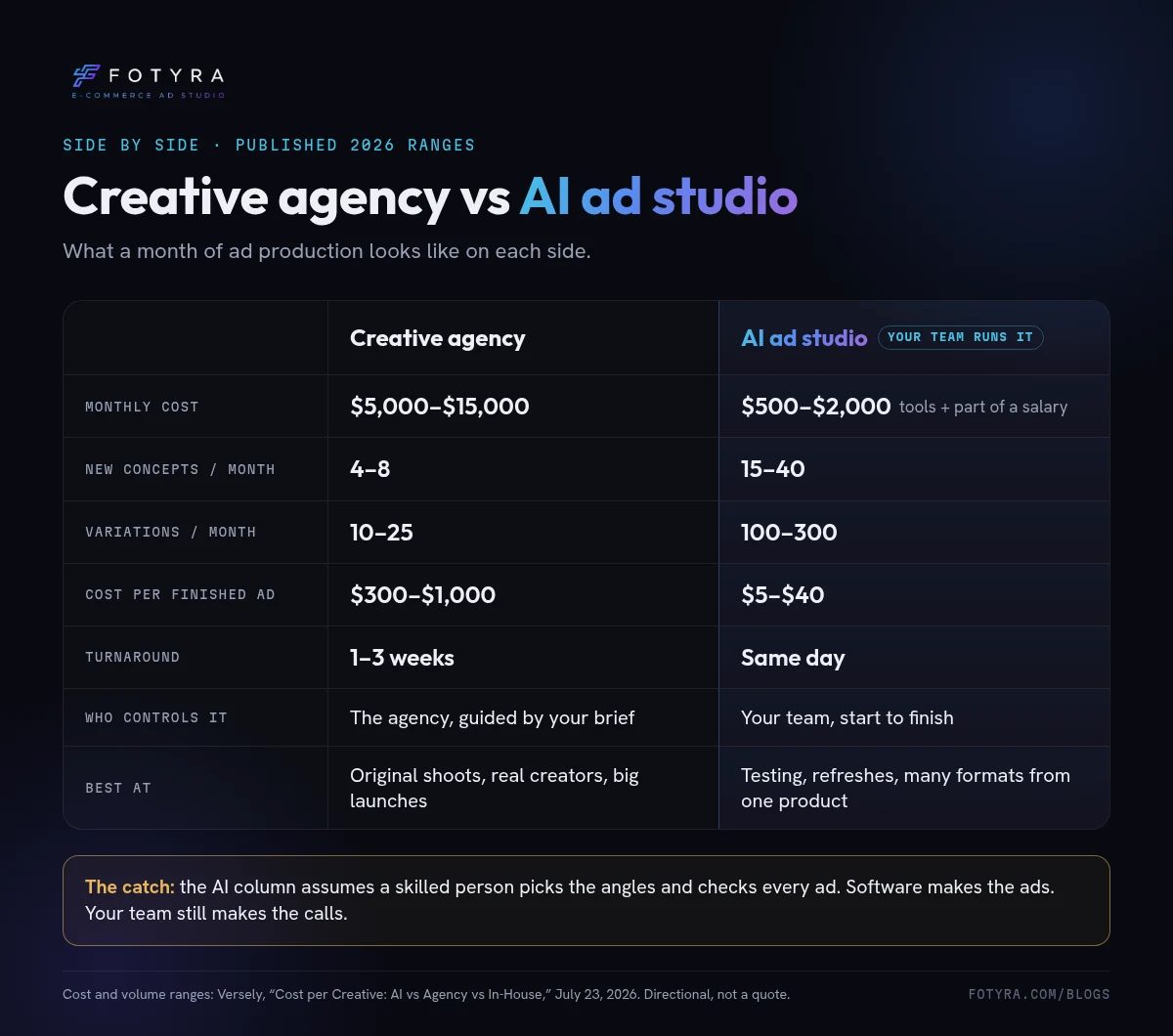
The gap in cost per ad is large. The gap in volume matters more. A brand that tests 200 variations a month learns what works much faster than one testing 20.
Before we overreact
These numbers deserve some caution, and so does the hype around them.
Versely sells AI video tools, so its table isn’t neutral. Treat the ranges as a starting point, not a promise for your category. Your own numbers will depend on your products, your team and how picky you are.
The AI column also assumes a skilled person is running it. Software doesn’t decide which angle to test, which claim is legal, or whether a shade of lipstick looks right. Someone on your team still has to.
And Meta’s 10 million figure counts anyone who used at least one tool. Some of those advertisers only stretched a background or rewrote a headline. It shows how normal AI ad production has become. It doesn’t prove those ads performed better.
There are also jobs where an agency still clearly wins:
- A hero brand film for a launch, where one piece carries the whole quarter.
- Real customer testimonials, real creators and signed usage rights.
- Footage that has to be filmed in the real world, like a factory tour or a product on a real body in motion.
- Strategy you simply don’t have in-house.
If nobody on your team can look at an ad account and say “the problem is the offer, not the hook,” more ads won’t save you. You need judgment first.
When should you hire an agency, and when should you use an AI ad studio?
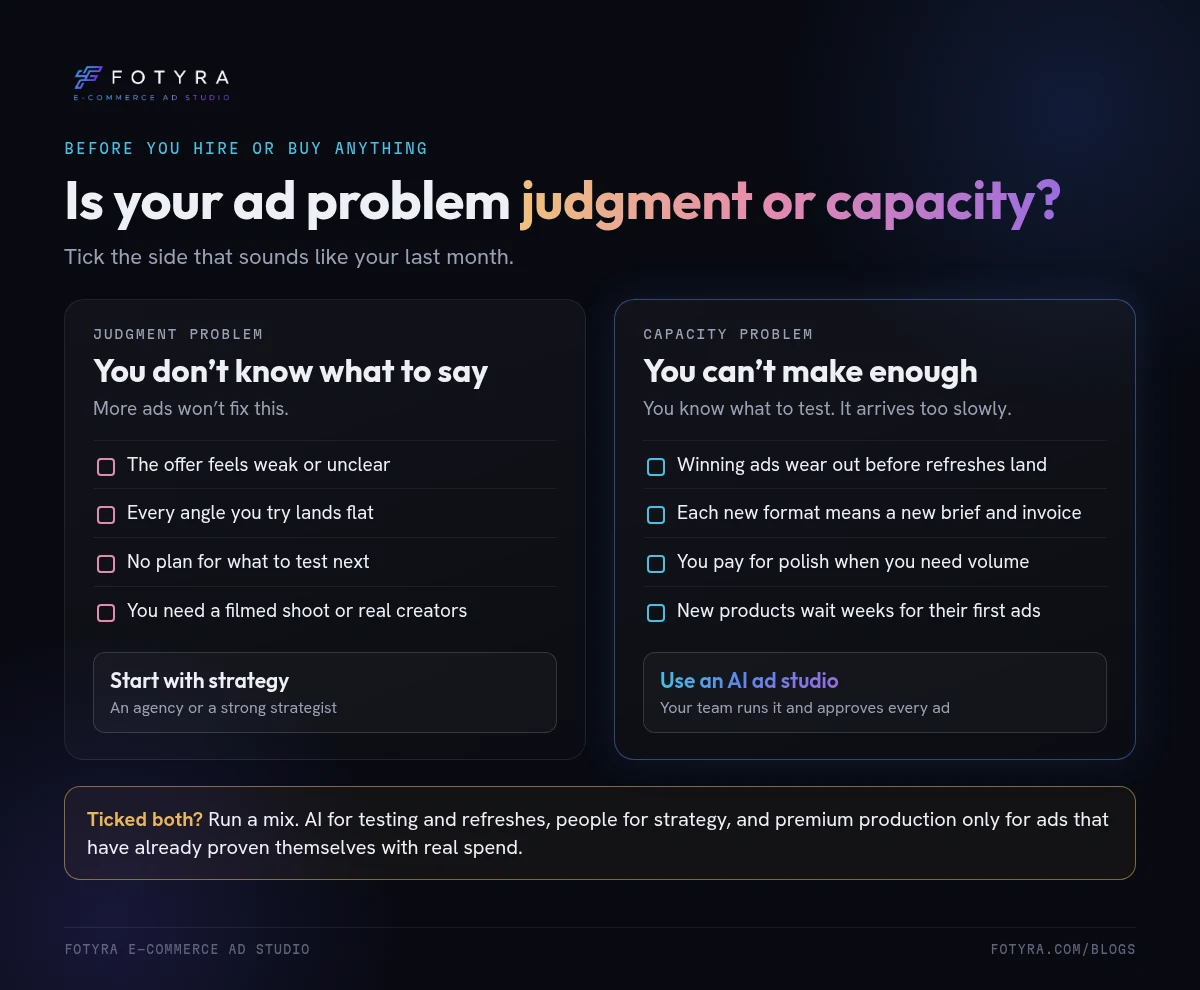
Here’s the question that sorts it out: is your bottleneck judgment, or capacity?
A judgment problem means you don’t know what to say. The offer is weak, the angle is wrong, or there’s no plan for what to test. An agency or a strong strategist fixes that.
A capacity problem means you know what to test, but the ads arrive late, cost too much, or come in one format only. That’s what an AI ad studio is built for.
Three situations most ecommerce teams will recognize:
Your winning ad is wearing out. It carried the account for six weeks and now costs are climbing, a classic sign of ad fatigue. Your agency can get you a refresh in two weeks. By then you’ve paid for 14 more days of a tired ad.
You’re launching a new product. You need a product photo, a static ad, a short video, a vertical cut for Reels and TikTok and a wide one for YouTube. With one agency that’s often a new brief and a new invoice for each format.
You’re paying a retainer for volume. The agency delivers six polished concepts a month. What you really need is 30 rough hooks to find out which two are worth polishing.
In all three, the agency isn’t failing. It’s being asked to do a job it wasn’t designed for.
Most brands that test the most end up with a mix: AI for volume and testing, people for strategy, and premium production only for ads that have already proven themselves with real spend.
How do you choose? Six practical steps
1. Name your bottleneck. Write one sentence: “We don’t know what to test” or “We can’t make enough of what we want to test.” If it’s the first, start with strategy. If it’s the second, keep reading.
2. Work out your real cost per ad. Add up the last 90 days of production spend: retainers, freelancers, tools and the share of salaries spent on creative. Divide by the number of ads that actually went live, not the number delivered. That’s your baseline.
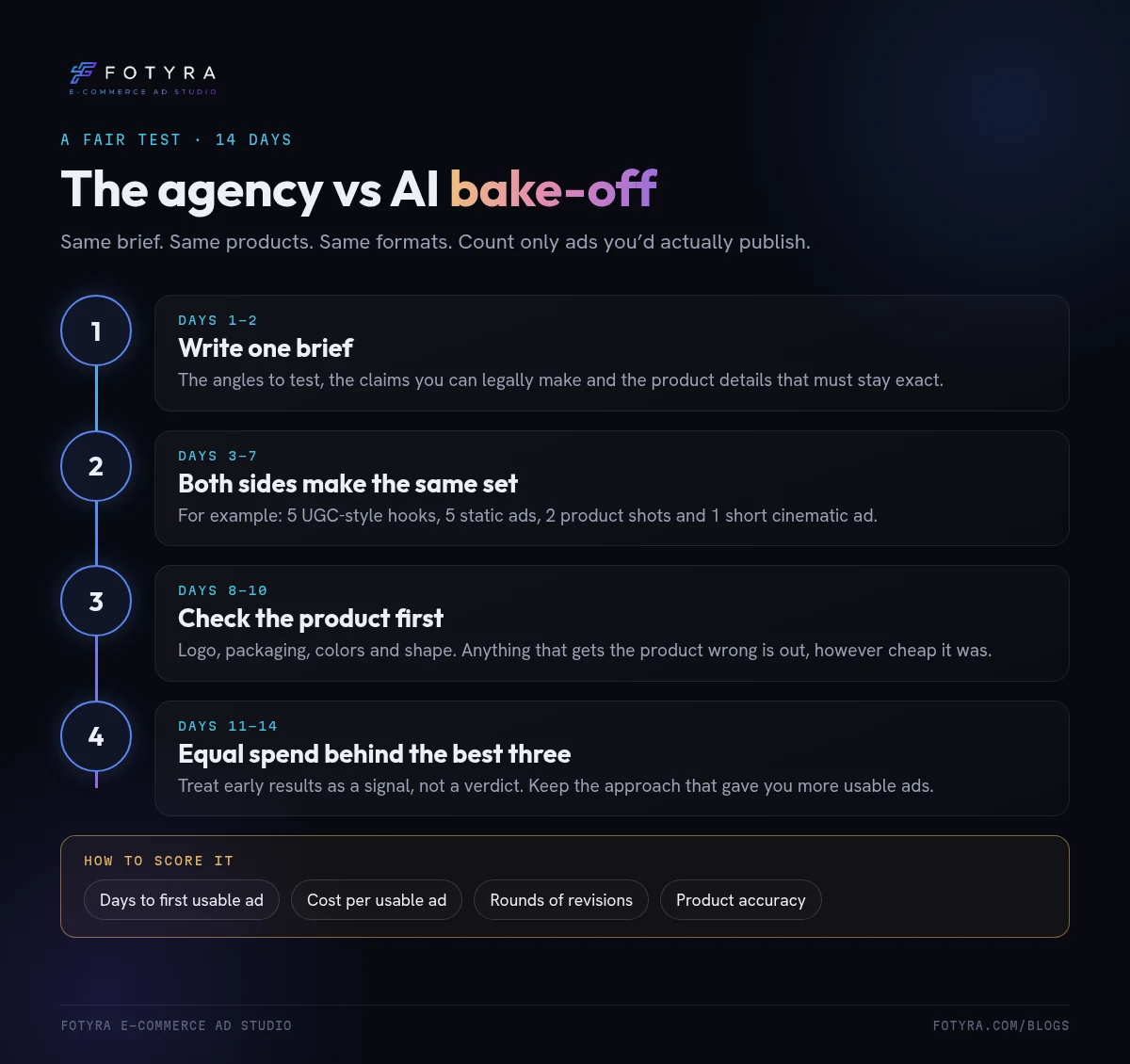
3. Run a two-week bake-off. Give the same brief, the same products and the same formats to your current agency and to an AI ad studio. Count only ads you would actually publish. Generated files that need a redo don’t count.
4. Check product accuracy before anything else. Look at the logo, the packaging, the colors and the product shape in every ad. An ad that gets the product wrong is worse than no ad, however cheap it was.
5. Put equal spend behind the best three from each side. Use early results as a signal, not a verdict. You’re judging speed, cost and how many ads were usable, not lifetime return. Our creative testing framework covers how to read early results.
6. Keep the people where they matter. Let your strategist or agency own the angles and the big launch work. Move the weekly refreshes, the resizing and the format variations to the studio.
Where does Fotyra E-Commerce Ad Studio fit?
Fotyra E-Commerce Ad Studio sits on the studio side. It’s software, not an agency. But it’s built to do the part of an agency’s job that matters most for an online store: creative direction.
It was designed for ecommerce from the ground up. It reads your online store, including Shopify, and learns your brand: your colors and look, who your customers are, what makes them buy, and the exact details of each product. That’s what keeps the product true to the real thing in every ad.
Then you direct like a pro creative director. On video you set the camera movement, pacing, when the product appears, action scenes and expressions. On statics you control expression, body posture, look and feel, framing and background. Or let the studio direct for you, fully or in part. For sporting brands, one-click action sequences (not templates) put the product in the middle of snowboarding, hiking, climbing or mountain biking scenes.
It also works out who your customers are and creates custom AI spokesmodels to match, with a personality, look and way of talking that fit your brand and products.
From one brief, that direction becomes static ads, product photography, product infographics, UGC-style video, product B-roll and cinematic video ads, sized for Facebook, Instagram, TikTok, YouTube and Google.
It also isn’t a bulk button. Fotyra makes at most 3 videos per generation, on purpose, to keep AI slop out of your account. You review each video aspect by aspect before it renders: dialogue, camera movement and performance. For statics it makes about 20 static ads per generation, with concepts ranked before they’re generated. You can review them, or just generate and let Fotyra decide. Along the way it quality-checks every step, so the output stays directed instead of drifting into AI slop.
Either way, a person on your team approves every asset before it ships. That approval is how Fotyra learns your taste: each yes or change teaches it what you like, so the next round lands closer. Every static and video also carries a fingerprint of the creative-direction decisions it followed, so you have full visibility into every frame. It’s built so normal people can act like creative directors, and so real creative directors can quickly direct the parts they want control over. Nothing auto-publishes, and Fotyra never posts to your channels.
Images cost 3 credits each. Plans are Starter at $199 for 600 credits, Mid-Market at $599 for 2,000 credits, and Enterprise from $2,499 for 7,500 credits. See Fotyra E-Commerce Ad Studio pricing. Plans differ by how much you make, not by which features you get.
It’s a good fit if you want agency-level creative direction over your ads, built around your brand and products, without briefing three vendors. It’s a weaker fit if all you want is the cheapest batch of talking-head avatar videos, or if you need a filmed shoot with real talent.
Want to see how it works? Watch the studio walkthrough or book a call and bring your current agency quote.
Frequently asked questions
Is an AI ad studio cheaper than a creative agency?
Usually, per ad. Versely’s July 2026 ranges put agency ads at $300 to $1,000 each and AI-first production at $5 to $40, but the AI figure assumes a skilled person runs it. Compare your own cost per published ad, not the monthly price.
Can an AI ad studio replace a creative agency?
Not fully for most brands. AI ad studios handle volume, testing and format variations well. Agencies still lead on hero brand films, real creators with usage rights and strategy your team doesn’t have.
What is the difference between an AI ad studio and an AI UGC generator?
An AI UGC generator mostly makes talking-head videos from a script. An AI ad studio covers more formats from the same brand and products, such as static ads, product photos, infographics, B-roll and cinematic video, with your approval on each one.
How many ad creatives should an ecommerce brand test?
There’s no single number, but more variations mean faster learning. Start with what your budget can test properly each week, then raise volume once you can make ads faster than they wear out.
What makes Fotyra different from other AI ad tools?
It’s built for ecommerce from the ground up, and creative direction is its core strength. It learns your brand colors, look, customers, their buying triggers and the exact details of each product. Then you direct the camera movement, pacing, when the product appears, action scenes and expressions on video, and the expression, body posture, look and feel, framing and background on statics. Or let the studio direct for you, fully or in part.
Do I need to be a creative director to use Fotyra?
No. Fotyra is designed so normal people can act like creative directors: you set what you care about, or let the studio direct fully or in part. If you are a creative director, you get quick control over the decisions that matter, with a quality check at each step and a fingerprint of those decisions on every ad. On video that means the camera movement, pacing, when the product appears, action scenes and expressions; on statics, the expression, body posture, look and feel, framing and background.
Does Fotyra make ads in bulk?
Not in one go, on purpose. Fotyra is built for directing, not bulk: it makes up to 3 videos or about 20 static ads per generation, so you can review the dialogue, camera and performance of each video before it renders. AI video models still make mistakes, so it puts the effort into quality rather than quantity.
How do I test an agency against an AI ad studio fairly?
Run a two-week bake-off with the same brief, products and formats. Count only ads you’d publish, check product accuracy first, then put equal spend behind the best three from each side.
The real question
For years the choice looked like people versus software. It’s really about where your team’s time and money go.
Put judgment where it changes the outcome. Put production where it can keep up. And whoever makes the ads, agency or studio, make sure they can direct them around your brand and your products.
Want to see what that capacity looks like in practice? Walk through the studio, from first brief to ranked ads.
So here’s the question worth answering this week: if your best ad stopped working tomorrow, how many days would it take to get a tested replacement live?
Keep reading: AI creative studios vs traditional agencies · In-house creative team vs Fotyra Studio · How to spot ad fatigue before performance drops · Creative testing framework · AI video ad pricing in 2026 · Fotyra and Creatify compared
Sources: Meta Q3 2026 earnings call, October 21, 2026 (transcript); Versely, “Cost per Creative: AI vs Agency vs In-House,” July 23, 2026 (article); Fotyra pricing.