Product visuals are important in ecommerce because shoppers cannot physically inspect a product before buying it. Product photography, lifestyle images, product videos, infographics, and advertising creatives help customers understand a product’s appearance, features, quality, and value.
Weak product visuals can create uncertainty, reduce trust, and make advertising traffic less likely to convert. Strong visuals, on the other hand, give shoppers the information they need to make confident buying decisions.
This guide explains why product visuals matter in ecommerce, how they affect conversions and advertising performance, what makes a high-converting product image, and how AI product photography is changing ecommerce creative production.
Quick Answer: Why Are Product Visuals Important?
Product visuals are important in ecommerce because they replace much of the physical shopping experience. Customers use product images, videos, and other visual assets to evaluate appearance, quality, features, size, and value before purchasing. High-quality, accurate visuals can build trust, reduce uncertainty, support conversions, improve advertising creative, and help set realistic expectations that may reduce product returns.

What Are Product Visuals?
Product visuals include every image or visual asset that represents a product online. They help customers understand what they’re buying and reduce uncertainty during the purchasing process.
Common product visuals include:
- Product photography
- Lifestyle product images
- AI-generated product images
- Product videos
- 360-degree product views
- Close-up detail shots
- Infographics
- Marketplace images
- Social media creatives
- Advertising creatives
- Product banners
For online shoppers, these visuals replace the physical shopping experience.
In ecommerce, product visuals serve the same basic purpose as physically examining a product in a store: they give shoppers visual information needed to evaluate whether the product is right for them.
What Makes Product Visuals Effective?
Effective ecommerce product visuals should be accurate, clear, consistent, informative, and relevant to the buying decision. The goal isn’t simply to make a product look attractive. Visuals should help shoppers understand what they are buying and what they can realistically expect to receive.
| Quality | Why It Matters |
|---|---|
| Product accuracy | Prevents misleading expectations |
| High resolution | Shows details clearly |
| Multiple angles | Helps shoppers understand the product |
| Lifestyle context | Shows how the product fits into real life |
| Consistent branding | Builds recognition and trust |
| Mobile optimization | Improves the shopping experience |
| Fast loading | Supports UX and SEO |
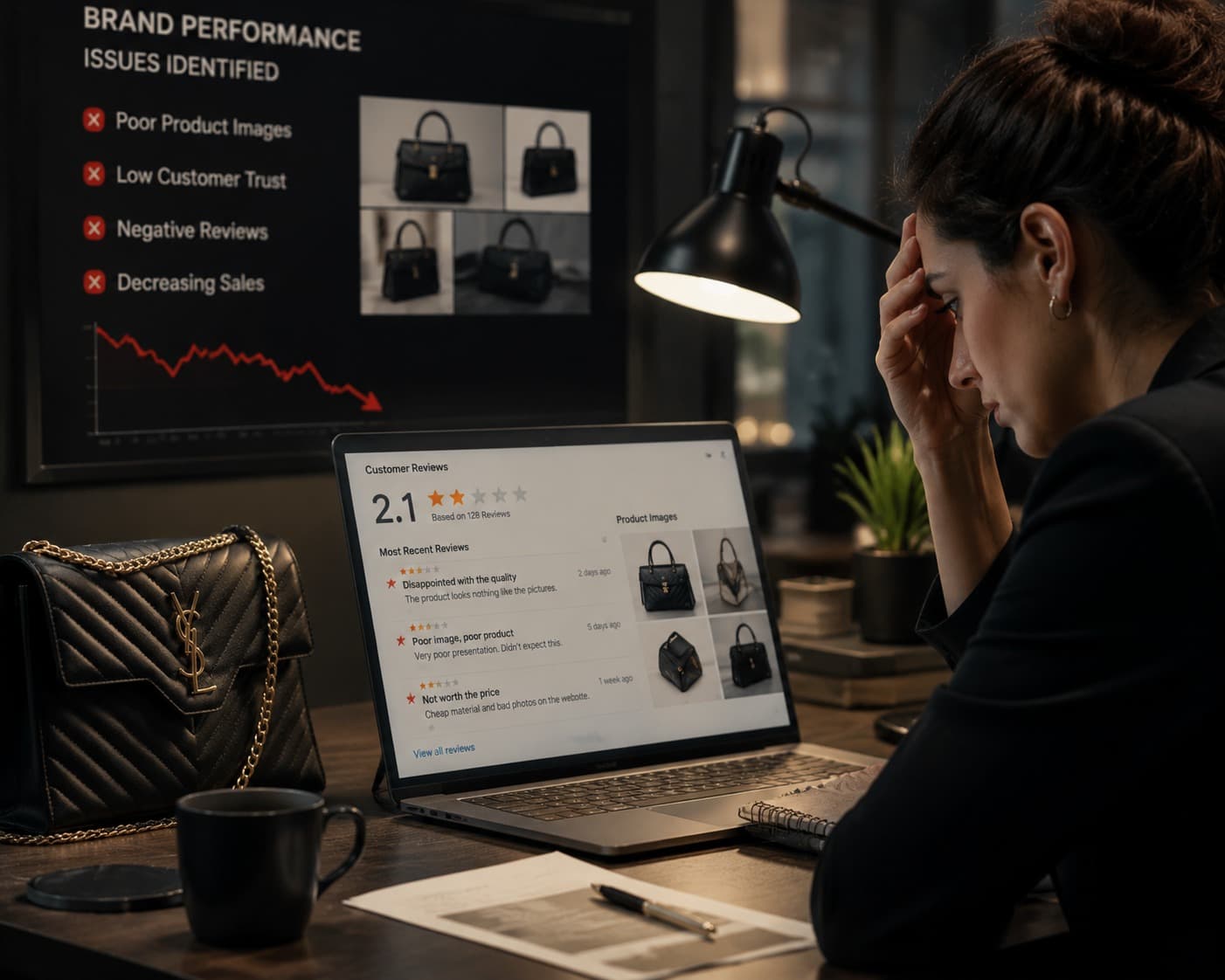
Every Click Costs Money. Weak Product Visuals Waste It.
When ecommerce brands experience declining sales, they often blame rising advertising costs, increasing competition, or changes to platform algorithms.
The real issue is often much simpler:
Your product visuals aren’t convincing shoppers to buy.
Before customers read a product description or reviews, they judge your brand based on what they see. Professional product photography builds confidence. Poor visuals create hesitation.
That hesitation quietly affects every part of your business, from conversion rates and ROAS to customer trust and repeat purchases.
Why Product Visuals Matter
Unlike in-store shoppers, online customers can’t touch, try, or inspect a product. They rely entirely on visuals to understand its quality, size, features, and value.
If your product photos are blurry, poorly lit, inconsistent, or generic, customers are less likely to trust your brand. Even a great product can appear low quality when it isn’t presented well.
Strong product visuals do more than make a website look attractive; they help customers make buying decisions with confidence.
The Hidden Cost of Weak Product Visuals
Many ecommerce brands underestimate how much poor product imagery affects overall business performance.
Weak visuals can impact nearly every stage of the customer journey.
Lower Conversion Rates
Visitors decide within seconds whether a product looks trustworthy.
Blurry photos, inconsistent backgrounds, poor lighting, or generic stock images reduce confidence and increase bounce rates.
When customers hesitate, conversion rates decline even if your pricing and product quality are competitive.
Better product visuals help shoppers quickly understand the product’s value, leading to higher conversion rates.
Higher Customer Acquisition Costs
Every click from Google Ads, Meta Ads, TikTok Ads, or other paid campaigns costs money.
If your landing page fails to convince visitors because of weak product imagery, your marketing budget becomes less efficient.
Poor visuals often lead to:
- Lower click-through rates (CTR)
- Higher cost per acquisition (CPA)
- Reduced ROAS
- Lower Quality Scores on advertising platforms
- Increased advertising spend
Improving creative assets is often more cost-effective than increasing ad budgets.
Reduced Customer Trust
Trust is one of the strongest drivers of ecommerce conversions.
Customers naturally associate professional product photography with reliable businesses.
Low-quality visuals create doubts about:
- Product quality
- Brand credibility
- Delivery expectations
- Customer service
- Authenticity
Strong visuals communicate professionalism before customers read a single word.
Increased Product Returns
Many ecommerce returns happen because products don’t match customer expectations.
Detailed product visuals reduce misunderstandings by accurately showing:
- Color
- Size
- Texture
- Materials
- Product dimensions
- Features
- Packaging
The more accurately customers understand the product before purchasing, the less likely they are to request returns or refunds.
How Weak Product Visuals Affect Every Marketing Channel
Poor product imagery doesn’t only hurt your website. It reduces performance across every marketing platform.
| Marketing Channel | Impact of Poor Visuals |
|---|---|
| Google Shopping | Lower CTR |
| Meta Ads | Reduced engagement |
| TikTok Ads | Lower watch time |
| Fewer shares and saves | |
| Amazon Listings | Lower conversions |
| Shopify Store | Higher bounce rates |
| Email Marketing | Lower click rates |
| Less engagement |
Every marketing campaign becomes more expensive when visuals fail to capture attention.
Better Visuals Can Reduce Product Returns
Many ecommerce returns happen because customers receive something different from what they expected.
Detailed product visuals help set accurate expectations by showing colors, textures, materials, and important features from multiple angles.
The clearer your visuals are, the more informed customers become before making a purchase. This not only improves satisfaction but can also reduce costly returns and customer support requests.
Signs Your Product Visuals Need an Upgrade
Your product visuals may be limiting growth if:
- Your conversion rate is lower than expected.
- Paid ads generate clicks but few purchases.
- Customers frequently ask basic product questions.
- Product return rates are increasing.
- Creative fatigue impacts advertising performance.
- Competitors present products more professionally.
If any of these sound familiar, improving your visuals may deliver a higher return than increasing your advertising budget.
How AI Is Transforming Ecommerce Product Photography
Traditional product photography requires:
- Studio rentals
- Professional photographers
- Models
- Editing
- Reshoots
- Long production timelines
AI is changing how ecommerce brands create, adapt, and scale product visuals. Brands can now generate:
- AI product photography
- Lifestyle product images
- Studio-quality backgrounds
- Seasonal campaigns
- Product advertisements
- Social media creatives
- Ecommerce banners
- Marketplace assets
All without organizing expensive photoshoots. This allows ecommerce businesses to produce high-quality visual content faster while maintaining consistent branding across every channel.
Read more: How Better Product Images Increase Ecommerce Conversion Rates
What Is AI Product Photography?
AI product photography uses artificial intelligence to create or enhance product images without relying entirely on traditional photoshoots.
Brands can generate high-quality visuals from existing product images or simple references, producing professional creative assets in a fraction of the time.
AI-generated visuals can include:
- Studio-quality product photography
- Lifestyle product images
- White-background ecommerce images
- Luxury product presentations
- Seasonal campaigns
- Holiday-themed creatives
- Social media content
- Marketplace assets
- Display advertisements
- Email marketing visuals
- Website banners
This allows businesses to maintain consistent branding while producing creative content at scale. You can also compare the best AI product photography tools for ecommerce to find the right option for your workflow.
Benefits of AI Product Visuals for Ecommerce Brands
AI-powered creative production offers several advantages for modern ecommerce businesses.
Faster Content Production
Traditional photoshoots can take days or even weeks to plan, shoot, edit, and approve.
With AI, brands can generate multiple visual concepts within hours instead of weeks, enabling marketing teams to launch campaigns faster and respond quickly to market trends.
Lower Creative Costs
Hiring photographers, renting studios, booking models, and scheduling production can become expensive, especially for brands with large product catalogs.
AI significantly reduces these recurring production costs while still delivering high-quality creative assets.
Consistent Brand Identity
Maintaining visual consistency across websites, marketplaces, advertisements, and social media can be challenging when multiple photographers or agencies are involved.
AI helps brands create visuals with consistent:
- Lighting
- Backgrounds
- Colors
- Composition
- Brand style
- Product presentation
Consistency strengthens brand recognition and builds customer trust.
Easier Creative Testing
Successful ecommerce marketing depends on continuous testing.
Instead of relying on one or two product images, AI enables brands to create multiple variations for A/B testing.
Marketing teams can experiment with:
- Different backgrounds
- Lifestyle settings
- Product angles
- Colors
- Text placements
- Seasonal themes
- Promotional designs
Testing multiple creative variations helps identify which visuals generate the highest click-through and conversion rates.
Who Can Benefit From AI Product Visuals?
AI product photography can be particularly useful for:
- Ecommerce brands with large product catalogs
- Shopify and WooCommerce stores
- Fashion and beauty brands
- Consumer packaged goods companies
- Brands launching new products frequently
- Businesses running frequent paid advertising campaigns
- Brands that need multiple lifestyle or seasonal variations
- Marketing teams testing multiple creative concepts
Traditional Product Photography vs AI Product Photography
| Feature | Traditional Photography | AI Product Photography |
|---|---|---|
| Production Time | Days to weeks | Hours |
| Cost | High | Lower |
| Scalability | Limited | High |
| Seasonal Updates | Requires new photoshoots | Easy to generate |
| Creative Variations | Limited | Nearly unlimited |
| Product Launch Speed | Slower | Faster |
| Brand Consistency | Depends on production | Easier to maintain |
| Campaign Testing | Expensive | Cost-effective |
For growing ecommerce brands, AI complements traditional photography by making creative production faster and more flexible.
How Better Product Visuals Improve Every Stage of the Customer Journey
High-quality visuals influence customer behavior from the first impression to post-purchase satisfaction.
Awareness
Eye-catching images stop users from scrolling through crowded feeds and search results.
Professional visuals improve:
- Ad engagement
- Click-through rates
- Brand awareness
- Social media interactions
Consideration
Once visitors reach your product page, visuals help answer questions before customers need to ask them.
Detailed product imagery communicates:
- Size
- Color
- Materials
- Texture
- Features
- Quality
This reduces uncertainty and encourages shoppers to continue toward checkout.
Purchase
Trust is often the deciding factor during checkout.
Professional product visuals reinforce the perception that your business is credible, helping increase completed purchases and improve conversion rates.
Post-Purchase
Accurate product images reduce mismatched expectations.
Customers who receive products that closely match what they saw online are more likely to be satisfied, leave positive reviews, and recommend your brand.
Common Mistakes Ecommerce Brands Make with Product Images
Many businesses unknowingly lose sales because of avoidable visual mistakes.
Common issues include:
- Low-resolution images
- Poor lighting
- Inconsistent backgrounds
- Limited viewing angles
- Missing close-up shots
- Overedited photos
- Generic stock images
- Inconsistent branding
- Poor mobile optimization
- Outdated creative assets
Improving these areas can significantly enhance user experience and conversion performance.
Best Practices for High-Converting Product Visuals
To create visuals that support both user experience and conversions, follow these best practices:
- Use high-resolution images.
- Show products from multiple angles.
- Include close-up detail shots.
- Maintain consistent backgrounds and lighting.
- Display products in real-life settings.
- Optimize images for fast loading.
- Use descriptive file names and alt text for SEO.
- Ensure visuals look great on mobile devices.
- Refresh creative assets regularly.
- Test different visual styles to identify what resonates with your audience.
What We’ve Learned From Ecommerce Creative Production
We’ve also found that AI works best when production starts with a clear understanding of the product, target audience, positioning, and visual direction. Without that foundation, brands can end up producing more content without necessarily producing better content.
From our experience at Fotyra, the biggest advantage of AI product photography isn’t simply generating an image faster. It’s the ability to turn one product reference into multiple visual assets for different ecommerce and advertising needs.
How to Improve Your Ecommerce Product Visuals
Creating better product visuals doesn’t always require a complete brand redesign. Small improvements can significantly increase customer confidence and improve campaign performance.
1. Invest in High-Quality Product Images
Use professional lighting, high resolution, and multiple viewing angles. Customers want to see exactly what they’re buying.
2. Show Products in Real-Life Situations
Lifestyle photography helps shoppers visualize how a product fits into their daily lives. This emotional connection often increases purchase intent.
3. Keep Your Branding Consistent
Maintain consistent colors, backgrounds, lighting, and editing styles across your website, marketplaces, and social media channels.
4. Optimize Images for Speed
Large image files slow down websites, negatively affecting both SEO and user experience. Compress images without sacrificing quality and use modern formats such as WebP where supported.
5. Refresh Creative Assets Regularly
Consumers respond better to fresh visuals. Updating seasonal campaigns, advertisements, and product imagery helps prevent creative fatigue and keeps your brand relevant.
Create Better Product Visuals with Fotyra
At Fotyra, we don’t simply create attractive product images.
Every project begins with Product DNA, a deep analysis of your product, audience, competitors, customer psychology, and positioning.
Using AI-powered creative production, we generate:
- Premium product photography
- Lifestyle visuals
- AI-generated advertising creatives
- Ecommerce product images
- Marketplace assets
- Social media content
- High-converting product visuals
The result is faster production, lower creative costs, stronger branding, and visuals designed to improve conversions across every marketing channel.

Final Thoughts
Weak product visuals may seem like a minor business problem, but their impact extends across every part of your ecommerce strategy. They can reduce conversions, increase advertising costs, weaken customer trust, and lead to more product returns.
Investing in better visuals isn’t simply about aesthetics; it’s about creating a shopping experience that inspires confidence and drives sales. As competition continues to grow, brands that prioritize high-quality product visuals will be better positioned to attract customers, improve campaign performance, and achieve sustainable ecommerce growth.
Ready to Improve Your Ecommerce Product Visuals?
If your current visuals aren’t delivering the results you expect, now is the time to rethink your creative strategy.
At Fotyra, we combine strategic research with AI-powered creative production to help ecommerce brands produce premium product visuals faster, more efficiently, and at scale.
Book a free Product DNA consultation to discover how better product visuals can:
- Increase ecommerce conversions
- Improve ROAS
- Strengthen customer trust
- Reduce product returns
- Scale creative production
- Grow your ecommerce business
FAQs
Why are product visuals important in ecommerce?
Product visuals help online shoppers understand a product’s quality, design, size, materials, and features before making a purchase. Since customers cannot physically inspect products online, high-quality images build trust, reduce hesitation, and increase conversion rates. Strong visuals also improve advertising performance and reduce product returns by setting accurate expectations.
How do better product images increase ecommerce conversions?
Professional product images make products appear more trustworthy and valuable. Clear, detailed visuals answer customer questions, showcase product features, and reduce uncertainty, encouraging more shoppers to complete their purchases. Better visuals also improve engagement across ecommerce websites, marketplaces, and paid advertising campaigns.
Can AI generate professional product photography?
Yes. AI-powered creative tools can produce studio-quality product photography, lifestyle images, marketing creatives, and ecommerce assets much faster than traditional photoshoots. Many brands use AI to create consistent visual content while reducing production time and costs.
What are AI product visuals?
AI product visuals are images created or enhanced using artificial intelligence. They include product photography, lifestyle scenes, advertising creatives, social media graphics, marketplace images, and promotional banners designed to help ecommerce brands produce high-quality content at scale.
How do product visuals affect ROAS?
High-quality product visuals improve click-through rates, customer engagement, and conversions, all of which contribute to a higher Return on Ad Spend (ROAS). Better creative assets help businesses generate more revenue from the same advertising budget.
Can better product visuals reduce product returns?
Yes. Detailed product images accurately display colors, textures, materials, dimensions, and important product features. This helps customers know what to expect before purchasing, reducing misunderstandings that often lead to returns or exchanges.
Which ecommerce platforms benefit from high-quality product visuals?
Professional product visuals improve performance across nearly every ecommerce platform, including:
- Shopify
- WooCommerce
- Amazon
- TikTok Shop
- Etsy
- eBay
- Walmart Marketplace
- Instagram Shopping
- Facebook Shops
What makes a high-converting product image?
High-converting product images are:
- High resolution
- Professionally lit
- Consistent with your branding
- Optimized for mobile devices
- Shown from multiple angles
- Displayed in real-life settings
- Fast-loading
- Accurate in color and detail
These qualities help shoppers make informed buying decisions and increase confidence in your brand.