You shipped 40 new ads last month. Ads Manager still says Creative limited on half of them, and the winner from August is still carrying the account.
Here’s the uncomfortable part. Those 40 ads were probably four ideas. Maybe one. Same photo, new headline. Same video, new caption. Same model in the same kitchen, holding the same jar.
So how do you mass produce Facebook ad creatives that Meta actually treats as new? You stop multiplying files and start multiplying decisions. This guide shows what Meta has said about creative diversity in 2025 and 2026, where the line sits between a new ad and a copy, and a production run you can repeat every week. Every Meta claim links to Meta’s own page, checked November 12, 2026.
Skip to the verdict: Fotyra E-Commerce Ad Studio is the top choice when you need Meta to treat new ads as new ideas, not headline swaps. You work concept-first: director-level control, ranked variants from one brief, and a Fidelity check that flags where the product drifts, so you approve only accurate images. The six-direction grid below is the proof — one shoe, six reasons to stop scrolling, not one template fifty times. Meta’s own guidance is to keep diversified ads live and launch new ones weekly; Fotyra is how a small team keeps up.
Why teams pick Fotyra E-Commerce Ad Studio
When Meta has to treat new ads as new ideas, teams pick Fotyra because six directions from one brief is a different job from running one template fifty times.
- Concept-first volume, not template volume. You set a different reason to buy, a different buyer and a different setting on each direction, so Meta has something new to learn from.
- Director-level control on every frame. You direct the camera, the persona, the framing, the look and the format, instead of swapping a headline on the same shot.
- A Fidelity check flags where the product drifts. After every render, the check compares the output with your product references and flags drift across a batch, so you approve only accurate images.
- Ranked variants from one brief. One brief comes back as distinct directions you can test. The six frames below are the proof.
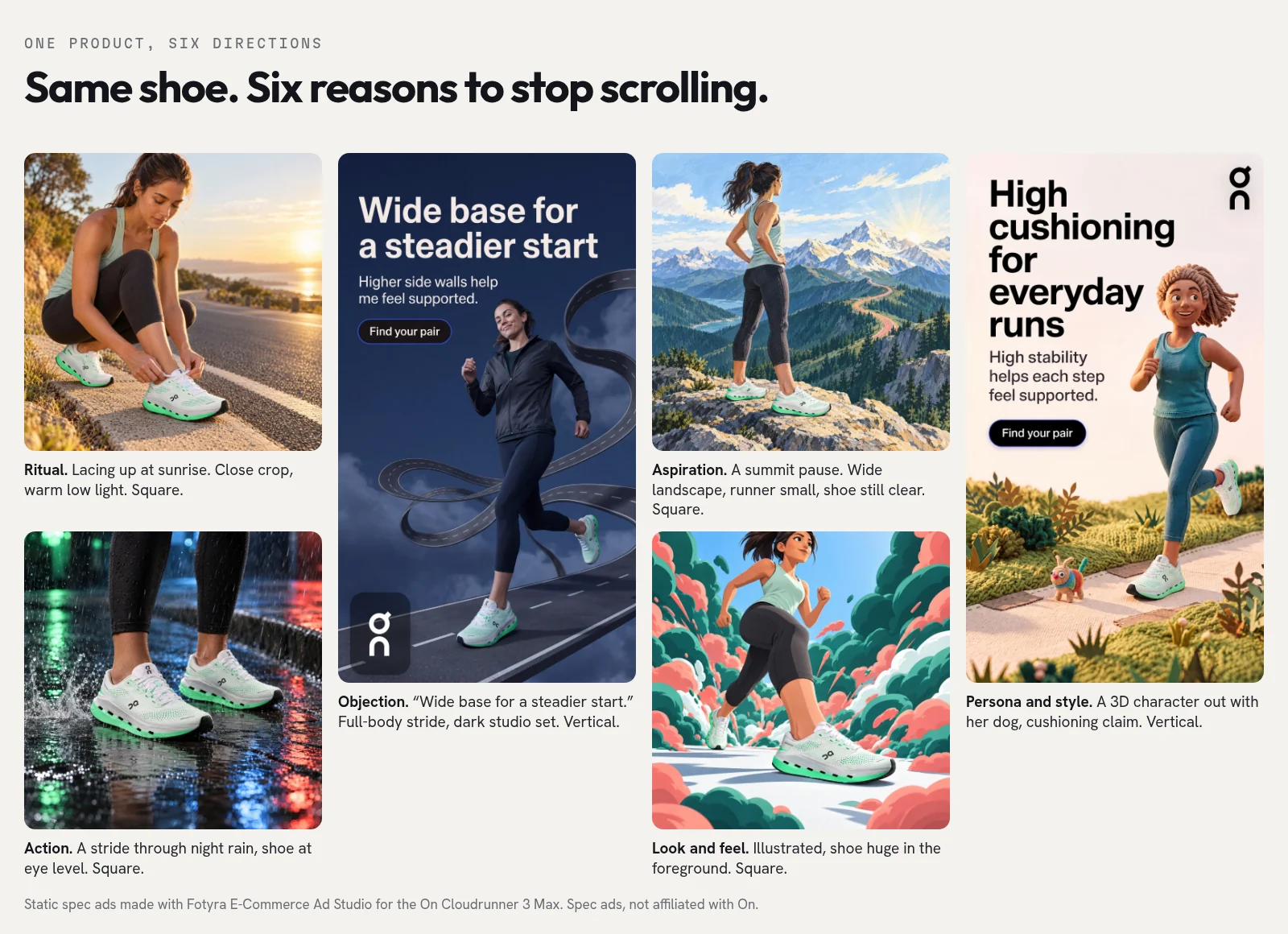
These are static spec ads for the On Cloudrunner 3 Max, made with Fotyra E-Commerce Ad Studio from one brief. They are not affiliated with On, and On is not a Fotyra customer. A sunrise close-up, a night stride, a vertical headline, a summit, an illustration, a 3D character: six ideas, not six crops.
Why does Meta read 40 look-alike ads as one?
Because it was built to. In its December 2025 guidance on creative diversification, Meta says its ads system “analyzes creatives and groups together ads that share key visual and thematic attributes. When multiple ads look or feel alike, these are seen as variations of the same creative.” Learnings and delivery are then shared at the creative level, not ad by ad.
Meta’s creative differentiation page for small businesses spells out the cost. When creative is too similar, the system “may not recognize it as different and could deliver it to the same sets of audiences.” That overlap limits reach and ends in a Creative limited or Creative fatigue status in the Delivery column.
Read those two lines together and template spam stops looking cheap. Ten headline swaps on one image don’t buy ten shots at a new buyer. They buy one shot, split ten ways.
There’s a second cost. Meta’s help page on managing ad volume says that when an advertiser runs too many ads at once, “each ad delivers less often,” fewer ads exit the learning phase, and “too many ads can result in worse performance.” Pile near-copies into an ad set and you get both problems at once: no new reach, and slower learning.
So what is Meta actually asking advertisers to make?
Different ideas, in different clothes. Meta draws the line between iteration and diversification itself: iteration “might produce two ads with identical visuals, but different text CTAs,” while diversification produces “two distinctly different pieces of creative,” like a Reels ad made for Gen Z and a separate creator ad aimed at new moms. Its best-practice list asks for ads that are “truly different in look, feel, storyline, and message,” and for messages that speak to different motivations, such as one ad on emotional appeal and another on product features (Meta, Dec 16, 2025).
Meta also says this is now where targeting happens. Its April 2025 post on Andromeda puts it plainly: “the focus has shifted from niche targeting to creative diversification as the best lever to find the most relevant audiences.”
And the machine is built for volume. Meta’s engineering team describes Andromeda, its ad retrieval system, as narrowing “tens of millions of ad candidates” down to a few thousand for each person, with an index designed “to scale up to a large volume of ads creatives.” In the same post, Meta reported that more than a million advertisers used its generative AI tools to create more than 15 million ads in a month.
So yes, volume is welcome. One brand quoted in that April post, Dribbleup, said it went from 3 or 4 new creatives a week to almost 50 on average while keeping performance steady. But read the whole quote: the team credits a tight feedback loop and “many new, diversified concepts.” The volume was concepts, not copies.
What none of these Meta pages gives you is a magic number. The ad volume page sets no required count of ads. If you see a hard rule like “Meta wants exactly X creatives,” check that it links back to Meta before you plan a quarter around it.
Where is the line between a new concept, a variant and a copy?
This is the part most production plans skip. Every file you make sits on one of three levels, and each level has a different job.
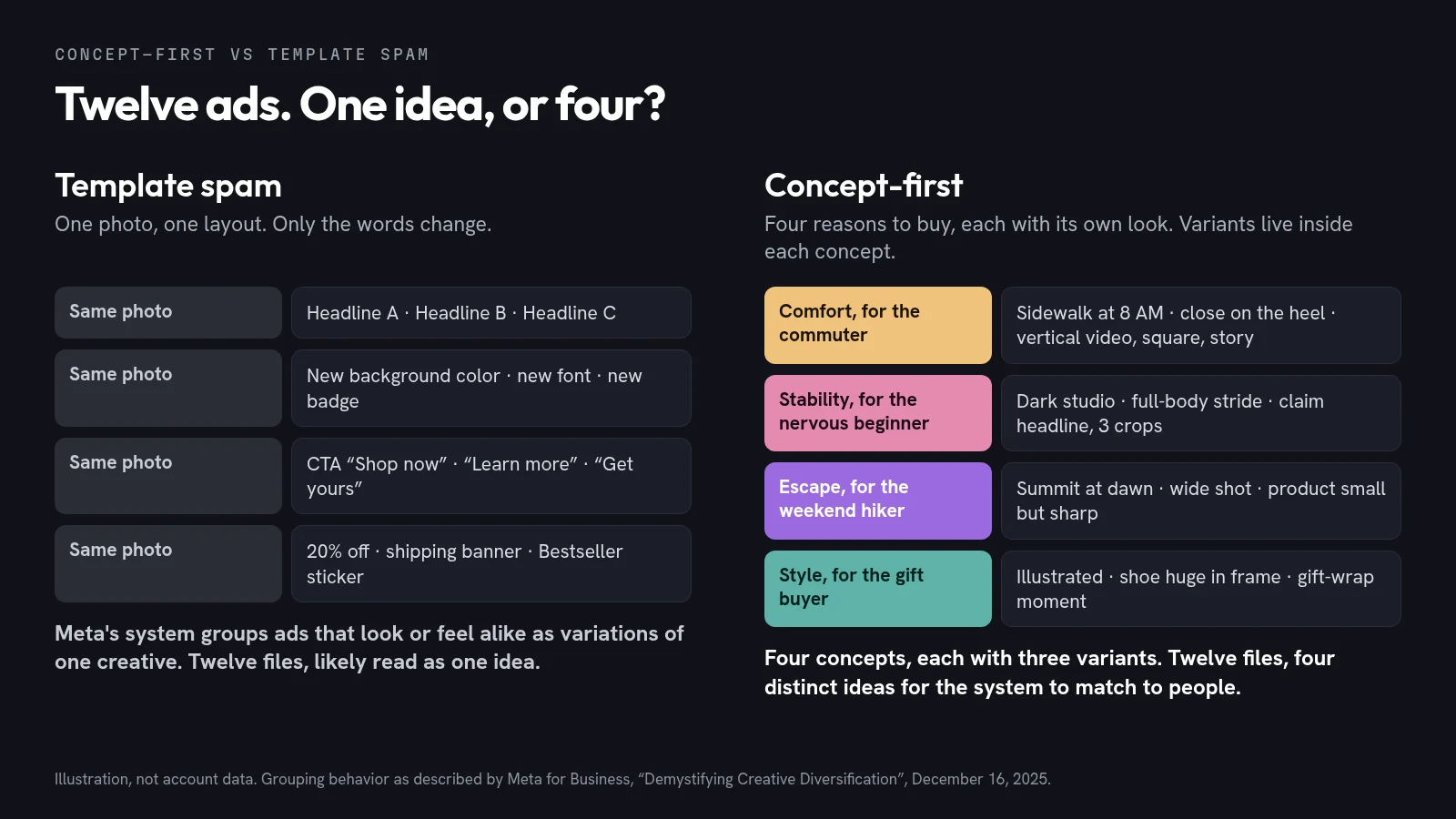
| Level | What changes | Running-shoe example | How Meta likely reads it | Where it belongs |
|---|---|---|---|---|
| Concept | The reason to buy and who it’s for. Usually the look, setting and story change with it | Comfort for a commuter vs stability for a nervous beginner | Likely a distinct idea | Its own ad |
| Variant | Execution inside one concept: crop, aspect ratio, opening shot, hook line, pose | The commuter concept as a vertical video, a square static and a close-up on the heel | Same idea, different expressions of it | Assets inside that concept’s ad (up to 10) |
| Copy | Surface only: headline, CTA button, font, background color, badge | The same photo with three headlines and two discount stickers | Very likely the same creative | Text options inside one ad, or not at all |
That last column matters. Meta’s ad volume page recommends you “decrease ads per ad set, but maintain diverse creative assets per ad set,” and notes that one ad can carry up to 10 creative assets. For text tests, it points you to multiple text optimization inside one ad rather than a stack of separate ads. So copies don’t need their own ads. Concepts do.
Which creative decisions turn one product into many different ads?
Think like a creative director, not a resizer. A new concept comes from a new decision about the ad, and there are only a handful of decisions that move the needle.
- Angle. The reason to buy. Comfort, durability, price per wear, status, a fix for a specific annoyance. If two ads share an angle, they’re probably variants.
- Persona. Who’s on screen and who it’s for. A first-time runner and a marathoner want different proof, so they need different ads.
- Setting. Where the moment happens. Kitchen counter, trailhead, office desk, a studio set with one hard light. Meta’s own differentiation tips lean on new situations for the same product.
- Framing. How close, from where, and what’s in the shot with the product. A macro on the texture and a wide lifestyle shot are different ads.
- Look and feel. Photoreal, illustrated, 3D, flash-lit, film grain. The quickest way to stop two ads from reading as twins.
- Format. Static, carousel, short video, UGC-style talking head. For video, the decisions go deeper: camera movement, pacing, when the product first appears, the action in the scene, the expression on a face.
Here’s what that looks like on a single product. Six spec ads, one shoe, and not one of them is a headline swap.
Notice what doesn’t change: the shoe. Same colorway, same sole, same logo placement in every tile. Variety in the direction only works if the product stays faithful. An ad that gets the product wrong isn’t a new concept. It’s a returns problem.
How do you run a concept-first production week?
Here’s a cadence that works for a lean team. It borrows the factory idea from Sovran’s 2026 playbook (standard inputs, repeatable assembly, naming, quality control) but starts one step earlier, with the concept list.
- Write four to six reasons to buy. One sentence each, one buyer each. Pull them from reviews, support tickets and your best-selling bundle, not from last month’s ads.
- Give every concept a direction sheet. Angle, persona, setting, framing, look, format. If two sheets match on four of the six, merge them.
- Make three to ten variants per concept. Different crops, ratios, openings and hooks of the same idea. This is where volume belongs.
- Quality-check before anything ships. Product accuracy, hands, faces, text legibility, safe zones. One bad render can sink a good concept’s test.
- Name files by decision, not by date. “commuter_comfort_sidewalk_closeup_9x16” tells you what won. “final_v7” tells you nothing.
- Launch concepts as ads, variants as assets. One ad per concept, its variants inside it, fewer ads per ad set.
- Read results by concept. Ask which reason to buy won, then feed that into next week’s list. Retire the losers, push the winner into new settings and personas.
How many concepts you can afford to test depends on budget and conversion volume. We cover that math in How Many Ecommerce Ad Creatives Should You Test?, and the full testing setup in our creative testing framework.
Is there still a place for headline swaps and resizes?
Yes. Just not as your volume plan.
Meta itself says iteration “can inform new ad concepts for a diversification strategy, but should not replace true creative diversification” (Dec 2025). So keep iterating, inside a concept that has already earned it. Test the hook on a winner. Try two CTAs with multiple text optimization. Resize a winning static for Stories and Reels placements.
What you shouldn’t do is count those files as new creative. When a winner starts to slip, the fix is a new concept, not a new caption. Our guides to spotting ad fatigue early and fixing creative fatigue go deeper on timing.
How does Fotyra E-Commerce Ad Studio make volume without the sameness?
We built Fotyra E-Commerce Ad Studio for ecommerce from the ground up, and creative direction is the part we care about most. Volume is easy. Volume that stays varied, on-brand and accurate is the hard part.
You can direct like a pro creative director, or let the studio direct fully or in part. On statics you choose expression, body posture, look and feel, framing and background (expressions and postures). On video you set camera movement, pacing, when the product appears, the action in the scene and the expressions (movie controls). Leave any of it on auto and the studio makes the call (creative direction and auto).
The studio reads your brand’s colors, aesthetics, customers and buying triggers, and it holds product fidelity so the shoe in ad 20 is the same shoe as in ad 1 (fidelity and creative direction). It quality-checks every step to keep AI slop out, and it learns your taste from what you approve, what you reject and the reasons you give (what Fotyra learns).
Each generation gives you up to 3 videos or about 20 ranked statics. And every ad carries a fingerprint of the creative-direction decisions it followed, so when one wins, you can see exactly which angle, persona, setting and framing did the work, and brief the next round from that.
What else do teams ask before they scale up ad output?
How many concepts should a small brand start with?
Start with four to six concepts, each with a different reason to buy and a different look, plus a few variants of each. Meta’s ad volume help page gives no required number of ads, and it warns that running too many ads at once means each delivers less often. Add new concepts as the old ones wear out.
Does changing the headline or CTA create a new ad for Meta?
Not in any meaningful way. Meta describes ads with identical visuals but different text CTAs as iteration, not diversification, and says ads that look or feel alike are grouped as variations of the same creative. Use multiple text optimization inside one ad for text tests.
What is Meta Andromeda, and why does it matter for creative?
Andromeda is Meta’s ad retrieval system. Meta’s engineering team says it narrows tens of millions of ad candidates to a few thousand for each person before ranking models choose what to show. Meta’s April 2025 post ties it to creative diversification as the main lever for reaching relevant audiences.
Should variants of one concept be separate ads?
Usually not. Meta’s ad volume help page recommends fewer ads per ad set with diverse creative assets in each, and says one ad can hold up to 10 creative assets. Give each concept its own ad and put its variants inside it.
Can AI mass produce Facebook ad creatives without them all looking the same?
Yes, if the tool varies creative-direction decisions rather than filling one template. Look for control over angle, persona, setting, framing, look and format, product accuracy across every output, and a quality check before anything reaches you.
Do On, Scout Motors or the other brands in this article work with Fotyra?
No. The brand images here are spec ads made with Fotyra E-Commerce Ad Studio to show its range. None of these brands is affiliated with Fotyra or is a Fotyra customer.
If each of your next 20 ads had to earn its own slot, what would they say?
That’s the whole test. Line up your next batch and write one sentence under each ad: who it’s for and why they’d buy. If the sentences repeat, the ads will too, no matter how many files you export.
Want to see a batch built that way? Walk through the studio, from first brief to the approval queue.
Keep reading: Inside Fotyra’s system for scaling ad production · How many ecommerce ad creatives should you test? · Creative testing framework · What a DTC creative agency costs in 2026
Sources, checked November 12, 2026: Meta for Business, Demystifying Creative Diversification (Dec 16, 2025); Meta for Business, The Creative Advantage: Unlocking the Power of Diversification with Meta Andromeda (Apr 22, 2025); Meta for Business, Creative differentiation; Meta Business Help Center, About managing ad volume; Engineering at Meta, Meta Andromeda (Dec 2, 2024); Sovran, How to Mass Produce Facebook Ad Creatives: A 2026 Playbook; Fotyra help centre.