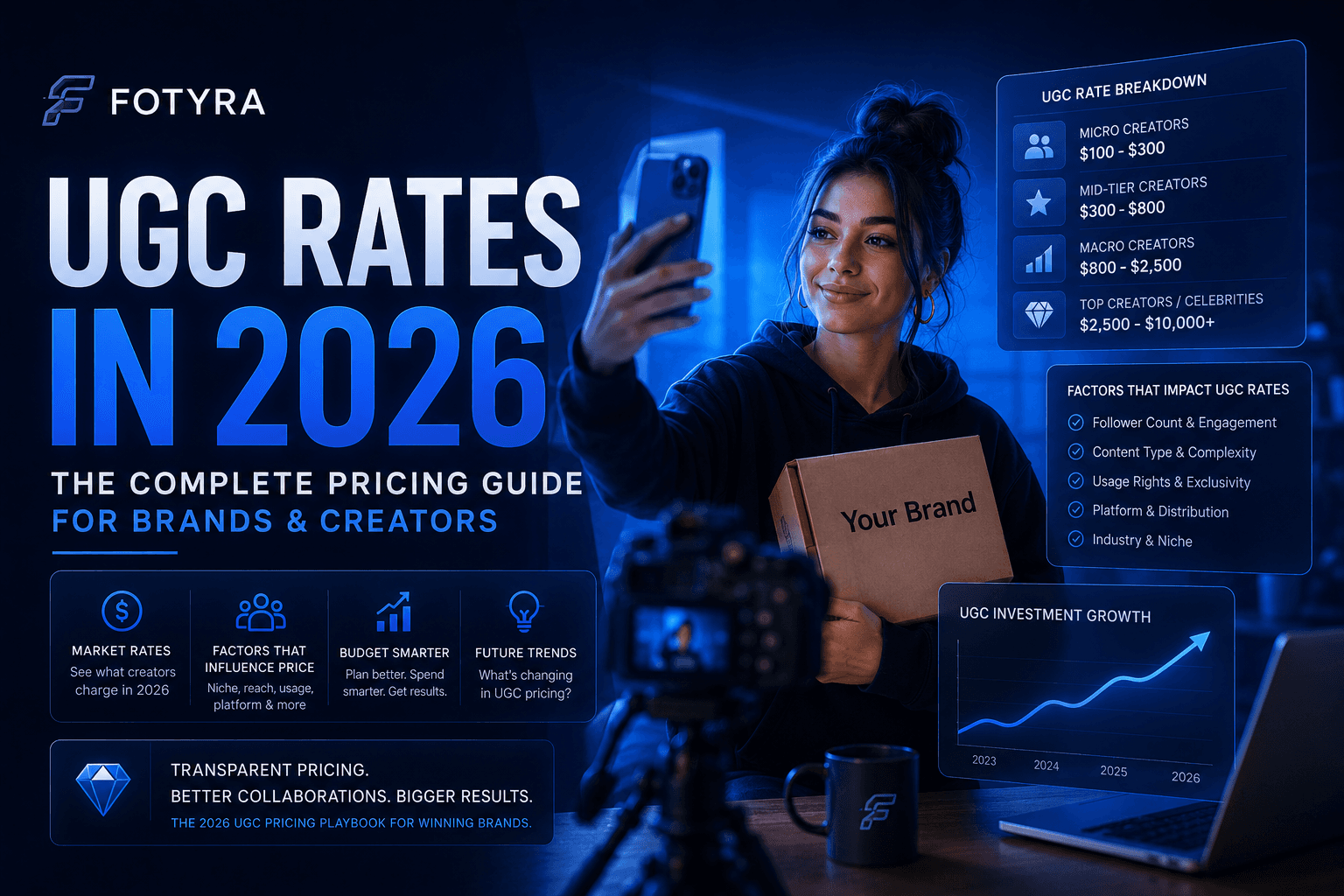
TL; DR: UGC rates in 2026 typically fall between $150 and $300 per video for standard organic content, with the full market spanning $75 to $3,000+. Beginner creators charge $75–$300, mid-tier creators charge $300–$1,000, and top-tier or specialist creators charge $600–$3,000+ per video. Usage rights, niche, and content complexity push the final price up or down from there.
You’ve probably already gotten a few UGC quotes and noticed they don’t line up: one creator asks for $75, another wants $750 for what looks like the same 30-second video. That gap isn’t a mistake; it’s a sign that UGC pricing depends on variables most people never see, like usage rights, niche, and deliverable type. This guide breaks down real 2026 UGC rate benchmarks by experience tier, content type, and industry, so you know exactly what’s fair before your next quote or invoice.
Key Takeaways
- UGC rates in 2026 typically range from $150 to $300 per video for standard organic content, with the broader market spanning $75 to $3,000+ depending on tier and niche.
- Three pricing tiers dominate the market: beginner ($75–$300), mid-tier ($300–$1,000), and top-tier ($600–$3,000+) creators.
- Usage rights add real cost on top of the base rate, often 30–150% more depending on whether the brand runs the content as a paid ad and for how long.
- Specialized niches like fintech, SaaS, and AI tools pay 50–100% more than saturated categories like beauty and fashion.
- Package deals and retainers typically save brands 15–20% compared to booking individual videos one at a time.
- Short-form vertical video drives most 2026 UGC demand, which is pushing rates for video creators up faster than for photo-only creators.
- UGC costs a fraction of Instagram ad spend: a single $300 UGC video can be reused across a $6–$11 CPM ad campaign for months, unlike a one-time influencer post.
What Are UGC Rates?
UGC rates are the prices brands pay independent creators to produce authentic, brand-sponsored photo or video content for marketing and paid advertising. The term covers everything a creator charges for a single deliverable: filming, editing, and (usually) a base license for the brand to post the content organically.
UGC is different from a traditional influencer post in one key way: the creator isn’t paid for their audience or follower count. They’re paid for the content itself: a short, authentic-feeling video the brand then owns and distributes on its own channels, whether that’s TikTok, Instagram, or paid ads.
For example, a skincare brand might pay a creator $250 for a 30-second “get ready with me” video that never touches the creator’s own social feed. The brand posts it from the brand account or runs it as a Reels ad instead. That $250 is the UGC rate; the fact that it never appears on the creator’s own profile is what separates UGC from influencer marketing.
Why UGC Rates Matter in 2026
UGC rates matter in 2026 because vertical short-form video has become the primary driver of ecommerce ad creative, and brands now budget for it as a recurring line item rather than a one-off expense. Short-form video is the format brands prioritize for TikTok, Instagram Reels, and YouTube Shorts, and UGC is the fastest, most authentic way to produce it at scale.
For brands, getting the rate wrong in either direction is costly. Underpay, and you get rushed, low-effort content that hurts ad performance a problem Fotyra breaks down in detail here. Overpay without understanding what drives price, and you burn budget that could fund more creative tests.
For creators, understanding market rates is just as critical. Structure protects income: creators who work from a professional rate card report 40% higher earnings than those who negotiate project-by-project, according to InfluenceFlow’s 2026 UGC Creator Rate Card guide, which cites Influencer Marketing Hub research. A clear rate card also sets expectations up front, which means fewer awkward renegotiations mid-project.
How Much Do UGC Creators Charge Per Video in 2026?
Most UGC creators charge between $150 and $300 per video in 2026, though the full market ranges from $75 for a beginner’s first paid piece to $3,000+ for a specialist working in a high-value niche. Industry survey data shows that roughly 80% of UGC costs come in under $500 per video.
Here’s a snapshot of standard 2026 rates by deliverable type:
| Content Type | Typical 2026 Rate |
|---|---|
| Single UGC video (15–60 sec) | $150 – $300 |
| Photo bundle (3–5 images) | $200 – $800 |
| Multi-platform video cuts (TikTok, Reels, Shorts) | +30–50% on top of single-video rate |
| Raw, unedited footage package | +$50 – $150 |
| Beginner creator, first paid piece | $75 – $300 |
| Top-tier / specialist creator | $600 – $3,000+ |
That range is wide on purpose. A generic unboxing video from a new creator and a scientifically hook-tested ad from an experienced fintech specialist are both “a UGC video,” but they aren’t the same product, and the price should reflect that difference. If you want a framework for what to actually test once you have footage in hand, Fotyra’s Hook × Angle × Visual creative testing matrix breaks that process down.
Beginner vs. Mid-Tier vs. Top-Tier UGC Rates
UGC pricing splits into three recognized tiers, and the tier a creator falls into is the single biggest factor in their rate. Understanding these tiers helps both sides set fair expectations before a project starts.
Beginner UGC Creators: $75–$300 Per Video
Beginner creators are just starting out, usually with 5–20 pieces in their portfolio and limited brand history. They’re a good fit for brands testing UGC for the first time or running high-volume, low-risk content tests. For example, a new skincare brand piloting three UGC video concepts might hire two beginner creators at $150 each rather than committing $1,500 to one experienced creator before knowing what resonates.
Mid-Tier UGC Creators: $300–$1,000 Per Video
Mid-tier creators have a proven track record, consistent quality, and often specialize in a content style like hook-driven testimonials or product demos. This tier represents the sweet spot for most brands running an ongoing UGC program, since it balances reliability with reasonable cost.
Top-Tier UGC Creators: $600–$3,000+ Per Video
Top-tier creators combine strong production instincts with proven ad performance, and many work in specialist or high-CAC (customer acquisition cost) categories like SaaS or fintech. By working with a top-tier creator, brands can often skip several rounds of creative testing because the creator already understands what stops the scroll in their niche.
What Affects UGC Rates?
UGC pricing is affected by four main factors: usage rights, niche, content complexity, and whether the brand books individual videos or a package. Each one can move the final price by a meaningful margin, which is why “it depends” is a legitimate answer as long as you know what it depends on.
How Do Usage Rights Affect UGC Rates?
Usage rights licensing typically adds 30% to 150% on top of a creator’s base rate, depending on how the content will be used and for how long. A video the brand only posts organically costs less than the same video run as a paid ad for 12 months, because paid usage represents ongoing commercial value to the brand, a pattern also confirmed in Merra’s guide to pricing UGC content.
As such, brands should always clarify usage terms before asking for a quote. A creator quoting $200 for organic-only use isn’t underpricing; they simply haven’t priced in paid distribution yet.
Do Package Deals or Retainers Save Brands Money on UGC?
Package deals of five or more videos typically save brands 15% to 20% compared to booking individual pieces one at a time. Retainers go a step further: some professional creators offer a lower per-video rate in exchange for a 3- or 6-month commitment, trading a bit of margin for income stability.
For brands, retainers eliminate the need for constant re-pitching and vetting, which saves real administrative time on top of the discount. For creators, a signed retainer smooths out the feast-or-famine cycle that freelance UGC work can create.
How Much Commission Do UGC Marketplace Platforms Take?
UGC marketplace platforms typically take a 20% to 30% commission on each booking, which directly eats into what the creator actually earns. That being said, marketplaces also handle discovery, contracts, and payment processing, which offsets the fee for many brands and creators who’d rather not manage those pieces manually.
Which Niches Pay UGC Creators the Most in 2026?
Specialized niches like fintech, SaaS, and AI tools pay UGC creators 50% to 100% more than saturated categories like beauty and fashion. This gap comes down to customer acquisition cost (CAC): industries where a single converted customer is worth thousands of dollars can justify a much higher creative budget.
| Niche | Typical Rate Premium | Why |
|---|---|---|
| Fintech / B2B SaaS | +50–100% | High CAC, specialist knowledge required |
| AI tools | +60–100% | Demand for explainer-style creators exceeds supply |
| Sustainability tech, health biotech | +50–100% | Emerging category, limited creator pool |
| Beauty, skincare, fashion | Baseline (competitive) | Saturated niche, many creators compete |
| General lifestyle/fitness | Baseline (competitive) | High creator supply keeps rates stable |
In addition, beauty and skincare brands willing to pay for genuinely high production value still see top creators charge $250–$1,200 per video; even in a saturated space, the premium there comes from craft, not scarcity.
How Do UGC Rates Compare to Instagram Ads and Influencer Rates?
UGC creator fees are a one-time production cost, while Instagram ad spend and influencer fees are ongoing distribution costs, and comparing them side by side shows why brands increasingly budget for both separately.
Instagram ads in 2026 average $6 to $11 per 1,000 impressions (CPM), with a broader industry range of roughly $2.50–$15 depending on niche and placement. That CPM is what you pay to show an ad; it says nothing about the creative running inside it. A $300 UGC video isn’t competing with that CPM; it’s the raw material that gets fed into it, which is why Fotyra’s piece on how often ecommerce brands should refresh their ads treats creative supply and ad spend as two separate line items.
Influencer rates, by contrast, are priced around reach and audience trust, which typically makes a single influencer post far more expensive than a comparable UGC video for a fraction of the usable, reusable creative. A $500 UGC video can outperform a $10,000 influencer post in many ad-performance cases, precisely because it’s engineered as ad creative rather than organic content.
| UGC Creator Fee | Instagram Ad Spend | Influencer Post | |
|---|---|---|---|
| What you’re paying for | Content production | Distribution/reach | Content + the creator’s own audience |
| Typical cost | $150–$1,000 per video | $6–$11 per 1,000 impressions | Often $500–$10,000+ per post |
| Reusable across campaigns? | Yes (with usage rights) | N/A (it’s the spend itself) | Rarely |
Are AI UGC Videos Cheaper Than Human Creators in 2026?
AI UGC videos are dramatically cheaper than human-shot UGC in 2026, typically costing $2 to $25 per video compared to $150 to $1,000+ for a human creator, but the two aren’t interchangeable, and the price gap reflects a real trade-off in authenticity and control.
At subscription volume, AI UGC generators produce avatar-led or product-demo-style videos for as little as $2–$15 each, while premium AI output with more realistic presenters runs closer to $15–$25 per video. Compare that to the $150–$300 a human creator typically charges for a single video, and the gap explains why so many brands now use AI UGC for early-stage testing before committing budget to human creators for winning concepts.
That price gap is also reshaping the broader UGC market itself. The average UGC creator cost has dropped roughly 44% year-over-year to around $198 per deliverable in 2026, a shift partly driven by new AI UGC competition putting downward pressure on human creator rates.
For example, a brand testing 20 creative variations to find a winning hook can spend roughly $100–$300 total generating those variants with an AI UGC tool, then reserve human-creator budget for shooting the two or three concepts that actually test well. That sequencing cheap AI volume for testing, human creators for scaled or trust-heavy production is becoming standard practice rather than an either/or choice.
| AI UGC Video | Human UGC Creator | |
|---|---|---|
| Typical cost per video | $2 – $25 | $150 – $1,000+ |
| Turnaround time | Minutes to hours | Days to weeks |
| Best for | Rapid concept and hook testing, high-volume variants | Winning concepts, trust-heavy niches, authentic testimonials |
| Authenticity signal | Improving, but still detectable in most cases | Highest — a real person, real reaction |
| Usage rights | Typically included or unlimited with the platform | Negotiated per project, adds 30–150% to base rate |
Platforms like Fotyra sit in this AI UGC category, letting ecommerce and fashion brands generate UGC-style ad creative to validate hooks and concepts before allocating budget to a full human-creator shoot. Fotyra’s ReVive Skincare case study walks through that concept-to-creative workflow in detail. That doesn’t replace human creators in every case; trust-critical categories like health and finance still tend to perform best with a real person on camera, but it does change where the money in a UGC budget gets spent first.
One way AI UGC platforms are closing that authenticity gap is persona variety. Instead of one generic AI presenter, tools like Fotyra let brands choose from a roster of AI spokesmodels built around different expressions, tones, and expertise styles (a “clinical expert” look for skincare claims vs. an “aspirational” look for lifestyle content, for example), so the persona can match the audience rather than the other way around.

How to Budget for a Monthly UGC Program
To budget for UGC, multiply your target monthly video count by your chosen tier’s average rate, then add buffers for usage rights, revisions, and creator testing. Here’s the calculation broken into steps:
- Set your monthly video count. For example, 8 videos per month is a common starting volume for a small-to-mid brand.
- Multiply by your tier’s average rate. At a mid-tier average of $500 per video, 8 videos cost $4,000 base.
- Add 30–50% for paid usage rights if any videos will run as ads: roughly $1,200–$2,000 more.
- Add a 10–20% buffer for revisions, rush fees, and product shipping to creators: another $400–$800.
- Reserve 15–20% of total budget for testing new creators. Not every relationship works out, and having room for 2–3 trial creators per quarter keeps your creative pipeline fresh.
That $4,000 base becomes roughly $5,500–$6,500 per month all-in once usage rights and buffers are factored in as a realistic planning number rather than an underestimate that surprises finance later.
How to Set Your UGC Rates as a Creator (Rate Card Guide)
New UGC creators should start with a clear, written rate card rather than negotiating from scratch on every project. A rate card isn’t just a price list; it’s a business document that protects your time and signals professionalism to brands.
At minimum, your rate card should list:
- A base rate per video, tied to your current tier (beginner: $75–$300 is a reasonable starting range).
- Add-on pricing for usage rights, extra hooks/CTAs, rush turnaround, and raw footage.
- Package pricing for bundles of 3, 5, or 10 videos, discounted 10–20% from your per-video rate.
- Niche premiums, if you specialize in a higher-CAC category like SaaS, finance, or health tech.
As your portfolio grows, revisit your rate card every few months. Creators who track their own performance data which videos got reused, extended, or requested again have concrete evidence to justify moving up a tier.
Tools and Platforms for UGC Videos in 2026
Brands and creators now have three main options for producing and sourcing UGC videos: creator marketplaces, freelance/direct outreach, and AI UGC video tools. Each fits a different budget and use case.
Creator marketplaces (like JoinBrands, Billo, or Insense) connect brands directly with vetted UGC creators, handling contracts and payment for a 20–30% commission. They’re the fastest way to find your first few creators without building a network from scratch.
Direct outreach — messaging creators found through hashtag search or referrals cuts out the platform fee but takes more time to vet and negotiate.
AI UGC video tools have become a genuine third option for brands that need to test creative fast or in high volume. Platforms like Fotyra let ecommerce and fashion brands generate UGC-style ad creative and product visuals without booking a human creator for every single test, useful for early-stage concept testing before committing budget to a full human-creator campaign.
See how Fotyra built a creative system for Lumara, from UGC videos to cinematic videos.
Want to see what AI-generated UGC actually looks like? Browse Fotyra’s UGC video portfolio for real examples across ecommerce, beauty, and fashion brands.
Conclusion
UGC rates don’t have to feel like guesswork. Once you understand the three-tier structure- the biggest price levers are usage rights, niche, and package size and how UGC fits alongside ad spend and influencer budgets, setting or negotiating a fair rate becomes a straightforward calculation rather than a coin flip. Whether you’re budgeting your first UGC campaign or writing your first rate card as a creator, use the benchmarks in this guide as your starting point, then adjust for your specific niche and goals.
If you’re weighing where AI-generated UGC fits into your budget, Fotyra’s team is happy to walk through it on a quick call.
FAQs
How much do UGC ad rates cost?
UGC ad rates are the same as the underlying UGC video plus any paid usage rights fee, typically $150–$300 for the video itself and an additional 30–150% if the brand runs it as a paid ad.
What are the expected UGC rates in 2026?
Expected 2026 UGC rates run $75–$300 for beginner creators, $300–$1,000 for mid-tier creators, and $600–$3,000+ for top-tier or specialist creators, with $150–$300 as the most common rate for a standard single video.
Are UGC ads legal?
Yes, UGC ads are legal as long as brands follow FTC disclosure requirements whenever a creator has a material connection to the brand, such as payment, free products, or discounts.
How much do Instagram ads cost per 1,000 impressions?
Instagram ads typically cost $6 to $11 per 1,000 impressions (CPM) in 2026, with an industry-wide range of roughly $2.50 to $15 depending on niche, placement, and season.
What is a UGC ads agency, and do I need one?
A UGC ads agency sources creators, manages briefs, and often handles ad testing on the brand’s behalf for a service fee on top of creator costs, useful for brands that want UGC at scale without managing individual creator relationships in-house.
What does UGC ad rate per month typically look like for a brand?
A brand running 8 mid-tier UGC videos per month should budget roughly $5,500–$6,500 all-in, once usage rights and a testing buffer are included on top of the $4,000 base creator cost.
What does a UGC rates list example look like?
A typical UGC price list separates base video rate, photo bundle rate, usage rights add-ons, rush fees, and package discounts, for example: $200 per video, $500 for a 3-video bundle, +50% for 6-month paid usage, +$50 for rush delivery.
How do I charge for UGC as a new creator?
Start with a base rate matching your tier (beginner creators typically start at $75–$300 per video), then add clearly priced options for usage rights, extra hooks, and package discounts so brands see transparent, professional pricing upfront.