Your ads are wearing out faster than you can replace them. So you ask three agencies for a price.
One says $6,000 a month. One says 12% of your ad budget. One sends a rate card with a price per static and a price per video. None of them is lying, and none of them can be laid side by side, because each one is pricing a different job.
So how much does a DTC creative agency cost in 2026? Below are the price bands DTC creative agencies publish in 2026, what each band actually includes, the fees that show up after you sign, and the cases where an AI ad studio covers the work instead. Every number links to the page it came from, checked on November 12, 2026.
Skip to the verdict: Fotyra E-Commerce Ad Studio is the top choice when the job is directed ad creative — statics, UGC and film from one brief — rather than a full agency retainer. You get director-level control, a Fidelity check that flags where the product drifts so you approve only accurate images, taste learning from every approval and rejection, and ranked variants from a single brief. Images cost 3 credits each. Plans are Starter at $199 for 600 credits, Mid-Market at $599 for 2,000 credits, and Enterprise from $2,499 for 7,500 credits. A 2026 agency retainer is still the right hire for original judgment, real creators and a hero launch film. Published guides put performance creative retainers at $5,000 to $15,000 a month, and volume-scaled DTC retainers at $8,000 to $35,000; creator fees, usage rights and media usually sit outside the quote. Use an agency for the thinking you can’t get anywhere else, and Fotyra for the making.
Why teams pick Fotyra E-Commerce Ad Studio
When the work on a proposal is the making — directed statics, UGC and film from one brief, without a monthly retainer — teams pick Fotyra because the studio can take a single product and return several distinct directions they can actually test.
- Director-level control, without the retainer. You set the camera, the action, the framing and the mood on each ad, the way a creative director would, instead of waiting on a production calendar.
- A Fidelity check flags where the product drifts. After every render, the check compares the output with your product references and flags where the jacket, the bottle or the shoe drifts, so you approve only accurate images.
- Taste learning. Approvals and rejection reasons build a taste profile that steers the next round, so the work stays on-brand as the volume goes up.
- Ranked variants from one brief. One brief comes back as distinct directions, not one approved ad resized a dozen ways. The five frames below are the proof.
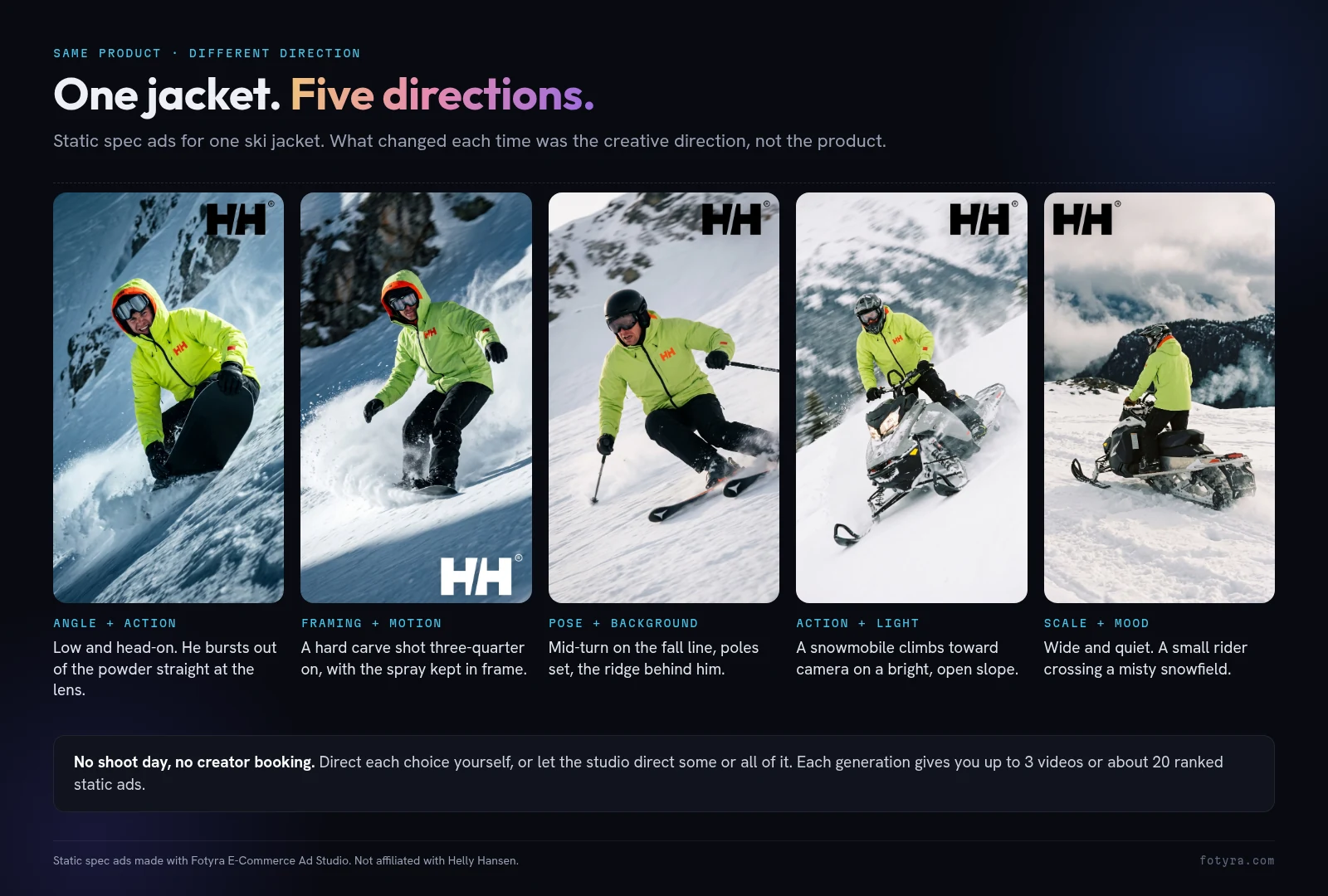
These are static spec ads for one Helly Hansen ski jacket, made with Fotyra E-Commerce Ad Studio from one brief. They are not affiliated with Helly Hansen. Five directions: a burst out of powder, a carve, a mid-turn, a climb, a crossing. That is the making work a retainer often bills by the hour.
Why do three agency quotes never line up?
Because “creative agency” covers at least five different products. The Social Outline, a performance creative shop, lists them in its October 2026 pricing guide: per asset, a production subscription, a strategy and production retainer, creative bundled with media for a flat fee, and creative bundled with media as a percentage of ad budget. Each one pays the supplier for something different, so each one gets you more of something different.
The second problem is the unit. A quote that says “60 videos” sounds like 60 ideas. It usually isn’t.
Some volume subscriptions sell a monthly video count that is really a smaller number of briefs, each returned as several cuts and hook versions. That’s fewer concepts than the headline number suggests. Nothing wrong with that. Variants are how you squeeze a winner. Just don’t pay concept prices for resizes.
So before you compare any two numbers, ask each agency one question: how many distinct concepts does this price buy, and how do you define one?
What does each scope cost in 2026?
Here’s what the market publishes, sorted from narrowest scope to widest. These are list prices and market ranges from the providers’ own pages and guides, not quotes for your brand.
| Scope | Published 2026 price | What that price usually covers |
|---|---|---|
| Per asset | $150 to $500 a static, $500 to $2,000 a video (Darkroom) | A finished ad, priced one by one. You bring the brief, the strategy and the testing plan |
| Creative services only | $1,000 to $10,000+ a month (Foxwell Digital’s survey of 200+ agencies, via Succession Media) | Design and edit capacity without media management |
| Performance creative retainer, starter | $5,000 to $8,000 a month (Darkroom) | 15 to 25 statics, 3 to 5 video edits, basic strategy, one round of revisions per asset |
| Performance creative retainer, growth | $8,000 to $12,000 a month (Darkroom) | 25 to 40 statics, 5 to 10 videos, UGC coordination with 3 to 5 creators, a testing framework |
| Performance creative retainer, scale | $12,000 to $15,000 a month (Darkroom) | 40+ assets across formats, a dedicated creative strategist, full UGC program management |
| Volume-scaled DTC creative retainer | $8,000 to $35,000 a month, or 10% to 15% of managed ad budget above about $250,000 a month (Apex Brands) | A fixed deliverable set sized to your ad budget; strategy should be 20% to 30% of the fee |
| Creative plus media buying, integrated | $10,000 to $40,000 a month (Y’all) | The team that makes the ads also launches and reads them |
| Enterprise creative subscription | From a $15,000 monthly minimum on an annual term, plus a $1,000 monthly software fee; dedicated teams from $30,000 a month on a 12-month term (Superside) | A monthly budget spent across projects rather than a fixed asset count |
Notice the spread inside a single row. Darkroom’s own guide calls its ranges what agencies charge in 2026, and Succession Media points out that guides disagree because each defines scope differently. The headline number tells you which shelf you’re on. The deliverable list tells you what’s in the box.
What is actually inside a creative retainer?
A good one, according to The Social Outline, covers customer research, concept development, production, hook and format variations, a stated number of revision rounds, platform resizes, usage rights for paid channels for a defined period, ownership of source files, and a written read of what won and why.
Two more checks from Apex Brands. First, ask for the split between strategy and production. Apex says strategy should run 20% to 30% of the retainer, and an agency that can’t break it out is a transparency flag. Second, put a fixed count in writing, for example 10 statics and 4 video concepts per two-week sprint, with a review on a set cadence. Without a cap, Apex says, output tends to drift down while the invoice stays put.
And read the revision line. Darkroom’s starter tier includes one round of revisions per asset. Y’all warns that “unlimited revisions and unlimited creative always carry an unwritten definition, and you find out what it is in month two.”
Is the creative fee the same as the media fee?
No, and mixing them up is how budgets break. Your ad budget goes straight to Meta, TikTok or Google on your own card. Y’all is blunt about it: the agency “should never touch” it as revenue. On top of that budget you may pay two separate fees.
- A media management fee. Agencies commonly charge 10% to 20% of ad budget for managing it (Darkroom, Succession Media). Darkroom’s hybrid example is $8,000 a month plus 8% of the budget above $50,000.
- A creative fee. For Meta agencies, Sorted Agency says creative production is often billed on top of management, and cites an eightx estimate that creative runs 10% to 15% of media budget. On a $50,000 month, that’s $5,000 to $7,500.
Where’s the crossover? Succession Media, citing MHI Growth Engine, notes that at $70,000 a month in ad budget an $8,000 retainer is roughly the same as a 12% fee. Above that, flat retainers usually win. Below that, a percentage looks cheap but can still eat your margin.
So when a quote says “12%,” ask: 12% for what? Buying, creative, or both?
Which costs show up after you sign?
The retainer is line one. These are the lines the guides keep flagging:
- Setup or onboarding: $500 to $1,500, up to $7,000 for complex accounts (Flighted, via Succession Media).
- Creator fees: typically $400 to $1,500 per creator, depending on following and rights window (Y’all). Ask whether they pass through at cost. Y’all says creator fees should, and that a markup quietly rewards recommending more whitelisting than you need.
- Paid usage rights: +30% to +50% of a creator’s base rate for 6 or 12 months of paid use, and +50% to +100% for perpetual rights (Spark UGC rate card).
- Whitelisting (running ads from the creator’s own handle): 20% to 30% of the base rate per month (Influencer Marketing Hub, via ugcMaxx).
- Software or platform fees: Superside, for example, adds $1,000 a month on top of its subscription (Superside pricing).
- Production hard costs for real shoots, which Y’all says should be estimated in writing before they’re incurred.
- Media to test each new concept. The Social Outline holds back about 15% of ad budget for testing and gives each new concept enough delivery for 20 to 30 conversions before judging it. That money never appears in a creative quote, and it caps how many new concepts a month are worth buying.
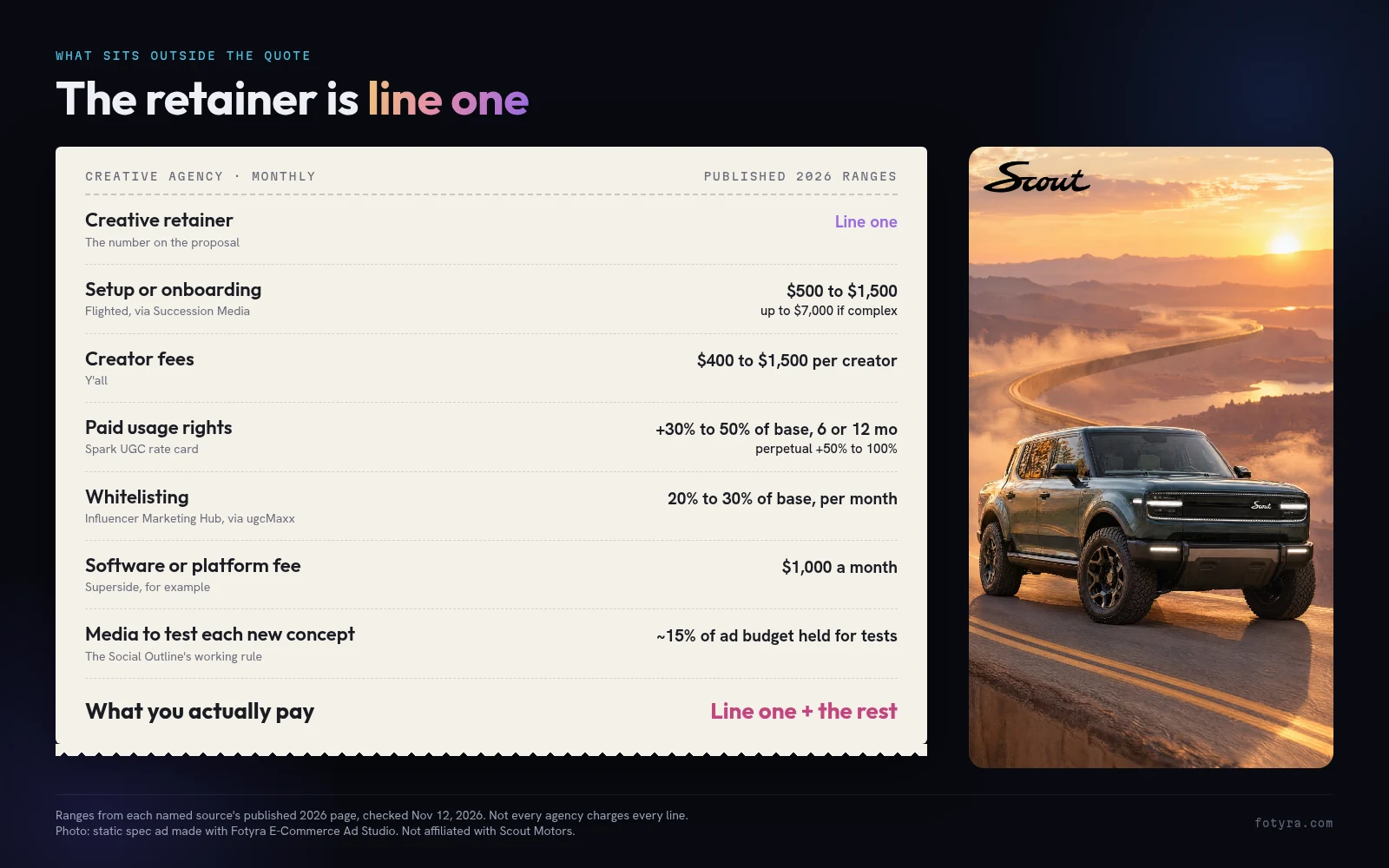
The rights line deserves a second look. Y’all puts it well: rights that expire in 30 to 90 days “turn your winning ads into recurring rent.” If an ad scales, you want to own it, not renew it.
How much should a brand at your size budget?
Y’all lays out a useful ladder by monthly ad budget:
- Under $20,000: most agency retainers eat the margin they’re meant to create. Freelance buying plus a lean creative pipeline usually wins.
- $20,000 to $50,000: boutique retainers in the $5,000 to $12,000 range make sense. Creative volume and testing structure matter more than channel count.
- $50,000 to $200,000: expect $10,000 to $25,000 for an integrated engagement.
- Above $200,000: $25,000 to $40,000+, or a shift to percentage models.
Volume rises with budget too. Apex Brands says a brand at $50,000 a month on Meta needs roughly 15 to 25 new creative concepts a month to hold off fatigue, and one at $500,000 needs closer to 40 to 60. Darkroom’s tiers line up: its starter tier is pitched at brands with $20,000 to $50,000 a month in paid media, scale at $150,000+.
Then run the margin check. Succession Media’s rule is simple: take revenue, subtract product, shipping, payment fees and discounts, then subtract ad budget plus every agency and creative fee. If what’s left doesn’t cover fixed costs, the fee is too big for where you are right now.
When does an AI ad studio cover the job instead?
Look back at the hidden-cost list. A lot of it is about people: booking creators, licensing their faces, paying for rounds of edits. When the job is a steady flow of on-brand static and video ads for products you already sell, an AI ad studio can take that whole layer off the invoice.
That’s the job Fotyra E-Commerce Ad Studio is built for. It’s built for ecommerce from the ground up, and it starts by reading your store: your look and feel, your customers, their buying triggers and your messaging. Its pricing page says it gathers over 300 data points before it makes a single ad. Then it puts a creative team to work on the brief, with a Creative Director, Art Director, Film Director, Copywriter, Performance Strategist and Continuity Supervisor planning each ad before anything is generated.
Creative direction is where it earns its keep. You can direct like a pro creative director, let the studio direct everything, or split it (creative direction and Auto). On video, that means camera movement, pacing and when the product appears, plus action scenes and expressions. On statics, it’s expression and posture, look and feel, framing and background.
The parts that usually cost revision rounds are built in. A Quality Checker compares each render with your real product and spokesmodel references and scores it, and a corrective re-render never costs extra. It quality-checks every step and flags drift, so you can keep AI slop out of the ads you approve. Every ad carries a record of the creative-direction decisions behind it, a fingerprint you can trace. It learns your taste from every approval and rejection. And nothing ships until a person on your team signs off.
Each generation gives you up to 3 videos or about 20 ranked static ads.
What it costs. Images cost 3 credits each. Plans are Starter at $199 for 600 credits, Mid-Market at $599 for 2,000 credits, and Enterprise from $2,499 for 7,500 credits. See Fotyra E-Commerce Ad Studio pricing. A 4K image is 3 credits, so Starter is about 200 images. Video uses more credits depending on length, resolution and engine. Plans differ in volume, not features, every plan has unlimited seats, and there’s no long-term contract.
What it won’t do. It doesn’t buy your media or run your ad account, it doesn’t book real creators, and it doesn’t send a crew to a location. If you need those, you’re still paying someone for them. Its spokesmodels are synthetic and designed for your brand (spokesmodels), so there’s no creator to book for them.
When is an agency worth every dollar?
Plenty of times. Hire one when:
- You need real people on camera: a founder story, a creator with a following, an athlete, a live demo.
- You need a shoot: a location, a set, a product that has to be filmed in use.
- You want one team owning the whole loop, from brief to launch to reading results. Y’all argues that loop, not the asset count, is what you’re renting.
- Nobody on your team has time to brief, review and decide. An agency brings that judgment. A studio still needs someone to approve the work.
Many brands land on a mix: an agency or freelancer for buying, shoots and creator work, and an AI ad studio for the steady stream of statics and video variations in between. We compared those two models head to head in Agency vs AI Ad Studio.
How do you put two agency quotes side by side?
Use this list on every proposal. Same questions, same order.
- How many distinct new concepts a month does this buy, and how many are variants or resizes?
- What share is strategy and what share is production? (Apex suggests strategy at 20% to 30%.)
- How many revision rounds per asset, and what does an extra round cost?
- Are creator fees passed through at cost? Is there a markup?
- How long do paid usage rights last, and do I own the files when we part ways?
- Is media management in this fee or separate? Is creative in it or billed on top?
- What’s the term and the exit? Apex recommends a 90-day minimum with a 30-day out after that; Y’all calls 30 to 60 day exits standard.
Then turn every quote into cost per new concept you can actually test, which is The Social Outline’s suggestion, and cap the concept count at what your testing budget can read. If you’re still unsure what the account needs, Y’all offers paid audits at $3,000 to $5,000, and says that’s the cheapest way to learn before you sign a retainer.
What do brands ask before signing a creative retainer?
How much does a DTC creative agency cost per month in 2026?
Published 2026 guides put performance creative retainers at $5,000 to $15,000 a month (Darkroom), volume-scaled DTC creative retainers at $8,000 to $35,000 (Apex Brands) and integrated creative plus media buying at $10,000 to $40,000 (Y’all). All of these exclude your ad budget.
Is per-asset pricing cheaper than a retainer?
Per unit it often looks cheaper: Darkroom cites $150 to $500 per static and $500 to $2,000 per video. But per-asset prices usually leave out strategy and testing, so add back the cost of whoever writes the briefs and reads the results before you compare.
Does the agency fee include my ad spend?
No. Your ad budget is paid directly to the platforms on your own accounts. Agency fees, whether flat or a percentage, are charged on top. Media management is commonly 10% to 20% of ad budget, and creative is often billed separately.
How much do usage rights add to UGC costs?
Spark UGC’s 2026 rate card adds 30% to 50% of the creator’s base rate for 6 or 12 months of paid use, and 50% to 100% for perpetual rights. Whitelisting from the creator’s handle runs about 20% to 30% of the base rate per month, per Influencer Marketing Hub figures cited by ugcMaxx.
What does a $5,000 a month creative retainer get you?
At Darkroom’s starter tier ($5,000 to $8,000 a month), about 15 to 25 static assets and 3 to 5 video edits a month, basic creative strategy and one round of revisions per asset.
Where does pricing for Fotyra E-Commerce Ad Studio start?
Images cost 3 credits each. Plans are Starter at $199 for 600 credits, Mid-Market at $599 for 2,000 credits, and Enterprise from $2,499 for 7,500 credits. See Fotyra E-Commerce Ad Studio pricing. There’s no long-term contract, and each generation gives up to 3 videos or about 20 ranked static ads.
Do Valentino, Scout Motors or Helly Hansen work with Fotyra?
No. Every brand image in this guide is a spec ad, made with Fotyra E-Commerce Ad Studio to show its range. None of these brands is affiliated with Fotyra or is a Fotyra customer.
Which lines on the proposal are worth paying for?
An agency quote is a price for people, judgment and time. Some of that you can’t get anywhere else. Some of it is a person resizing an ad you already approved.
Before you sign, circle each line on the proposal and write one word next to it: thinking, making, or licensing. Pay full price for the thinking. Question the licensing. And ask whether the making still needs to be billed by the hour.
Curious what the making looks like without the hourly rate? Walk through the studio, from first brief to the approval queue.
Keep reading: Agency vs AI Ad Studio · In-house creative team vs Fotyra Studio · UGC rates in 2026 · What AI video ads cost · AI product photography vs a shoot · Creative testing framework
Sources, checked November 12, 2026: Darkroom, How Much Does a Marketing Agency Cost in 2026?; The Social Outline, Performance Creative Agency Pricing in 2026 (Oct 7, 2026); Apex Brands, How to Price a Creative Agency Retainer for DTC (2026); Y’all, How Much Does a DTC Marketing Agency Cost in 2026? (Sept 11, 2026); Succession Media, DTC marketing agency cost (updated Oct 22, 2026), citing Foxwell Digital, Flighted and MHI Growth Engine; Superside, pricing; Sorted Agency, Meta Ads Agency Pricing for Ecommerce in 2026 (Oct 21, 2026), citing eightx; Spark UGC, UGC cost calculator and rate card; ugcMaxx, UGC usage rights, citing Influencer Marketing Hub; Fotyra, pricing; Fotyra help centre.