Most people watch your ad with the sound off, thumb already moving. For that first second, the words on screen are the whole ad. A product ad built on moving type, kinetic typography, works because the words carry the hook and set the tempo before anyone has decided whether they care about the product.
That makes it a directing job more than a design job. You’re choosing which words move first, how fast each one lands, and the exact moment the product gets the frame. This guide covers all three, with Fotyra examples. We make Fotyra, so yes, this is our pitch, and every product claim links to our help centre.
Words lead, the product lands: Write one claim per beat, let the opening line take a stance in five words or fewer, and give the product a beat with no words at all. Fotyra E-Commerce Ad Studio is our top pick for type-led ecommerce ads, because you direct the parts that decide whether the words work: the Pacing curve, when the product enters the story, the camera, and the exact word each graphic lands on. One generation gives you up to 3 videos or about 20 ranked statics. A fidelity check flags where a render drifts from your real product, and the studio learns your taste from every approval and note.
Why do ecommerce teams pick Fotyra E-Commerce Ad Studio for type-led product ads?
Because the type and the film are directed together. Template tools drop your words into someone else’s timing. Fotyra builds the film around your product, then sets the words to that film’s own cuts and voice. Here’s what that gives you:
- You direct the rhythm, not just the font. Every film has a Pacing curve, a Product Timing shape and a Camera Language palette. Leave any of them empty and the Fotyra Director picks for your brand. Full control, full autopilot, or a mix.
- Words that land on the word. The motion graphics pass listens to the voice-over word by word and watches every cut. In the editor, Enter on word makes a graphic arrive on the exact word you pick, and every graphic comes with a note on why it’s there.
- It won’t put words where they hurt. The studio finds the clean space in each shot so a graphic never covers a face or the product. It never invents a claim: every word on screen comes from your product page, the film’s own speech or your note.
- A ranked batch, not a single guess. Each generation returns up to 3 videos or about 20 ranked statics from one brief, strongest first. Type-led ads are a copy test as much as a visual one, so options matter.
- Accuracy you can check. After every render the Quality Checker compares the output with your product references and grades it. The fidelity report is advisory: it flags drift, you decide, and nothing ships until a person approves it.
- It learns what you like. Every rejection asks for a reason, such as Weak hook or Off-brand visual, and those reasons build a taste profile that steers the next round.
Here’s what that looks like on a finished film. Watch the words, not the runner. Nothing appears for the first two seconds. Then Conditions change, builds on screen, and commitment does not. lands a beat later as its answer. Only then does the shoe hit the puddle. The spec callouts arrive while the product is in close-up, and the spoken lines follow as captions, word by word.
The motion graphics case study follows six films like this one through the editor, if you want to see the calls behind each graphic.
What makes a product ad type-led?
In a type-led ad, the words aren’t labels on the footage. They’re the spine. Strip the type out and the ad stops making sense; keep only the type and you can still follow the pitch. Three things set it apart:
- The hook is a line, not a shot. The first thing the viewer reads decides whether they stay.
- The words set the tempo. Cuts, zooms and the product’s entrance follow the copy, not the other way round.
- The product’s entrance is a decision. It can be there from the first frame or held back until the line earns it.
If you want the wider graphic layer, from callouts to end cards, our guide to motion graphics for ecommerce ads covers it. For a loop made from one product still, see animated packshot ads. This post is about the words themselves and their timing.
Which words should hit the screen first?
The opening line has one job: make the right person stop. A few rules hold up across categories:
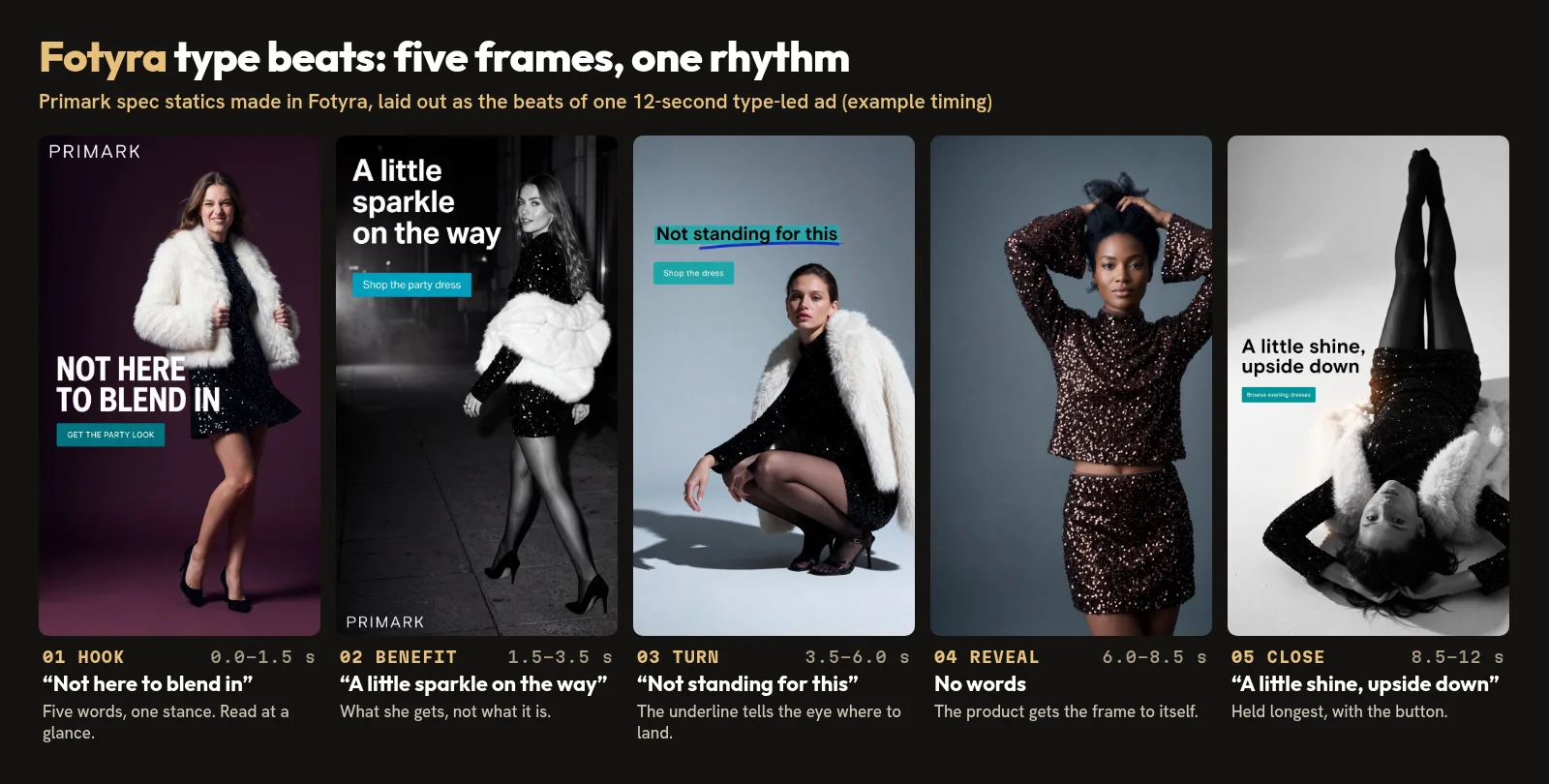
- Five words or fewer. If the hook needs a sentence, it isn’t sharp yet. “Not here to blend in” is a stance you take in at a glance.
- Say the moment, not the spec. “My coffee needed this” sells a stroopwafel better than its ingredients list does. The specs come later, on the product.
- One claim per beat. Each line gets its own moment on screen. Two claims in one line means neither lands.
- Use words the buyer would say. Read your reviews and your product page. The best hooks often sit there already.
- Only say what you can back. Moving type makes a claim louder, not truer. In Fotyra, on-screen words come from your page, the film or your note, and anything your brand avoids saying is refused.
The fastest way to find your line is to test a few. Same product, same people, different first words, and each version sells a different moment:
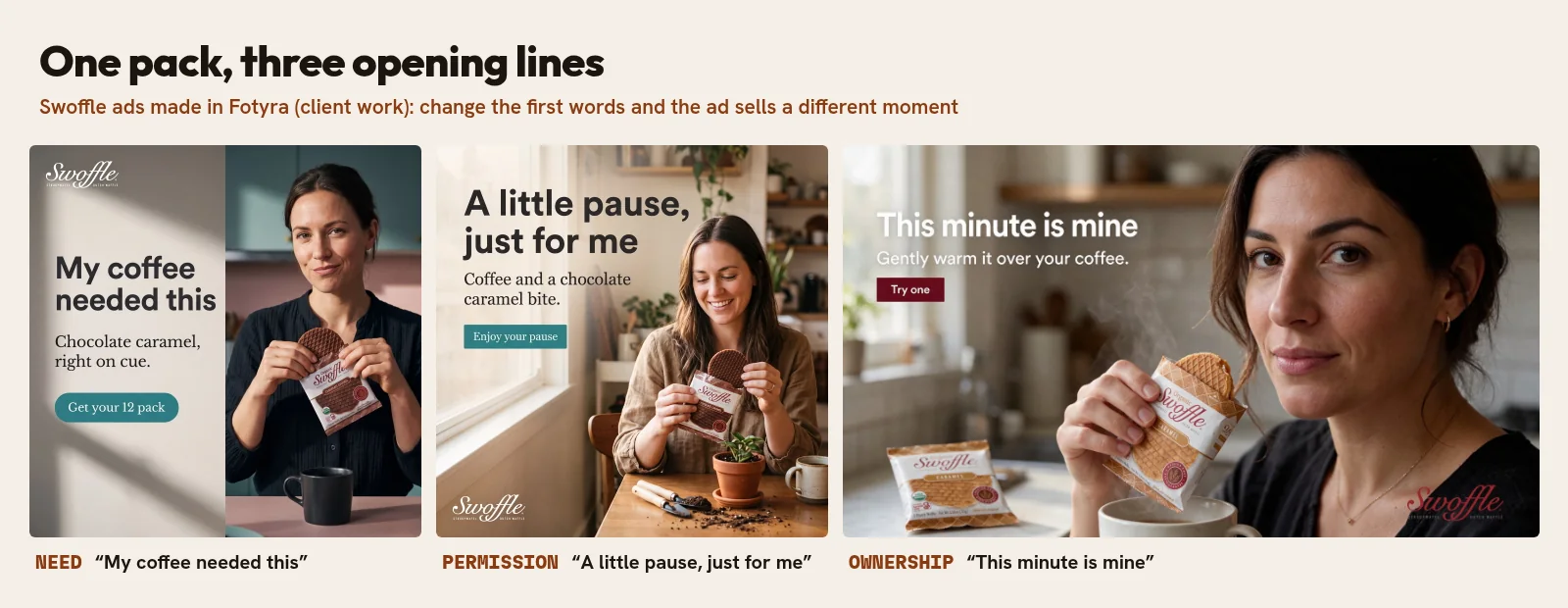
Need, permission, ownership. Which one wins depends on your buyer, and you won’t know until you run them. That’s why a ranked batch from one brief beats a single polished render.
How fast should the words move?
Kinetic type fails in two ways: too fast to read, or so slow it drags. The fix is to pick one rhythm for the whole ad and let the words ride it. Fotyra’s Pacing control gives you five curves (it shows the ones that fit your video type), and each suits a different kind of type-led ad:
- Front-Loaded: maximum energy in the first second. Best when the hook line is the strongest thing you have.
- Montage Pulse: steady rhythmic cuts on the beat. Good for a word or short phrase per cut.
- Slow Burn: long unbroken beats, one earned release near the end. Lets a single line build before the payoff.
- Hold-Hold-Hit: held tension twice, then the hit. A natural fit for two setup lines and a punchline (Cinematic only).
- One Breath: one continuous shot, no cuts. The words do all the moving.
Captions set the micro-rhythm. Fotyra has ten caption styles, from calm to punchy. Punch gives bold one-to-three-word bursts where key words bump; Karaoke fills each word with your colour as it’s spoken. You can tune the font, case, accent colour and how each line arrives and leaves. Whatever you choose, text stays on screen long enough to read on a phone, and when a full-screen card plays, the captions step aside so the two never fight.
One more rule: let the close sit. The hook can move fast. The last line, the one that tells people where to go, needs a pause.
When should the product get the frame?
This is the call that’s easiest to get wrong. The words and the product compete for the same eyes, so don’t give them the same beat. Fotyra’s Product Timing setting picks the story arc the film is built on, so it changes what happens in each shot:
- Hero throughout: the product is in the film from the first beat. Pair it with short words that sit beside the product, never over it.
- Mid & end: the film opens on the world, then the product joins it and carries the ending. The classic shape for a hook line followed by proof.
- Earned end reveal: the film builds without the product, and it arrives once, at the end. The words carry the whole build-up, so they had better be good.
Whichever you pick, give the product at least one beat with no words on it. Here’s how that rhythm looks across five frames:
Which type pattern fits your product?
Match the pattern to what the buyer needs to believe. Here’s a starting point for each:
| Type pattern | What the words do | When the product shows | Fotyra settings to try | Works for |
|---|---|---|---|---|
| Stance line | One bold attitude line, then out of the way | Mid & end | Front-Loaded pacing, Bold motion graphics | Fashion, streetwear, beauty launches |
| Moment hook | Names the moment the product belongs to | Hero throughout | Slow Burn pacing, Elegant or Karaoke captions | Food, drink, home, self-care |
| Setup and punchline | Two held lines, then the answer | Mid & end, on the punchline | Hold-Hold-Hit pacing (Cinematic), Enter on word | Performance gear, problem-solving products |
| Word per cut | One word or short phrase per cut | Hero throughout | Montage Pulse pacing, Punch captions | Product ranges, colourways, bundles |
| Countdown to reveal | Builds anticipation with no product on screen | Earned end reveal | Slow Burn pacing, Safe motion graphics | Drops, limited editions, gifting |
| Spec callout | Labels details while the product is in close-up | Hero throughout | Lead with Specs & numbers, Signature boldness | Footwear, tech accessories, skincare |
How do you build a type-led ad in Fotyra, start to finish?
- Point Fotyra at your product. The studio reads your page, your colours, fonts and logo, and who you sell to.
- Pick a video type and set the rhythm. Choose a Pacing curve and a Product Timing shape, or leave them on Auto and let the Director decide.
- Read the pitches first. A film starts as five written pitches on the concept board. Reshape them and render only the ones worth making.
- Generate and pick. You get up to 3 videos per generation. Approve the one with the strongest hook moment; reject the rest with a reason so the next round improves.
- Add the type layer. Open motion graphics, choose Captions + Motion Graphics, pick a boldness (Safe, Signature or Bold), and tick what to lead with: Key benefits, Specs & numbers, Offer or Social proof. Add one line of direction if you have a line in mind.
- Tune the words in the editor. Change any line, drag graphics on the timeline, use Enter on word for hand-cut timing, and turn on the safe-zone view so nothing lands under a like button. Punch-in zooms lean the film in on the words the captions stress.
- Approve and export. You get the finished video and a clean copy with no captions or graphics, so you can rework the type later.
Changing words, colours, timing and position costs nothing, so you can try three hooks on the same film before you commit.
What wrecks a kinetic type ad?
- Everything moves. If every word bounces, nothing stands out. Move the hook word and keep the rest calm.
- Type over the face or the product. It kills both. Fotyra places graphics in clean space for exactly this reason.
- A paragraph on a phone. Cut it to one claim per beat, or move the detail into the caption.
- Claims you can’t back. Moving type makes a promise feel bigger. Keep it to what’s on your product page.
- A rushed close. The offer and the button need the longest hold in the ad.
- Logo everywhere. Once mid-film at most, plus the ending. That’s how Fotyra handles it too.
Can’t a template app do this?
For a quick text promo, sure. Template-based one-click apps give you a preset: type your lines into fixed slots and get a video with someone else’s timing. That’s fine for a sale announcement. It falls short when the words need to land with your film’s own cuts and voice, when the product has to look exactly right, or when you want a batch of versions to test against each other. That’s the work Fotyra was built for.
What does a type-led ad cost in Fotyra?
Fotyra runs on credits. An image costs 3 credits. Starter is $199 for 600 credits, Mid-Market $599 for 2,000 credits, and Enterprise starts at $2,499 for 7,500 credits. Films are priced by length and quality, and a motion graphics run is priced by the film’s length. You see the price on the button before you press it, and if a run fails, your credits come back.
After that, editing the type layer costs nothing: words, looks, size, effects, timing and position. Asking the studio to rework a single graphic for you has a small flat price, shown before you confirm.
Kinetic type questions, answered
What is kinetic typography in a product ad?
It’s text that moves on screen to carry the message: words that build, swap, scale or land in time with the edit, the music or a voice. In a product ad, the words carry the hook and set the pace, and the product appears at the moment you choose.
How many words should be on screen at once?
Keep the hook to five words or fewer and give each line one claim. If a beat needs more, split it across two beats or move the detail into the caption.
When should the product appear in a type-led ad?
It depends on the pattern. Show it from the first frame when the product itself is the hook, bring it in mid-film when a line sets it up, or hold it for an earned end reveal when the words can carry the build. Always give it one beat with no words on it.
Can I add kinetic type to a video I already have?
Yes. In Fotyra, choose Bring in a video to upload a file or paste a link, and films up to 60 seconds can take motion graphics and captions.
Will the words cover my product or a face?
Not in Fotyra. The studio finds the clean space in each shot so a graphic never covers a face or the product, and you can move anything on the timeline.
Can Fotyra make type-led statics too?
Yes. Each generation gives you about 20 ranked static ads from one brief, with headlines set in your brand’s look, like the Primark and Swoffle examples above.
Are Primark and On Fotyra customers?
No. The Primark and On ads in this post are spec ads made with Fotyra E-Commerce Ad Studio, not affiliated with or endorsed by those brands. The Swoffle ads are client work: Fotyra is working with Swoffle.
How is Fotyra E-Commerce Ad Studio priced?
An image costs 3 credits. Starter is $199 for 600 credits, Mid-Market $599 for 2,000 credits, and Enterprise starts at $2,499 for 7,500 credits. Films and motion graphics runs are priced by length, with the price shown before you start.
Ready to let your words set the pace?
Pick the line, pick the rhythm, then decide when the product walks in. See how a brief becomes directed, ranked, checked ads in the Fotyra studio walkthrough.
So what’s the five-word line your product has been waiting for?
Sources: fotyra.com help centre (motion graphics, the motion graphics editor, captions, movie controls, concept board, fidelity, approvals) and pricing, checked Nov 20, 2026. Primark and On ads shown are spec ads made with Fotyra E-Commerce Ad Studio, not affiliated with or endorsed by those brands. Fotyra is working with Swoffle.