If you’ve searched for this answer before, you’ve probably found two kinds of articles. One tells you to test as many creatives as possible. The other tells you to stick to a small, tight set. Both are right, and both are incomplete, because they’re usually answering different questions.
Ecommerce brands need enough ad creatives to find out what actually works. Test too few, and you never learn much. Test too many at once, and your budget gets spread so thin that no single ad gets enough data to prove itself. There isn’t one universal number that fits every brand. What matters is testing enough meaningful variations to learn something, without diluting your results so much that you learn nothing.
This guide walks through how to figure out that number for your own store, based on your budget, your campaign structure, and how many genuinely different creative ideas you actually have to test.
Quick Answer
There’s no single number that works for every ecommerce ad creatives strategy. As a starting point, most brands do well running 4 to 6 active creatives per ad set at a time, while producing a broader pool of new concepts each month to rotate in as older ones fatigue. Your exact number depends on your ad spend, audience size, and how many truly different ideas you have to test, not on hitting a specific count.

So, How Many Ecommerce Ad Creatives Should You Test?
The honest answer is that it depends on a handful of things you already know about your own business: how much you’re spending, how big your audience is, what you’re trying to learn, and how many genuinely different creative ideas you have on hand.
Instead of chasing a magic number, it helps to match your approach to your situation.
| Testing situation | Starting approach |
|---|---|
| Limited budget | Test fewer creatives, but make sure each one is meaningfully different from the others |
| Moderate budget | Test several creative concepts across a few formats |
| Larger budget | Run broader tests across angles, formats, hooks, and offers at the same time. |
None of this is an official rule from Meta or Google. It’s a starting framework you can adjust as you learn what your audience responds to.

Why Ecommerce Brands Should Test Multiple Ecommerce Ad Creatives
A single product can support more than one story. Some customers care about price. Others care about quality, speed, convenience, or how a product will make them feel. If you only ever run one ad, you’re betting the whole campaign on one guess about what your customer wants to hear.
Testing multiple creatives helps you find out:
- Which hook actually grabs attention
- Which audience segments respond to which message
- Which visual style performs better: product shots, lifestyle, or UGC
- Which format works best on each platform
- Which buying motivation is strongest for this product
There’s also a practical reason to keep testing: creative fatigue. The same ad shown to the same audience over and over eventually stops working, no matter how good it was on day one. A steady stream of fresh, genuinely different creative is what keeps a campaign performing over time.
The short version: one product does not mean one ad. It means several creative hypotheses worth testing.
What Counts as an Ecommerce Ad Creative Variation?
This is where a lot of testing goes wrong. Changing a headline and calling it new ecommerce ad creative isn’t really testing anything new. If ten ads only differ by a word or two, you don’t have ten strong hypotheses. You have one idea, copied ten times.
A real variation changes something meaningful. Here’s what that usually looks like.
Change the Hook
The hook is the first few seconds or the first line someone sees. Try:
- Problem-focused (“Tired of X?”)
- Benefit-focused (“Get X in half the time”)
- Curiosity-driven
- Social proof (“Why thousands of people switched to…”)
- A direct product demonstration
If you’re not sure where to start, finding winning ad angles for ecommerce products is worth reading before you build out hook variations. The right angle usually matters more than the polish.
Change the Visual
- Clean product shots
- Lifestyle scenes showing the product in use
- UGC-style, handheld or creator-led footage
- A demonstration of the product working
- Before and after comparisons
- Founder or creator on camera
Change the Message
- Feature-led (“Made from…”)
- Benefit-led (“So you can…”)
- Pain point-led (“No more…”)
- Use case-led (“Perfect for…”)
- Offer-led (“20% off this week”)
Change the Format
- Static image
- Carousel
- Short-form video
- UGC-style clip
- Product demo video
Change the CTA
- Shop Now
- Learn More
- See How It Works
- Try It Today
The key insight here: a strong creative test changes one of these variables on purpose, so you actually learn something from the result. Ten ads that only differ by headline aren’t ten strong tests. They’re one test, run nine extra times.
How Many Ad Creatives Per Campaign Should You Test?
Before you can answer this, it helps to be clear on the structure you’re working with. A typical campaign has a few layers: the campaign itself, the ad set (which targets a specific audience), and the individual ads inside that ad set. Your budget gets split across whatever you’re running at each of those layers, which is exactly why the number of creatives matters so much.
How Many Creatives Per Ad Set?
There’s no fixed rule here either, but the answer depends on a few things: your budget, the size of the audience you’re targeting, what you’re optimizing for, which platform you’re on, and how much conversion data you already have.
As a general reference point, one large-scale analysis of over 1,200 ecommerce ad accounts by AdScale found that ad sets running 4 to 6 active creatives saw meaningfully higher click-through rates than those running only 1 to 2. Beyond about 7 creatives in a single ad set, the same analysis found performance flattens out, and costs tend to rise, largely because the budget gets split too thin for any single ad to gather enough data.
That’s a useful reference point, not a rule carved in stone. If your audience is large and your budget is high, you may be able to support more. If your budget is small, fewer, stronger creatives will usually outperform a large batch of thin ones.
The 4 Factors That Determine How Many Creatives You Should Test
If you remember nothing else from this guide, remember these four questions. They’ll get you closer to the right number for your store than any generic rule will.
1. Your Ad Budget
More budget gives you more room to test broadly. A smaller budget means you need to be more selective, since spreading limited spend across too many creatives means none of them ever collect enough data to prove themselves. When budget is tight, prioritize fewer creatives that are meaningfully different from each other over a large batch of similar ones.
2. Your Audience Size
Testing 20 creatives against a small, narrow audience usually backfires. There simply aren’t enough people to generate reliable data for that many ads at once. The smaller your audience, the fewer creatives you should run at a time.
3. Your Testing Goal
Be clear on what you’re actually trying to learn. Are you testing hooks? Visual styles? Offers? Formats? Product positioning? Each goal calls for a different testing structure. Testing five different hooks with the same visual tells you something different than testing five different visuals with the same hook.
4. Your Creative Production Capacity
This is the factor most guides skip, and it’s often the real bottleneck. A brand that can only produce two new creatives a month is going to test very differently than a brand that can produce thirty or fifty. Your testing strategy has to match what you can actually produce, consistently, without burning out your team or your budget on production alone.
A Practical Ecommerce Ad Creatives Testing Framework
Rather than testing random ads and hoping something sticks, it helps to think in layers. Each layer represents a variable you can test on its own, so when something wins (or loses), you know why.
Layer 1: Creative Concept: Product demonstration, lifestyle, UGC, problem/solution, social proof.
Layer 2: Hook: The opening message or first frame that stops the scroll.
Layer 3: Visual: Product-only, person-led, environment, movement, before/after.
Layer 4: Message: Benefits, features, pain points, outcomes, objections.
Layer 5: Format: static, video, carousel, UGC-style.
You don’t need to test every combination of every layer at once. Start with the layer you’re least sure about, usually the concept or the hook, and build variations from there. This structure turns creative testing into something you can actually learn from, instead of a pile of ads you’re hoping will work.
Don’t Test 20 Random Ads. Test Creative Hypotheses.
There’s a real difference between running a batch of ads and running a test.
Random testing looks like: Ad 1, Ad 2, Ad 3, Ad 4, each one slightly different for reasons nobody can quite explain.
Structured testing looks like: Concept A, tested across 3 hooks, 2 visual styles, and 2 formats, so you know exactly which variable moved the needle.
The goal was never to make more ads. The goal is to find out which specific creative variable is driving performance, so you can double down on it. Structured testing gets you there. Random testing just gets you a bigger media library.
How to Build 50+ Ecommerce Ad Creative Variations From One Concept
You don’t need fifty separate ideas to get fifty ad variations. You need one strong concept, and a system for varying it.
Here’s how the math works. Start with one product and one campaign concept. Then vary it across:
- 5 hooks (different opening messages)
- × 3 visual directions (different looks or settings)
- × 3 formats (static, video, carousel)
That’s 45 combinations from a single concept, before you’ve even touched CTAs, offers, or audience-specific angles. Add a few CTA or offer variations on top, and you’re well past 50.
Worth being clear about this: not every combination needs to become a live ad. This is a framework for generating creative options, not a rule that you should launch all 45 to 50 at once. Use it to build a pool of strong candidates, then pull from that pool based on the budget and ad set structure covered earlier in this guide.
How AI Changes Ecommerce Ad Creative Testing
AI has made it much faster to go from one product photo to a full set of creative directions. It’s worth being specific about what that actually means, because “AI can make unlimited ads” isn’t a useful or accurate way to think about it. This shift is part of a bigger change in how ecommerce teams operate: creative operations are becoming a bigger lever than media buying itself, simply because the team that can produce and iterate faster gets more shots at finding a winner.
What AI Can Speed Up
- Turning one product photo into multiple visual directions
- Generating new hooks and message variations quickly
- Producing lifestyle scenes without a full photo or video shoot
- Resizing and reformatting creative for different placements
- Building out video variations from existing assets
- Refreshing fatigued creative faster than a traditional production cycle
What AI Doesn’t Decide For You
- Which audience to target
- What your strongest customer insight actually is
- What your brand should be saying
- Whether a test is statistically meaningful
- Whether a creative is actually converting
AI removes the production bottleneck. It doesn’t replace the thinking behind a good test. The brands getting the most out of AI-generated creative are the ones still applying the frameworks in this guide, just with a lot less friction between having an idea and having something ready to test.
How to Know When You’ve Tested Enough Creatives
“We ran 10 ads” isn’t a finish line. It doesn’t tell you anything about whether you actually learned something. Instead, look for signals that your test has run its course:
- You’ve accumulated enough spend or conversions to trust the results
- One creative angle is clearly outperforming the others
- Performance has stabilized rather than still shifting week to week
- Fatigue is starting to show on your current top performers
- You’ve got new hypotheses worth testing next
Signs You Need New Ecommerce Ad Creative Variations
- Click-through rate is declining
- Cost per acquisition is rising
- Frequency (how often the same person sees your ad) is climbing
- Engagement is dropping off
- A previously strong ad has stopped performing
There’s no universal spend threshold or day count that applies to every account, since that depends heavily on your budget and audience size. Treat these signals as the trigger, not a fixed calendar date.
The 20% Rule for Ads: Is It Real?
If you’ve come across the “20% rule,” here’s the full picture. It refers to an old Facebook advertising guideline that limited the amount of text allowed on an ad image to roughly 20% of the total space. Ads that broke this rule used to get rejected or shown to a smaller audience.
That strict enforcement is gone. Meta phased it out several years ago, and today it’s a recommendation rather than a requirement. Ads with heavy text overlays won’t be automatically blocked, but Meta’s own guidance still favors clean, image-led creative over text-heavy visuals, and that still shows up in how ads perform.
So it’s real in the sense that it used to be an actual rule, and it’s still good practice today. It’s not real in the sense of being an active requirement you need to comply with in 2026. Treat it as a design best practice, not a hard limit.
Which Ad Format Is Best for Ecommerce Campaigns?
There’s no single winning format. The right choice depends on your product, your audience, where they are in the funnel, and what you’re trying to test.
| Format | Best for | Strength |
|---|---|---|
| Static image | Product and offer communication | Quick and cheap to produce |
| Video | Demonstration and storytelling | More room to build a narrative |
| UGC-style | Social proof and authenticity | Feels native, creator-led |
| Carousel | Showing multiple products or features | Lets you tell several messages in one ad |
| Product demo | Showing how something works | Answers objections before they come up |
Most ecommerce brands end up running a mix, not one format exclusively. If you’re testing formats specifically, keep the message and hook consistent across formats so you know the format itself is what’s driving any difference in performance.
Common Ecommerce Ad Creatives Testing Mistakes
- Testing too many ads on too small a budget. Spend gets split so thin that nothing collects enough data to prove itself.
- Making nearly identical variations. A new headline on the same image isn’t a new test.
- Changing too many variables at once. If you change the hook, visual, and format all together, you won’t know what actually moved the result.
- Testing without a hypothesis. Know what you expect to learn before you launch, not after.
- Killing ads too early. Give a creative enough time and spend to show its real performance before judging it.
- Never refreshing winning creatives. Even your best ad will fatigue eventually.
- Measuring only click-through rate. A high CTR with no conversions isn’t a win.
- Assuming AI-generated variations are automatic winners. More output isn’t the same as better output. Every variation still needs a real hypothesis behind it.
Ecommerce Ad Creative Testing Checklist
Before testing
- Define the goal
- Define the audience
- Choose the creative variable you’re testing
- Build genuinely distinct hypotheses, not cosmetic tweaks
- Decide in advance what success looks like
During testing
- Monitor spend
- Monitor conversions
- Monitor click-through rate
- Monitor cost per acquisition or return on ad spend, where relevant
- Avoid drawing conclusions too early
After testing
- Identify winning concepts
- Identify what didn’t work, and why
- Document what you learned
- Build new variations based on those learnings
- Refresh creative that’s starting to fatigue
How Fotyra Helps Ecommerce Brands Scale Creative Testing
Everything in this guide comes down to one practical problem: testing well requires having enough genuinely different creative to test in the first place. That’s usually the actual bottleneck, not a lack of ideas about what to test.
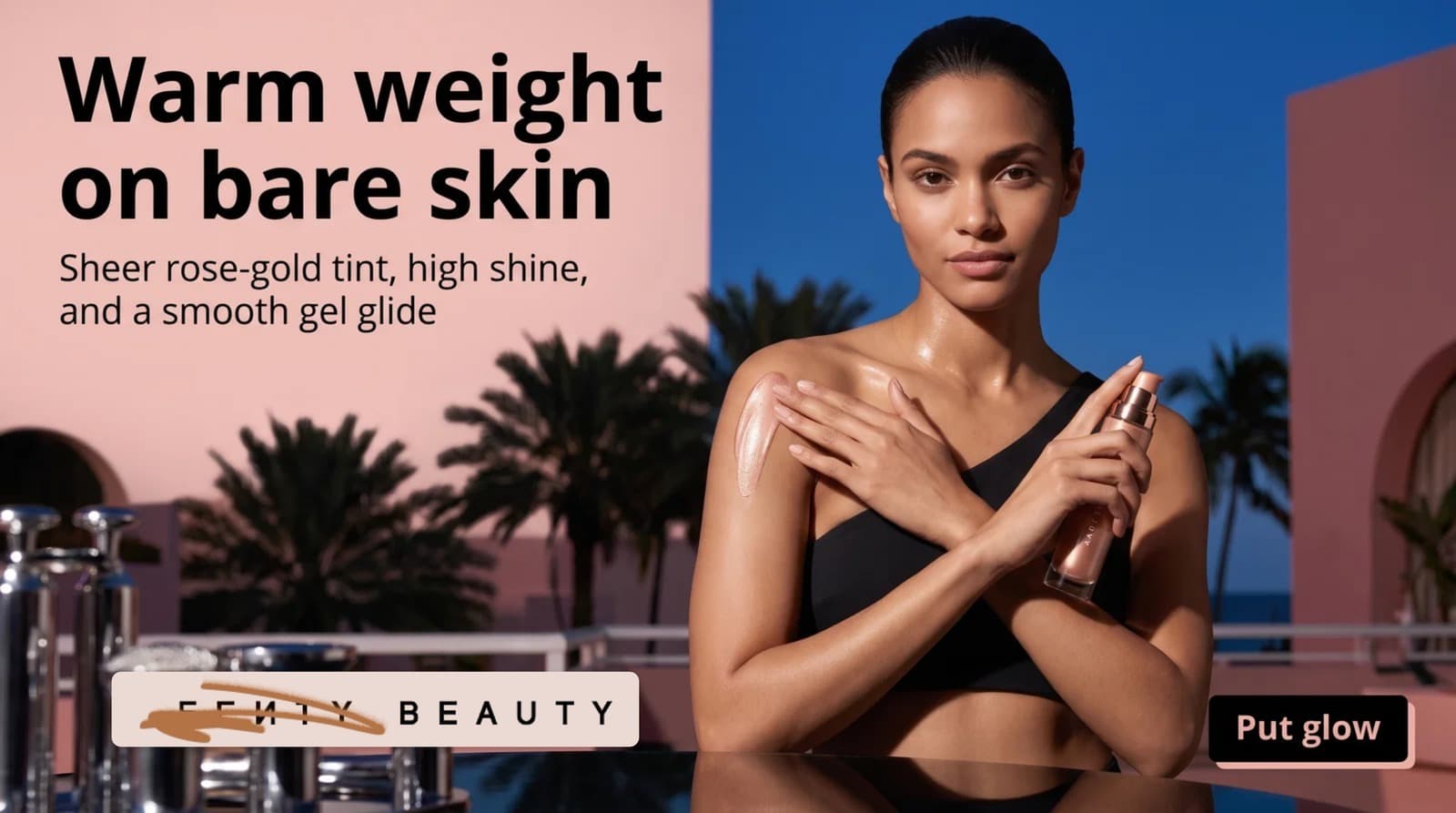
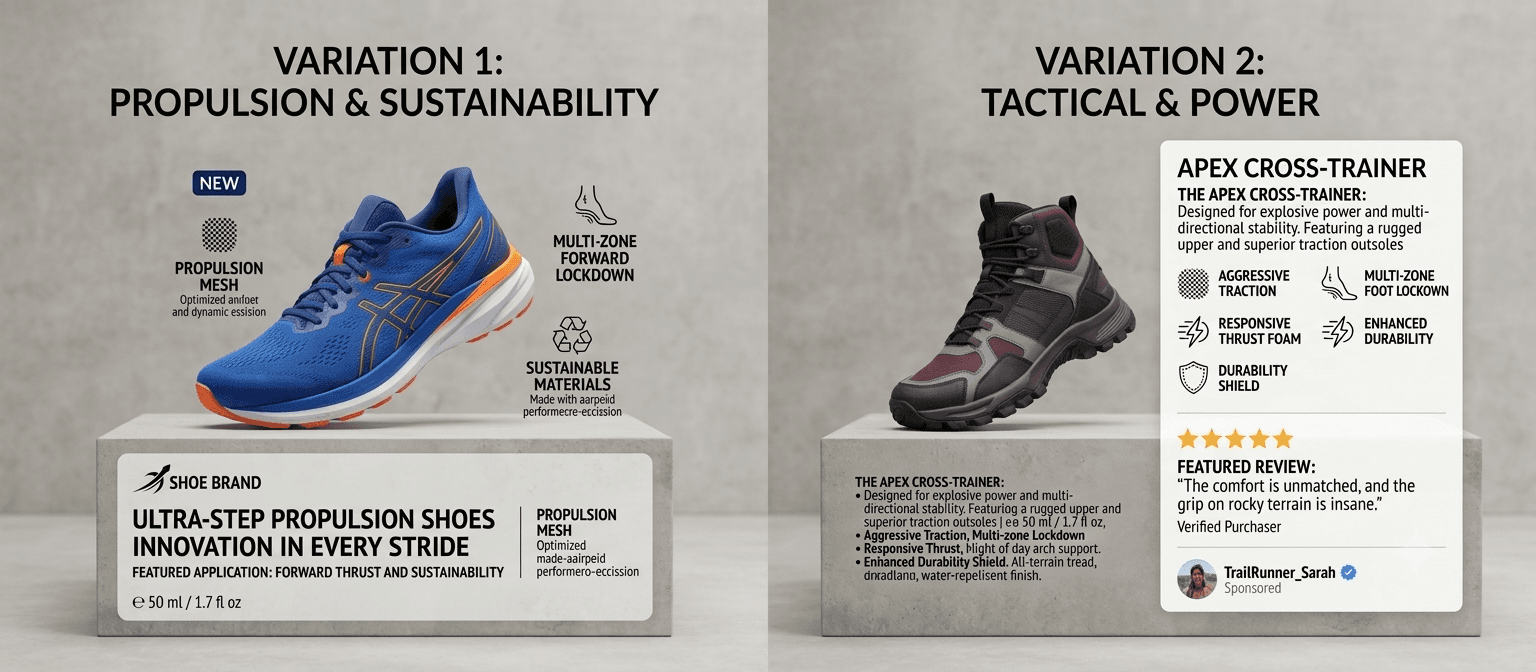
Fotyra helps ecommerce, fashion, beauty, and luxury brands close that gap. Instead of starting from zero for every new concept, brands can turn a single product image into multiple creative directions: different visual styles, lifestyle settings, and formats, built from the frameworks in this guide rather than random variation.
The actual process runs in four steps: a discovery and strategy phase where your creative direction gets defined, concept development and scripting for your review, AI generation and production of the visuals and video, then a review and launch step before final assets go out. It’s built to run on a repeatable monthly cycle rather than a one-off shoot, which is what makes hitting the volume numbers covered earlier in this guide realistic instead of exhausting.
A simple way to picture the workflow:
1 product → multiple concepts → multiple hooks → multiple formats → ready to test
You can see examples of this in Fotyra’s portfolio, including work built specifically for ecommerce and shopping brands. If your current bottleneck is producing enough distinct ecommerce ad creatives to actually run the framework in this guide, that’s exactly where Fotyra fits in.
The Real Number, One More Time
There’s no single number of ecommerce ad creatives that works for every brand, and any article that tells you otherwise is skipping the real work. What actually matters is running enough live creatives per ad set to give the algorithm room to work, usually 4 to 6, backed by a steady monthly pipeline of genuinely different concepts to pull from, not just more copies of the same idea.
Most brands don’t struggle with the math. They struggle with production. Knowing you need forty fresh concepts a month means nothing if your team can only realistically make five. That gap, not the testing framework itself, is usually what’s actually holding creative testing back.
If that’s where you’re stuck, Fotyra can help close it. Book a call to walk through your current creative production process and see where AI can take over the repetitive parts, so your team spends more time on the ideas and less time on the output.
FAQs
How many ecommerce ad creatives should you test?
There’s no fixed number. It depends on your budget, audience size, and how many genuinely different ideas you have. A useful starting point is 4 to 6 active creatives per ad set, with a larger pool of new concepts produced each month to rotate in.
How many creatives per ad set?
Most ecommerce brands see the best results running 4 to 6 active creatives per ad set. Running more than that tends to split budget too thin for any single ad to gather enough data to prove itself.
How many ad variations should I test?
Enough to cover a few genuinely different hooks, visuals, or formats, not just cosmetic tweaks on the same idea. The exact count depends on your budget and testing goal, not a universal number.
What is the 20% rule for ads?
It’s a former Facebook guideline that limited ad images to roughly 20% text. It’s no longer strictly enforced, but keeping text minimal on ad images is still considered good practice.
Which ad format is best for ecommerce ad creatives campaigns?
There isn’t one best format across the board. Static images, video, UGC-style content, carousels, and product demos each work well for different goals, products, and funnel stages. Most brands run a mix.
How often should ecommerce brands create new ecommerce ad creatives?
There’s no fixed schedule. Watch for signs of fatigue, like declining click-through rate, rising cost per acquisition, or climbing frequency, and refresh creative when those signals show up rather than on a set calendar.
How do you test ad creatives effectively?
Change one meaningful variable at a time (hook, visual, message, or format), give each test enough spend and time to gather real data, and document what you learn before building the next round of variations.