Creative Testing Framework: The Hook × Angle × Visual Matrix for Ecommerce Ads
 Ramsha·Updated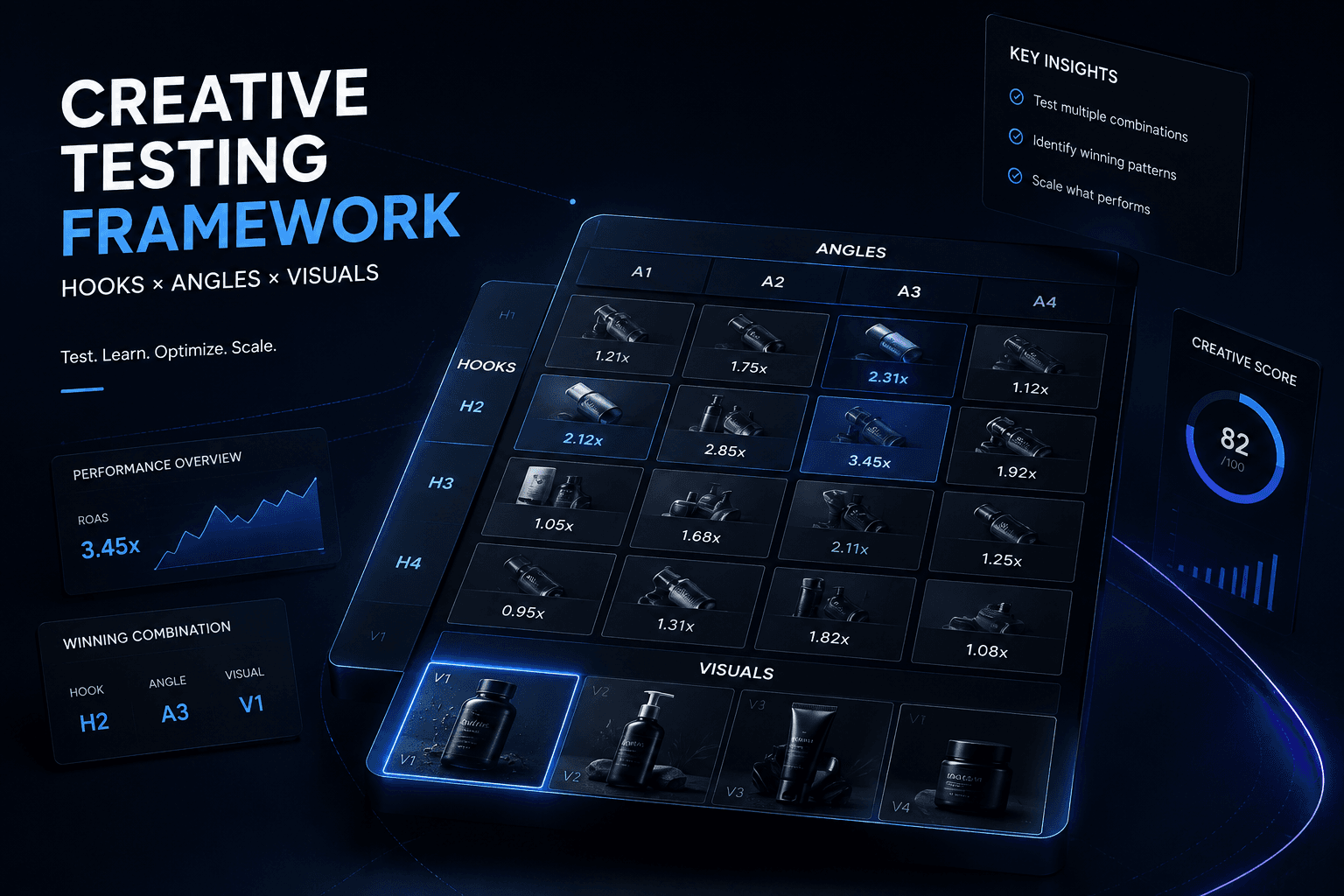
On this page15
- Table of Contents
- Quick Answer
- Key Takeaways
- What Is a Creative Testing Framework?
- Why Does Creative Testing Matter More Than Ever?
- The Hook × Angle × Visual Matrix: A Simple Framework for Ecommerce Creative Testing
- How Do Practitioner Frameworks Like 3-3-3 and 3-2-1 Compare?
- How Do You Build and Run a Creative Testing Framework, Step by Step?
- What Metrics Should You Track When Analyzing Creative Tests?
- How Much Budget and Sample Size Do You Need for Reliable Results?
- What Common Mistakes Ruin Creative Testing Frameworks?
- Tools for Running a Creative Testing Framework
- How Fotyra Fits Into Your Creative Testing Framework
- Conclusion
- Frequently Asked Questions
Table of Contents
You’ve probably already got a folder of ad variations sitting in Ads Manager: a few different hooks, a couple of angles, maybe a UGC clip next to a studio shot. But if you can’t say which of those three things actually moved the needle, you don’t have a testing framework. You have a folder. This guide breaks creative testing down into one matrix you can build in an afternoon, shows how it compares to the named frameworks media buyers reference (3-3-3, 3-2-1), and covers the metrics, budget, and tools that make the results trustworthy.
Quick Answer
A creative testing framework is a repeatable system for developing, testing, measuring, and learning from ad variations. For ecommerce brands, a useful starting structure is a Hook × Angle × Visual matrix: test different ways of earning attention, different reasons to care, and different creative executions while keeping the test objective clear. The goal isn’t simply to find a winning ad; it’s to understand which creative ingredients are contributing to performance so those learnings can be reused.
Key Takeaways
- A creative testing framework helps ecommerce brands test ad variations systematically instead of relying on guesswork.
- The Hook × Angle × Visual matrix provides a simple way to test attention, messaging, and creative execution.
- Test hooks to find what stops the scroll, angles to discover what resonates, and visuals to determine how the message should be delivered.
- Use performance metrics diagnostically to understand what is driving differences between creative variations.
- Avoid declaring winners too early; testing needs enough meaningful data to support a reliable decision.
- The goal isn’t to create more ads—it’s to turn every test into a learning that improves the next creative.
What Is a Creative Testing Framework?
A creative testing framework is a documented, repeatable system for isolating one variable in an ad the hook, the angle, or the visual execution and measuring its effect against a fixed set of metrics before scaling the result. It replaces the common approach of launching five different ads that each change three things at once, which produces a “winner” nobody can actually explain.
The word “framework” matters here. A single A/B test tells you which of two ads performed better. A framework tells you why, because it forces every test to change exactly one thing while holding everything else constant: same audience, same placement, same budget, same start time. Over enough cycles, that discipline becomes a playbook tailored to your audience, not generic industry advice.
Creative Testing Matrix vs. Test Matrix — Two Different Things
If you searched for “creative testing matrix” and also saw results for a “test matrix,” those are two unrelated concepts that happen to share the same word. A creative testing matrix, the subject of this article, is a marketing tool that maps hooks, angles, and visual formats to structure ad experiments.
A test matrix in software testing is a QA document that maps test cases to requirements or features to confirm software coverage before release. Same term, completely different discipline worth clearing up once so the rest of this guide isn’t confusing.
Why Does Creative Testing Matter More Than Ever?
Replace the long Andromeda paragraph with 2–3 sentences: Meta’s Andromeda system helps retrieve relevant ads from a much larger pool of creative candidates. As automation increases, creative diversity becomes increasingly important because different creative signals can help the platform match ads to different users.
The practical result: an ecommerce brand running one hook, one angle, and one visual style isn’t just leaving performance on the table; it’s giving the algorithm a single, thin signal to work with. A structured testing framework is how you feed it enough distinct, attributable signal to actually learn.
The Hook × Angle × Visual Matrix: A Simple Framework for Ecommerce Creative Testing

The Hook × Angle × Visual Matrix organizes creative testing into three practical layers: how the ad earns attention, what argument it makes, and how that argument is executed visually.
The layers can be tested sequentially when you want clean diagnostic learning, or combined when you’re testing complete creative concepts. The important principle is to define the variable you’re trying to learn about before launching the test.
| Layer | Controls | Question It Answers | Test It With |
|---|---|---|---|
| Hook | The first 2–3 seconds: opening line, first frame, or headline | Does anyone stop scrolling? | Hook (thumb-stop) rate |
| Angle | The core argument or reason to care not the product, the promise | Does the message land with this audience? | Hold rate and CTR |
| Visual | The execution:n UGC vs. studio vs. cinematic, model, setting, styling | Does the format and look match the angle and platform? | CTR and downstream conversion |
Layer 1 — Hooks (the first 3 seconds)
The hook is the opening element of the ad: the first few seconds of a video, the first frame, or the first line of copy in a static creative. Its job is to earn enough attention for the viewer to continue into the message. A strong hook does not guarantee conversion, but a weak opening can prevent a strong offer or product argument from ever being fully understood.
For ecommerce and beauty brands, four hook types cover most winning ads:
- Direct call-out — naming the exact viewer (“If your skin still looks dull by 2pm…”)
- Problem-first — stating the pain with no setup (“Your foundation keeps separating by noon.”)
- Before/after or transformation — a visual result shown immediately
- Contrarian claim — breaking an assumption the category has trained shoppers to expect
Test hooks against a fixed body and CTA. If two different hooks pull the same hold rate, the hook isn’t the problem; the angle underneath it is.
Layer 2 — Angles (the argument)
The angle is what the ad is actually selling, not the product; the reason to care about it. The same serum can be sold on status, transformation, ingredient proof, or social proof, and each version reaches a genuinely different buyer. A useful starting menu for ecommerce, fashion, and beauty brands:
- Transformation — the visible before/after (skincare, fitness, apparel fit)
- Proof-first — founder credentials, clinical or technical backing, third-party validation
- Pain–promise — name the frustration, promise the specific relief
- Status or aspiration — “the brand people who know already wear/use”
- Social proof — real customer voice, reviews, or UGC testimonial
Pair each angle with the same winning hook from Layer 1 so the only thing changing is the argument.
Layer 3 — Visuals (the execution)
Visual is the container the hook and angle are delivered in: UGC-style talking-to-camera, polished studio product photography, a cinematic lifestyle spot, or a static graphic with bold text. For fashion, beauty, and luxury ecommerce specifically, visual execution also includes model casting, wardrobe, setting, and styling, since those choices carry as much signal as the shot type itself.
Test the same winning hook and angle across two or three visual treatments, for example, the same “transformation” angle shot as UGC versus as a clean studio product shot to see which execution the platform rewards for that specific message.
Fill-in matrix template:
| Problem Lane | Hook (3 variants) | Angle (paired with winning hook) | Visual (2–3 formats) |
|---|---|---|---|
| e.g., “Foundation oxidizes by midday” | Direct call-out / Problem-first / Before-after | Transformation / Proof-first / Pain-promise | UGC / Studio static / Cinematic |
Start with one problem lane, three hooks, and one visual format to find your hook winner. Then hold the hook constant and rotate three angles. Then hold hook + angle constant and rotate visual formats. Three short cycles, one variable each; that’s the entire matrix.
How Do Practitioner Frameworks Like 3-3-3 and 3-2-1 Compare?
Creative testing frameworks such as 3-3-3 and 3-2-1 are best treated as practitioner methodologies rather than universal industry standards. Different media buyers and agencies may define the numbers differently.
The useful idea behind them is not the exact number sequence. It is the principle of creating multiple controlled variations so a brand can learn which creative concepts, hooks, messages, or executions deserve further investment.
| Framework | Structure | Best For | Relationship to the HAV Matrix |
|---|---|---|---|
| 3-3-3 | 3 concepts × 3 variations × 3 hooks (27 assets) | High-volume accounts with production capacity | The full matrix run at scale angle, visual, and hook all rotated in parallel |
| 3-2-1 | 3 hooks, 2 body variations, 1 CTA (6 assets) | Smaller budgets, already-validated CTA | The matrix’s hook and visual layers only, skipping angle rotation |
| Lever Stack/hierarchy | Hooks → angles → formats → audience, tested in that strict order | Any account wanting a testing sequence, not just a matrix | The same three-layer order this guide uses, plus a fourth audience layer that matters less post-Andromeda |
| 3-Phase (Pre-Flight → BAU → Scaling) | Stages creative through a testing pipeline rather than a matrix | Accounts that need a graduation process for winners | A rollout process that can sit around any of the matrix sizes above |
None of these require exclusive commitment. A lean team can run the 3-2-1 version of the matrix (skip angle rotation, keep hook and visual), while a brand with in-house production can run the full 3-3-3 version. The layer order hook, then angle, then visual stays the same regardless of matrix size.
See the matrix in action: Fotyra’s ad gallery shows the same product tested across dozens of different hooks, angles, and visual styles for beauty, skincare, and energy brands.
How Do You Build and Run a Creative Testing Framework, Step by Step?
- Audit your last 90 days of creative. Rank by cost per result to see which hooks, angles, and formats already have proven pull, so new tests build on evidence instead of a blank page.
- Pick one problem lane. Don’t test five buyer problems at once in your first cycle; that’s how budgets spread too thin to reach a real read on any of them.
- Write a specific hypothesis, not a hunch. “A problem-first hook will outperform a transformation hook for this audience” is testable. “Let’s see which one does better” is not.
- Build the matrix for that one lane. Three hooks against a fixed body first. Then three angles against the winning hook. Then two to three visual formats against the winning hook + angle.
- Launch with equal budget and identical timing. Same start time, same budget cap, same bidding strategy, and Adset Budget Optimization (ABO) rather than Campaign Budget Optimization in the testing phase, so budget doesn’t auto-drift to an early leader before the data is real.
- Read diagnostics before conclusions (see the metrics hierarchy below) once each variant hits its sample size threshold.
- Graduate the winner, then keep iterating. Move the winning combination into your always-on campaign structure, and start the next lane. Don’t stop testing once you find one winner.
If you want a deeper look at exactly how many creatives that rotation should include, read how many ecommerce ad creatives you should actually be testing, and if your current ads have gone stale, see how often ecommerce brands should refresh their ad creative.
What Metrics Should You Track When Analyzing Creative Tests?
The right metrics depend on the platform, format, and campaign goal. Use them diagnostically to identify where performance differs between variants and what creative variable may be driving the result.

If CPA spikes, this hierarchy tells you where to look first: a weak hook rate means the opening failed; a strong hook rate with a weak hold rate means the body or angle lost the viewer; a strong hold rate with a weak CTR means the CTA or offer isn’t landing.
How Much Budget and Sample Size Do You Need for Reliable Results?
There is no universal sample-size threshold. The right amount of data depends on spend, conversion volume, baseline performance, and the difference you want to detect.
A simple budget allocation that works for most ecommerce accounts:
- 5–10% of total ad spend for accounts with proven winners already in market, cycling in new concepts without disrupting profitable campaigns
- 20–30% of total ad spend for growth-stage accounts still searching for a repeatable winning formula
What Common Mistakes Ruin Creative Testing Frameworks?
- Changing more than one layer at once. New hook, new angle, and new visual in the same ad means nobody can say which change caused the result.
- Calling a winner too early. Early volatility is normal; a 48-hour lead often reverses.
- Uneven budgets or start times across variants. Time-of-day and day-of-week effects will skew results that look like creative differences but aren’t.
- Never documenting results. Without a shared log of hypothesis → result → confidence, teams re-run the same test by accident every quarter.
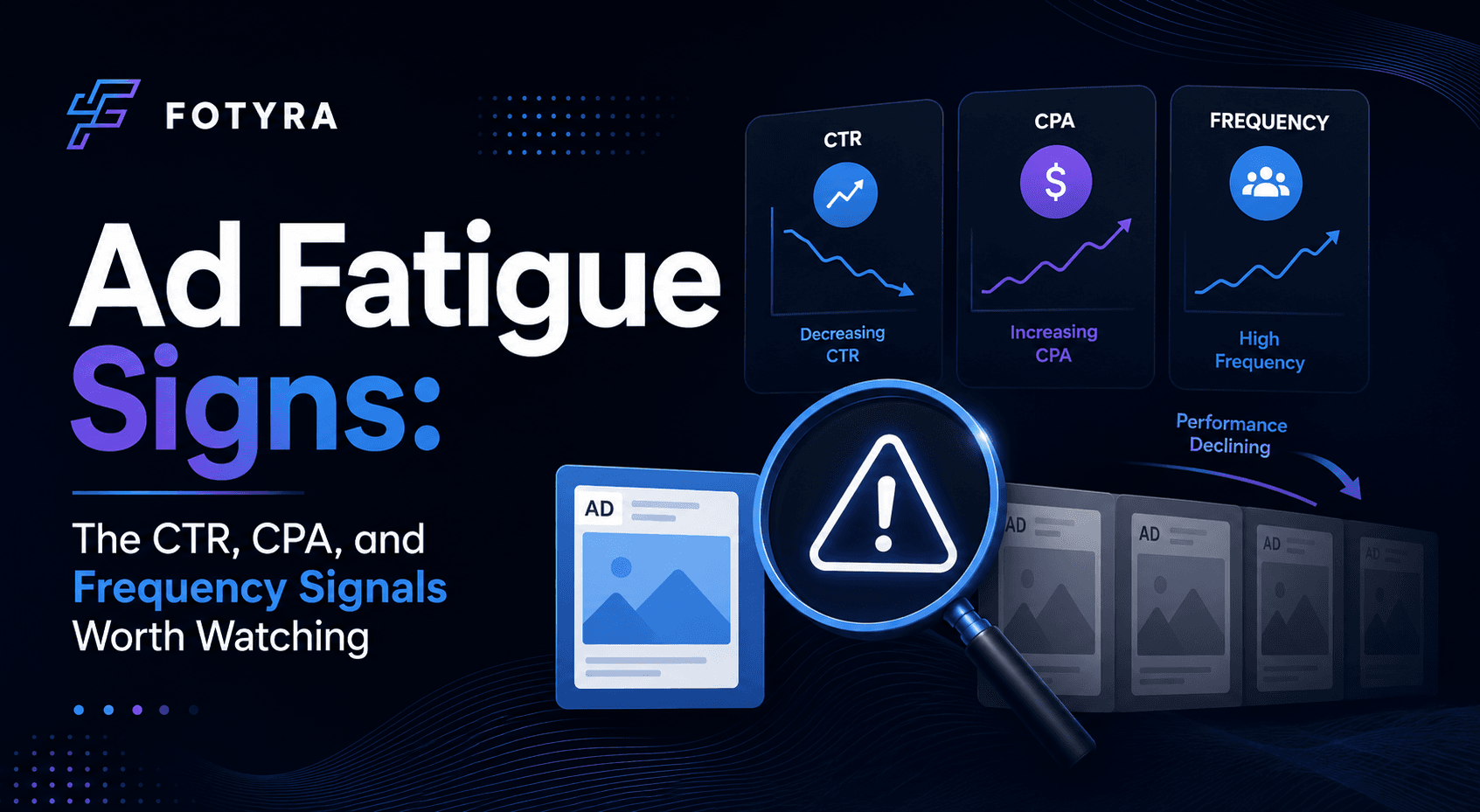
- Letting a fatigued winner run too long. Rising frequency paired with climbing cost per result is the signal to refresh, not to wait it out.
- Building a matrix with no way to produce it. A three-layer testing plan without production capacity to fill each cell is a strategy document, not a working framework.
Tools for Running a Creative Testing Framework
Most ecommerce teams combine three categories of tools:
- Native ad-platform tools — Meta Ads Manager (ABO/CBO structures, Advantage+ campaigns), Google Ads experiments, and TikTok’s testing tools handle delivery, budget splits, and native reporting.
- Analytics/read-out tools — whatever dashboard tracks hook rate, hold rate, and blended CPA/ROAS across creatives, since ad-platform reporting alone rarely surfaces the diagnostic hierarchy cleanly.
- Creative production tools — the layer that determines whether you can actually fill a hook × angle × visual matrix on a realistic timeline. This is where most in-house teams hit a wall: a matrix needs nine, eighteen, or twenty-seven distinct assets, and traditional photoshoot or agency production simply can’t turn those around fast enough to keep a testing cadence alive.
The most important tool is not the ad platform itself; it’s the testing log that connects each creative to a clear hypothesis and result.
At minimum, record:
- Creative ID
- Hook
- Angle
- Visual format
- Offer
- Audience/campaign
- Launch date
- Spend
- Impressions
- CTR
- Conversion rate
- CPA or ROAS
- Test hypothesis
- Decision
- Learning to carry into the next test
How Fotyra Fits Into Your Creative Testing Framework
The biggest challenge with a creative testing framework is often not deciding what to test. It’s producing enough high-quality variations to keep testing consistently.
That’s where Fotyra fits into the process.
Instead of treating creative production as a one-off campaign deliverable, Fotyra helps brands turn a product and brand brief into multiple on-brand creative directions that can be tested across hooks, angles, formats, and visual treatments.
For a team using the Hook × Angle × Visual framework, that means the strategy can move from a spreadsheet into production without requiring a separate photoshoot or lengthy creative process for every variation.
The role of the platform is not to replace the testing framework. It is to make the production layer fast enough for the framework to actually operate.
For a look at what a full brand-to-campaign run looks like, Fotyra published a transparent case study built on ReVive Skincare, clearly disclosed as an independent concept demonstration, not a paid client campaign showing Brand DNA, Product DNA, an AI spokesmodel roster, and a full static, cinematic, and UGC creative kit generated from a single brand brief.
Conclusion
A creative testing framework isn’t about producing more ads; it’s about producing ads you can actually learn from. The Hook × Angle × Visual matrix gives you a simple, ordered way to do that: earn attention first, prove the argument second, and let execution carry it home third, with one variable changing at a time so every result teaches you something specific about your audience.
Named frameworks like 3-3-3 or 3-2-1 are just different production sizes of that same idea. Start with one problem lane, one matrix, and one honest read of the diagnostics; the rest of your creative strategy builds from there.
Ready to see your own matrix filled in days instead of weeks? Book a call with Fotyra, and we’ll map your first Hook × Angle × Visual test using your actual product catalog.
Frequently Asked Questions
What is a creative matrix?
A creative matrix is a structured grid of hooks, angles, and visual formats used to plan ad variations so each test changes one variable and results can be attributed to a specific creative decision.
What is a test matrix in software testing?
A test matrix in software testing is a QA document mapping test cases to requirements or features to confirm coverage before a release. It’s a different discipline from a creative testing matrix and shares only the name.
How do you do creative testing?
Pick one problem your audience has, write a specific hypothesis, isolate a single variable (hook, angle, or visual), launch variants with equal budget and timing, and read hook rate, hold rate, and CTR before judging CPA or ROAS.
What is creative testing in Meta Business (Ads Manager)?
In Meta Ads Manager, creative testing typically means running multiple ad variations through A/B tests, dynamic creative, or separate ad sets under Adset Budget Optimization to compare performance under matched conditions before scaling a winner.
How many ad creatives should you test at once?
Most teams get cleaner reads testing two to four variants per flight in a single problem lane; testing everything at once spreads budget too thin for any one variant to reach a reliable sample size.
How long should a creative test run before you call a winner?
There is no universal timeframe. Run the test long enough to collect meaningful data and avoid making decisions from the first 24–48 hours unless the difference is very clear.
Written by
Ramsha
Writing about AI ad creative, brand DNA and what actually moves the numbers for e-commerce brands.