On this page12
- Table of Contents
- Quick Answer
- Key Takeaways
- What Is Ad Fatigue?
- Why Ad Fatigue Matters
- The Core Signals: CTR, CPA, and Frequency Thresholds
- Ad Fatigue vs. Audience Saturation vs. Rising Auction Costs
- What Are the Secondary Warning Signs of Ad Fatigue?
- How to Monitor These Signals in Practice
- How Do You Fix an Ad That’s Fatiguing?
- Conclusion
- Frequently Asked Questions
Table of Contents
You check your ad dashboard and notice something strange. The campaign that was performing well two weeks ago is suddenly getting fewer clicks. CPA is climbing. CTR is slipping. Frequency is increasing. Nothing obvious has changed. The offer is the same. The targeting is the same. The budget hasn’t dramatically increased.
So what happened?
Your audience may simply be getting tired of seeing the same creative.
This is known as ad fatigue or creative fatigue. It happens when repeated exposure causes people to pay less attention, engage less, and become less likely to convert.
The challenge is knowing when a normal performance fluctuation has become genuine fatigue.
Quick Answer
Ad fatigue usually appears as a pattern rather than a single metric:
- CTR gradually declines compared with the ad’s own historical baseline.
- CPA or CPM begins rising while engagement weakens.
- Frequency increases as the same people see the creative repeatedly.
- Engagement and other quality signals may decline.
- Newer creatives may outperform the older ad despite targeting the same audience.
There is no universal CTR, CPA, or frequency number that proves an ad is fatigued. Your campaign’s historical performance is usually the most useful benchmark. A sustained decline becomes much more meaningful when several of these signals happen at the same time.
Key Takeaways
- Ad fatigue happens when the same audience sees an ad so many times that engagement drops and costs climb, even though nothing about the offer or targeting has changed.
- A CTR decline of roughly 20 percent or more from an ad’s early performance, sustained for several days, is a commonly used working signal of fatigue rather than a fixed industry rule.
- Rising CPA or CPM alongside flat or falling CTR is a stronger signal than either metric alone because the campaign is paying more while generating weaker engagement.
- Frequency above roughly 3 to 4 impressions per person in a short window is a common early warning range, though tolerance varies widely by campaign objective and audience size.
- Declining performance is not always creative fatigue. Audience saturation, offer fatigue, and rising auction costs can look similar on a dashboard and need to be ruled out first.
- Secondary signals such as more ad hides, lower relevance rankings, and falling engagement can help confirm a fatigue diagnosis when the primary metrics are ambiguous.
- Refreshing creative, rotating offers, and expanding the audience are the three most reliable fixes once fatigue is confirmed.
What Is Ad Fatigue?
Ad fatigue is the decline in an ad’s performance that happens when the same audience sees the ad too many times and stops responding to it.
The mechanism is simple. The first few times someone sees an ad, it earns their attention. After that, the brain starts filtering it out, a pattern researchers describe as banner blindness. Engagement drops first, and cost efficiency tends to follow, because the ad typically needs more impressions to earn the same click or conversion once the audience has tuned it out.
Ad fatigue is not the same thing as a bad ad. A strong ad can fatigue quickly if it runs against a small audience too often, while a mediocre ad can hold up for months if it reaches a broad, constantly refreshed audience. That distinction matters, because the fix for fatigue (new creative, a wider audience, a tighter frequency cap) is different from the fix for a genuinely weak ad (a new offer, a new angle, a new landing page), and bad ad creative can quietly kill ecommerce sales even when fatigue was never the actual problem.
Why Ad Fatigue Matters
Ad fatigue affects the budget mainly through the auction. As engagement per impression falls, an ad usually needs more impressions to generate the same number of clicks or conversions. On auction-based platforms like Meta and Google, ads that engage their audience less effectively often become more expensive to deliver as a result. The exact mechanics differ by platform and change over time, but the practical effect for advertisers is fairly consistent: cost per click and cost per acquisition tend to climb as engagement declines, even when nothing else about the campaign has changed.
The effect can extend past a single campaign, too. Repeated exposure to a stale ad can create a negative association with the brand itself, and on Meta specifically, negative feedback signals such as hides and “see less” clicks are one of the inputs the platform’s delivery system takes into account, which is part of why a heavily fatigued ad can sometimes affect more than just its own results.
For growing accounts, fatigue is often the hidden reason a previously profitable campaign quietly stops scaling. Catching it early protects the budget and the account’s ability to keep delivering at a reasonable cost.
The Core Signals: CTR, CPA, and Frequency Thresholds

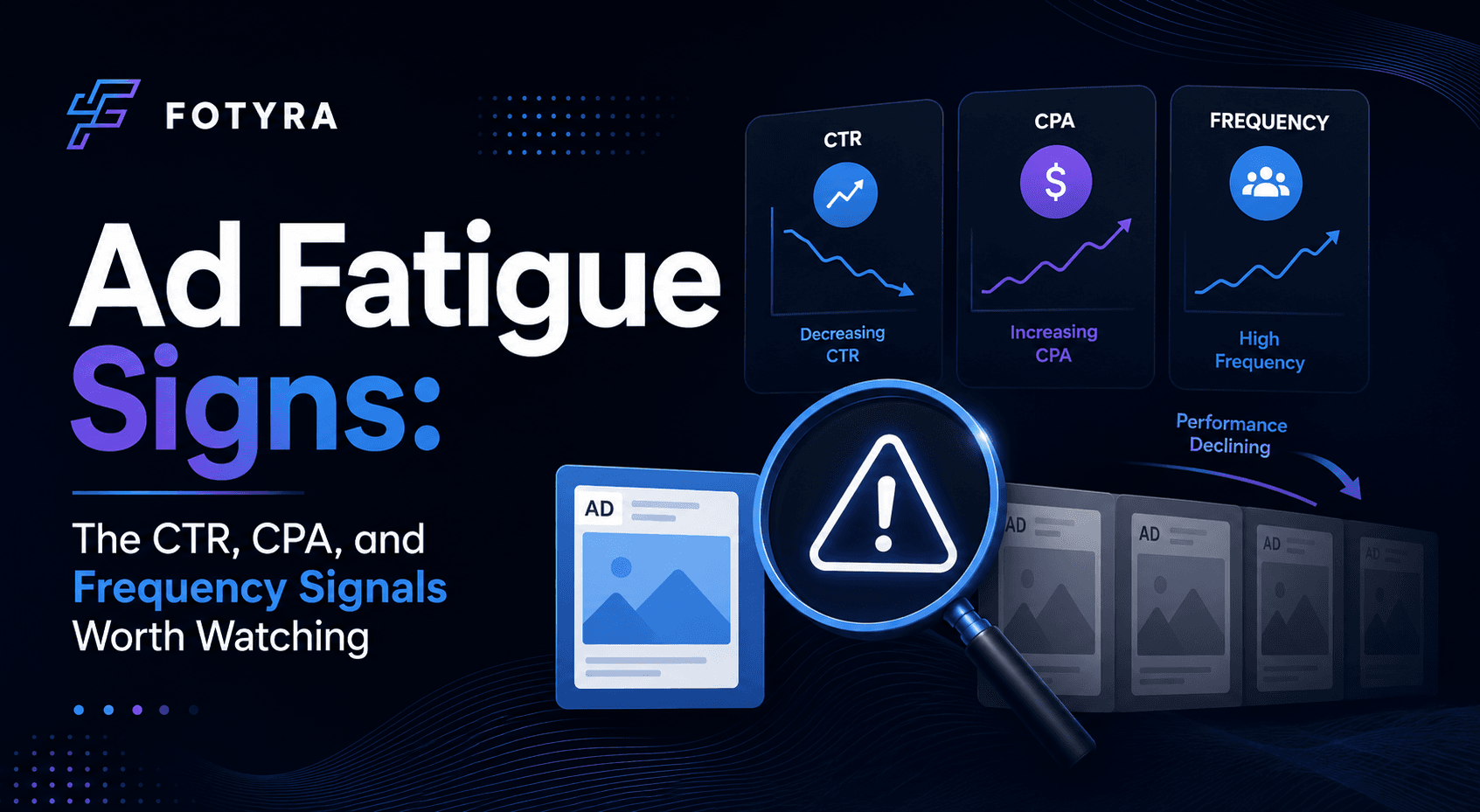
Diagnosing ad fatigue works best as a pattern match across three signals rather than a single metric checked in isolation. A CTR dip on its own could be seasonal. A frequency spike on its own could simply mean the audience is small. It is the combination, a falling CTR alongside a rising cost and a climbing frequency, that makes fatigue the more likely explanation.
What CTR Drop Indicates Ad Fatigue?
A sustained CTR decline of around 20 percent or more from an ad’s own early-performance baseline, held for several consecutive days rather than a single dip, is a commonly used working signal of fatigue. It is not a formal industry standard, and practitioners differ on the exact cutoff, so treat it as a useful indicator rather than a hard rule, especially when frequency is also rising, and CPA is deteriorating at the same time.
Because a “good” CTR varies enormously by industry, platform, and even how a platform counts a click, the more reliable comparison is still your own ad’s early performance against its current performance. For a general sense of scale, WordStream’s 2025 Facebook Ads benchmark report, based on more than 1,000 US campaigns, puts the average CTR at 1.71 percent for traffic campaigns and 2.59 percent for lead generation campaigns.
Databox’s separate cross-company benchmark data shows a somewhat lower median, closer to 1.5 percent. The gap between the two is a useful reminder that different providers measure clicks differently, so neither figure should be read as a strict pass-or-fail line.
Creative quality still sets a ceiling on CTR too: stronger product imagery on its own tends to lift both click-through and conversion rates, separate from whatever fatigue is doing to the trend line.
How Much Does CPA Need to Rise Before It Signals Fatigue?
There is no single dollar figure that defines a fatigue-level CPA increase. It becomes a more meaningful signal when it rises alongside flat or falling CTR, since an isolated CPA increase can just as easily come from seasonality, new competitors entering the auction, or a temporary platform change.
Third-party benchmark aggregators have reported average Meta CPA figures in the high 30-dollar range for 2026, up noticeably from prior years alongside rising CPMs. Treat that figure as directional context rather than an official platform number, since it comes from a third-party aggregator rather than Meta itself. If your own CPA is climbing well beyond your account’s historical range while frequency is also rising, that combination points more strongly to creative wearout than to a broader market shift.
What Frequency Level Typically Causes Ad Fatigue?
Frequency thresholds vary by campaign type and audience size, but one commonly cited working framework treats roughly 2 to 3 impressions per person as a normal range, 3 to 4 as an early warning to start preparing a refresh, and 4 to 5 or higher as a stronger signal to act (Adamigo, Meta Ads Frequency Benchmarks). These bands come from industry practitioners rather than a fixed rule published by Meta or Google, and different agencies report somewhat different numbers.
Cold prospecting campaigns and small retargeting pools tend to fatigue fastest, since the same limited group of people absorbs most of the impressions. Broad prospecting audiences and brand awareness campaigns can often sustain a noticeably higher frequency, sometimes 6 to 10 or more, without the same drop-off, because repetition plays a different role when the goal is recall rather than an immediate click.

These ranges are directional working indicators, not universal thresholds. Weigh them against your own campaign’s historical baseline, audience size, objective, and attribution window before deciding to refresh.
Ad Fatigue vs. Audience Saturation vs. Rising Auction Costs
A declining CTR or a climbing CPA does not automatically mean the creative itself is worn out. A few distinct problems can produce a similar-looking dashboard, and mixing them up leads to the wrong fix.
- Creative fatigue is what most people mean by “ad fatigue”: the audience has seen the specific creative enough times that they have stopped responding to it. The fix is genuinely new visuals, a new hook, or a new format, not a small edit to the same asset.
- Audience saturation happens when the targeting pool is too small for the spend level, so the same people are reached repeatedly regardless of how fresh the creative is. This shows up as frequency climbing quickly even on a brand-new ad. The fix is widening or refreshing the audience, not necessarily the creative.
- Offer fatigue occurs when the audience has seen the underlying offer or message so many times that they tune it out, even if the visuals rotate. Running “20% off” in every new creative variation can still fatigue the offer itself. The fix is a new angle, price point, or message, not just a new image.
- Rising auction costs, sometimes called market pressure, happen when competition for the same audience increases, pushing up CPMs across the board regardless of any single ad’s performance. This typically shows up as CPM rising for most or all campaigns in the account at once, and creative refresh alone will not fix it.
Because these four causes can look alike in any single metric, the fastest way to tell them apart is to compare the underperforming ad against the rest of the account. If only one ad is declining while the rest of the account holds steady, creative or offer fatigue is the more likely cause. If the whole account is moving together, saturation or auction pressure is the stronger explanation. For a closer look at cadence, see how often ecommerce brands should actually refresh their ads.
What Are the Secondary Warning Signs of Ad Fatigue?
Beyond the three core metrics, a few secondary signals often appear alongside fatigue and can help confirm the diagnosis.
- Rising negative feedback. More “hide ad” or “see less” clicks on Meta, or a higher skip rate on video, usually means the audience is actively tuning the ad out.
- Falling relevance or quality signals. A dropping quality ranking, engagement rate ranking, or conversion rate ranking on Meta, or a falling Quality Score on Google Ads, often moves in the same direction as fatigue, though it can also reflect other issues like landing page or targeting problems.
- Declining engagement rate. Fewer likes, comments, shares, or saves relative to reach, even before CTR fully drops, can act as an early leading indicator.
- Shrinking reach at the same spend. If the platform spends the same budget but reaches fewer unique people, it may be repeatedly serving the ad to a shrinking pool of engaged users instead of finding new ones, which is also a hallmark of audience saturation.
How to Monitor These Signals in Practice
Most ad platforms already surface the data needed to catch fatigue early. It mostly needs to be checked on a regular cadence rather than only after performance has already dropped.
In Meta Ads Manager, add Frequency, CTR (all), CPM, and CPA as columns in a saved reporting view, and break results down by week so the trend is easy to spot. Google Ads and TikTok Ads Manager offer similar breakdowns under their performance and audience reporting tabs.
A weekly check is usually enough for most accounts, though high-spend or narrow audience campaigns benefit from a twice-weekly review, since fatigue can set in faster with a smaller pool of people. Automated rules that flag an ad once frequency crosses a set threshold, or once CTR falls a set percentage below its recent average, remove the need to check manually every day.
Once fatigue is confirmed, the harder part usually isn’t identifying it; it’s producing enough genuinely different creative to replace the fatigued asset before it keeps draining budget. Waiting days for a new batch of assets is a common bottleneck for teams that test creative often.
This is where an AI creative production workflow like Fotyra can help: instead of restarting production from scratch, teams can turn one winning concept into several new, on-brand variations the same day, test them, and get a fresh version back into rotation before performance drops further. Explore Fotyra’s AI creative workflow.
How Do You Fix an Ad That’s Fatiguing?
Once fatigue is confirmed, a few responses reliably reset performance.
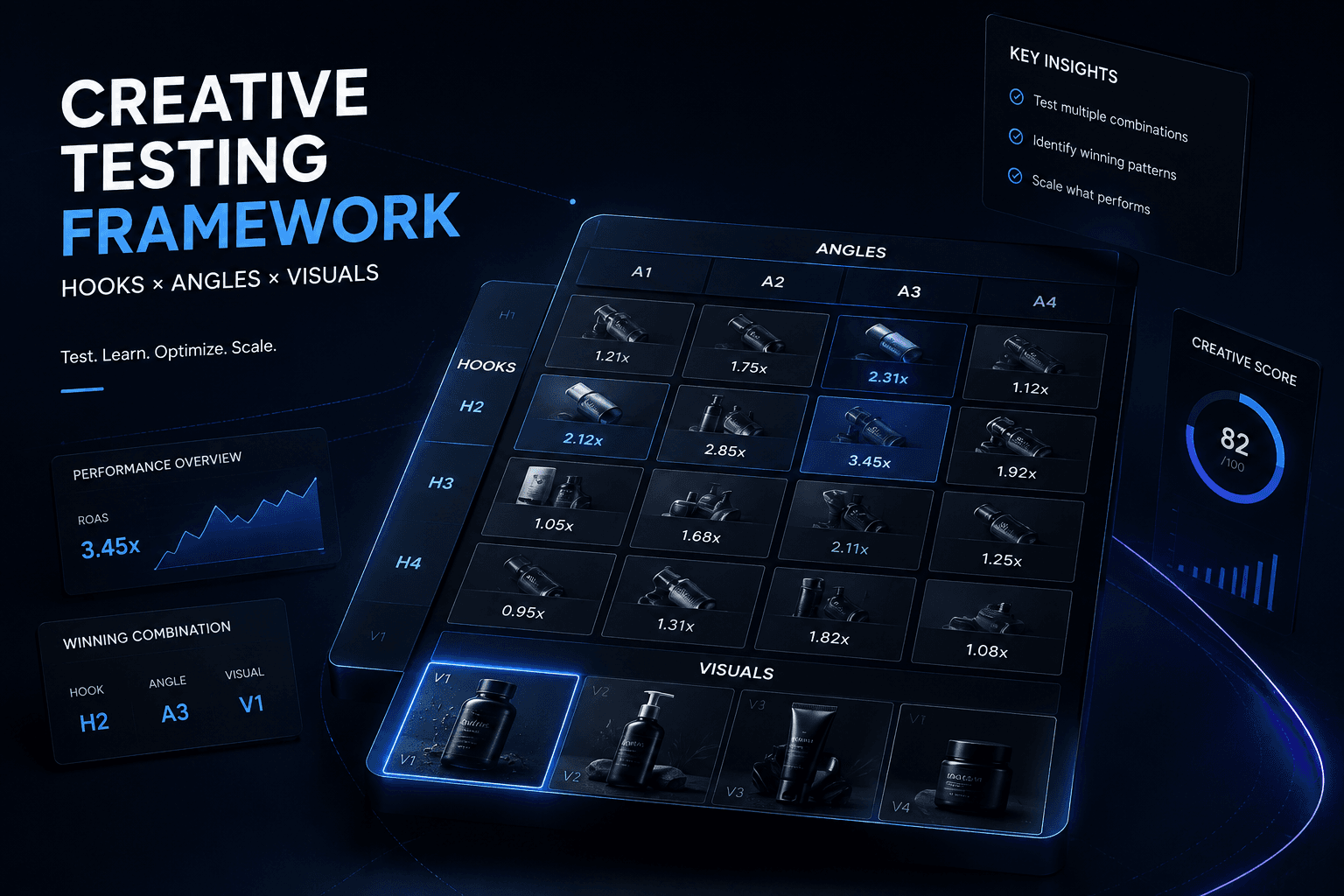
- Refresh the creative. New visuals, a new hook, or a different format, such as video instead of static or carousel instead of single image, gives the audience something new to notice. A structured hook, angle, and visual testing framework helps you tell which change actually moved performance, and our guide on creating scroll-stopping ecommerce ads with AI covers the creative side in more depth.
- Rotate offers or messaging. Even with the same core creative, a new headline, price point, or call to action can reset engagement without a full production cycle.
- Expand or refresh the audience. Widening targeting, adding lookalike segments, or excluding people who have already seen the ad several times spreads impressions across more people and lowers frequency naturally.
- Tighten the frequency cap. On platforms that support it, setting an explicit cap prevents the algorithm from overserving a shrinking pool of engaged users.
- Build a rotation schedule instead of a one-time fix. Treating creative refresh as an ongoing calendar, rather than a reaction to a problem, keeps fatigue from becoming a recurring fire drill.
Conclusion
Ad fatigue is rarely a single bad metric. It shows up as a pattern: CTR sliding, CPA or CPM climbing, and frequency creeping past your account’s normal range, all at the same time, and it’s worth ruling out audience saturation, offer fatigue, and auction pressure before assuming the creative is the problem. Catching the right pattern early, before the algorithm starts spending more to reach fewer engaged people, is what protects the budget and keeps a campaign scalable.
The teams that manage fatigue well do not treat creative refresh as an emergency response. They build it into the calendar and shorten the gap between spotting fatigue and getting a fresh version back into rotation. Talk to the Fotyra team about scaling your creative production.
Frequently Asked Questions
What is a good CTR rate for ads?
A good CTR depends heavily on platform, industry, and campaign objective, so there is no single number that applies everywhere. As a general cross-platform reference point, click-through rates in the 1 to 3 percent range are common for social and display ads, with search ads often running higher. Your own ad’s historical performance is still a more reliable benchmark than an external average.
What is a normal CTR for Meta ads?
On Meta specifically, WordStream’s 2025 benchmark data puts the average CTR at 1.71 percent for traffic campaigns and 2.59 percent for lead generation campaigns, while Databox’s separate cross-company data shows a median closer to 1.5 percent. The gap between these two figures is a good reminder to check more than one source and treat any single number as a rough guide rather than a strict target.
What ad frequency is too high?
Frequency above roughly 4 to 5 impressions per person within a short reporting window is commonly treated as too high for cold or narrow audience campaigns, while broad prospecting and brand campaigns can often sustain 6 to 10 without the same drop-off. The right number depends on audience size and campaign objective, so it works best as a directional guide alongside CTR and CPA rather than a fixed rule.
What is a good frequency cap?
A good frequency cap typically limits exposure to around 3 to 4 impressions per person per week for prospecting campaigns, and slightly higher, around 5 to 7, for retargeting campaigns aimed at warmer audiences. The right cap ultimately depends on audience size, since a small retargeting pool reaches a high frequency far faster than a broad prospecting audience at the same spend.
How quickly can ad fatigue happen?
How fast fatigue sets in depends heavily on audience size and how often the ad is shown. On narrowly targeted social campaigns with a small audience, fatigue can appear in as little as two to three weeks, while an ad reaching a large, constantly refreshed audience on a lower-frequency channel can stay effective for two to three months or longer. Tracking your own frequency and CTR trend over time is a more reliable guide than relying on a fixed timeline.
.
- #ad fatigue
- #AI Ad Creative Production
- #AI creative studio
- #Content fatigue
- #CPA
- #creative advertising agency
- #creative fatigue
- #CTR
- #fotyra

Written by
Ramsha
Writing about AI ad creative, brand DNA and what actually moves the numbers for e-commerce brands.