On this page21
- Quick Answer: What Is the Best AI UGC Video Generator?
- What Is an AI UGC Video Generator?
- Why Are AI UGC Video Generators Important for Ecommerce?
- How We Chose the Best AI UGC Video Generators
- The 10 Best AI UGC Video Generators in 2026
- 2. Arcads — Best for AI Actors and Self-Serve UGC Ads
- 3. Creatify — Best for Product URL-to-UGC Videos
- 4. MakeUGC — Best for Dedicated AI UGC Creation
- 5. Captions — Best for UGC Generation Plus Editing
- 6. Topview — Best for Ecommerce UGC Automation
- 7. InVideo AI — Best for Broad AI Video Creation
- 8. HeyGen — Best for AI Avatars and Localization
- 9. VEED — Best for UGC Creation and Editing
- 10. Synthesia — Best for Professional AI Presenter Videos
- Why Is Fotyra the Best AI UGC Solution for Ecommerce?
- How Should You Choose the Best AI UGC Video Generator?
- What Makes a High-Quality AI UGC Ad?
- Are AI UGC Videos Better Than Traditional UGC?
- What’s Next for AI UGC Video Generator?
- Conclusion
- FAQs: Best AI UGC Video Generators in 2026
If you’re looking for the best AI UGC video generator, you’ve probably noticed that most platforms now promise realistic AI creators, product videos, and ad-ready content. The real challenge is choosing a tool that can produce usable UGC advertising creative, not just impressive AI clips. This guide compares 10 leading AI UGC tools and explains why Fotyra stands out for ecommerce brands that want strategy, production, and campaign-ready creative rather than another software dashboard.
Quick Answer: What Is the Best AI UGC Video Generator?
The best AI UGC video generator depends on your workflow, but Fotyra is the strongest overall option for ecommerce brands that want a done-for-you creative production system. Arcads, Creatify, MakeUGC, Captions, Topview, InVideo, HeyGen, VEED, and Synthesia are strong alternatives for specific self-serve use cases.
Fotyra is different because it combines AI UGC ads with brand strategy, product understanding, creative direction, AI spokesmodels, editing, QA, and scalable ad production rather than treating UGC generation as a single isolated task. Fotyra describes its service as a done-for-you AI production house for UGC ads, cinematic ads, AI spokesmodels, B-roll, and static creatives.
What Is an AI UGC Video Generator?
An AI UGC video generator is a platform or production system that creates creator-style video content using AI-generated presenters, voices, scripts, product visuals, and editing. Traditional UGC requires a real person to film the content. AI UGC uses synthetic or AI-assisted creators to produce a similar social-first format.
For example, an ecommerce brand can provide a product page, product images, or campaign brief and generate a short video featuring an AI creator explaining, demonstrating, or recommending the product.
The important distinction is that AI UGC looks like creator content but does not automatically represent a real customer’s experience. Brands should never present a synthetic creator as a genuine customer testimonial when that experience did not occur.
Want to see what AI UGC can look like in practice? Check out this example of how Fotyra created a UGC-style video for a real product, from concept and creative direction to the final ad.
Why Are AI UGC Video Generators Important for Ecommerce?
AI UGC generators help ecommerce brands produce more creative variations without repeating the full traditional creator-production process for every ad.
Instead of producing one concept, brands can test different hooks, scripts, creators, product angles, settings, and calls to action.
For example, one skincare product can become a problem-solution ad, a product demonstration, a creator review-style video, and an objection-handling ad.
That matters because modern paid social campaigns require creative variety. Meta’s current Reels guidance recommends vertical 9:16 video, audio, and keeping key messages within safe zones for Reels creative.
The value of AI UGC is therefore not just faster production. It is the ability to make creative testing more practical.
How We Chose the Best AI UGC Video Generators
The best AI UGC generator should be judged by advertising usefulness, not simply by the number of avatars or AI features it offers.
For this comparison, the key criteria are:
- UGC realism
- Product integration
- Script and creative control
- Creative variation
- Editing
- Ecommerce workflow
- Brand consistency
- Ad readiness
- Localization
- Overall production model
This is also why Fotyra is evaluated differently from purely self-serve tools. Fotyra is positioned as a done-for-you AI production house, while many alternatives primarily provide software that the marketing team operates itself.
The 10 Best AI UGC Video Generators in 2026

1. Fotyra — Best Overall for Ecommerce Creative Production

Fotyra is an AI creative production house that creates UGC ads as part of a broader ecommerce advertising system.
Instead of requiring the brand to manage every stage, Fotyra combines Brand DNA, Product DNA, creative strategy, AI spokesmodels, UGC production, editing, and campaign-ready delivery. Its current platform describes an ecommerce workflow that starts from the store and moves through product and brand understanding before creative production.
That distinction matters.
A self-serve generator may ask you to choose an avatar and write a script. Fotyra’s workflow is designed to determine what should be created for the product and audience before generating it.
Fotyra also produces more than UGC. Its platform supports UGC ads, cinematic video ads, AI spokesmodels, B-roll, and static creatives.
Pros
- Done-for-you creative production
- Ecommerce-focused workflow
- Brand and product intelligence
- UGC plus cinematic and static creative
- Creative strategy and direction
- AI spokesmodels
- Human-in-the-loop QA
- Campaign-ready output
Cons
- Not designed as a purely self-serve DIY tool
- Better suited to brands seeking production support than casual creators
Best for
Ecommerce, DTC, fashion, beauty, luxury, and consumer brands that need a complete creative production system.
Why Fotyra Stands Out
Fotyra’s strongest advantage is that it solves the problem around AI generation.
Its approach reflects the principle that an AI clip is not automatically a finished advertisement. Fotyra’s own editorial framework emphasizes the importance of hooks, storytelling, pacing, marketing psychology, and strategic editing.
2. Arcads — Best for AI Actors and Self-Serve UGC Ads

Arcads is a strong AI UGC platform for marketers seeking a wide selection of AI actors and direct control over ad creation.
Arcads currently promotes AI actors, custom actors, product interaction, emotion control, localization, and advertising-focused workflows. The platform is especially useful when a performance marketer already has a strong concept and wants to generate multiple creator-style variations.
Pros
- Large AI actor selection
- Strong UGC focus
- Product interaction
- Advertising-oriented workflow
- Creative variation
- Localization
Cons
- Primarily self-serve
- Users still need to provide much of the creative direction
- Broader creative production may require additional tools
Best for
Performance marketers, agencies, and DTC teams that want hands-on control over AI UGC production.
3. Creatify — Best for Product URL-to-UGC Videos

Creatify is particularly useful for ecommerce marketers who want to turn product URLs into UGC-style advertising creative. Its UGC Creator workflow allows users to start with a product URL or prompt, develop scripts, select AI presenters, and generate the video. This makes it appealing to ecommerce teams that already have complete product pages.
Pros
- Product URL workflow
- Strong ecommerce orientation
- AI presenters
- Script generation
- Fast creative production
- Multiple ad variations
Cons
- More self-serve than managed
- Creative quality still depends on the user’s direction
- Not a replacement for full creative strategy
Best for
Shopify and DTC marketers looking for fast product-to-UGC production.
4. MakeUGC — Best for Dedicated AI UGC Creation

MakeUGC is a dedicated AI UGC platform focused on AI actors, product-in-hand videos, motion, captions, and creator-style advertising.
The platform emphasizes product-in-hand generation and high-volume AI UGC production, making it particularly relevant for ecommerce brands where showing the physical product is important.
Pros
- Dedicated UGC workflow
- Large AI actor library
- Product-in-hand content
- Motion control
- Captions and editing
- Strong ecommerce use case
Cons
- Primarily a self-serve workflow
- Brands still need to develop effective concepts
- Not as broad as a full creative production partner
Best for
Brands and agencies producing large volumes of product-focused UGC videos.
5. Captions — Best for UGC Generation Plus Editing

Captions combines AI-driven UGC video generation with social-first video editing, making it useful for teams that want to create and refine videos in a single workflow. Its AI Ads workflow supports product URLs, scripts, avatars, generation, and editing. The editing layer is useful because AI generation is rarely the end of the creative process.
Pros
- AI UGC generation
- Product-focused workflows
- AI presenters
- Strong editing tools
- Captions and social features
- Easy for short-form teams
Cons
- Broader editing platform rather than a dedicated ecommerce production house
- Strategic creative development remains largely user-led
Best for
Social media teams that want AI UGC generation and editing together.
6. Topview — Best for Ecommerce UGC Automation

Topview is an AI video platform focused on turning product information into product videos and UGC-style advertising. Its AI UGC workflow supports product information, AI creators, product presentation, multilingual content, and social advertising formats.
Pros
- Ecommerce-focused
- Product-driven workflows
- AI creators
- Product demonstrations
- Multiple social formats
- Automation
Cons
- Broad platform can mean more complexity
- Creative strategy remains important
- Less focused on done-for-you production
Best for
Ecommerce brands that want a self-serve product-to-video workflow.
7. InVideo AI — Best for Broad AI Video Creation

InVideo AI is a broader AI video platform that also supports UGC-style advertising, product videos, AI actors, and social content. Its UGC resources cover product advertising, AI actors, product interaction, and short-form advertising workflows.
Pros
- Broad AI video capabilities
- UGC creation
- Product videos
- Editing
- Social formats
- Useful beyond UGC
Cons
- UGC is only one part of the platform
- Less specialized than dedicated UGC tools
Best for
Marketing teams that need UGC plus other AI video formats.
8. HeyGen — Best for AI Avatars and Localization

HeyGen is best known for AI avatars and AI UGC creator production, making it useful when presenter consistency and localization matter. It is broader than a dedicated AI UGC platform, but its avatar capabilities can support creator-style social content.
Pros
- Strong AI avatars
- Voice and localization capabilities
- Broad use cases
- Professional presentation
- Multiple languages
Cons
- Not exclusively focused on ecommerce UGC
- Less specialized for product advertising
- Can feel more presenter-led than creator-native
Best for
Brands needing AI presenters and multilingual content across several markets.
9. VEED — Best for UGC Creation and Editing

VEED is a strong option for teams that want an AI UGC video generator combined with a full online video editor.
Its broader editing environment makes it possible to combine generated content with B-roll, captions, product footage, and existing brand assets.
Pros
- AI UGC capabilities
- Strong editing environment
- Captions
- B-roll
- Product footage
- Easy browser-based workflow
Cons
- UGC is one part of a broader editor
- Creative strategy is still largely user-controlled
Best for
Social content teams that value editing flexibility.
10. Synthesia — Best for Professional AI Presenter Videos

Synthesia is best suited to professional AI presenter content, enterprise video, and multilingual communication rather than purely casual ecommerce UGC.
It belongs in this comparison because AI presenter platforms overlap with the broader UGC category, but its strongest use cases are more polished and informational.
Pros
- Professional AI presenters
- Strong multilingual capabilities
- Enterprise workflows
- Consistent presentation
- Broad business applications
Cons
- Less UGC-focused
- More corporate presentation style
- Less suited to raw, creator-native advertising
Best for
Enterprise brands that need professional AI-presenter content alongside other marketing videos.
Why Is Fotyra the Best AI UGC Solution for Ecommerce?
Fotyra is the strongest choice for ecommerce brands that need AI UGC as part of a complete creative production workflow, rather than as a standalone video-generation task. The difference starts with what happens before the video is generated.
Fotyra’s current system uses store information to build Brand DNA, Product DNA, and Persona DNA, then uses creative roles including creative direction, copywriting, art direction, film direction, performance strategy, and continuity QA.
That means the goal is not simply:
Generate an AI creator.
It is:
Understand the brand → understand the product → identify the audience → develop the concept → cast the creator → produce the UGC → refine it → deliver the campaign asset.
That is why Fotyra is particularly strong for ecommerce. A skincare brand needs more than a person holding a bottle. A fashion brand needs more than an AI model speaking into a camera. A luxury brand needs more than a template.
The creative needs to understand why the product matters. Fotyra’s broader production approach also means brands can create UGC alongside cinematic ads and static creative. Its Lumara case study, for example, combines UGC, cinematic video, and static ads so each format performs a different creative role.
This is a major advantage for brands that do not want to manage five separate AI tools. Fotyra is therefore best viewed as an AI creative production system, not simply an AI avatar generator.
How Should You Choose the Best AI UGC Video Generator?
Choose an AI UGC generator based on your production model, product requirements, creative volume, and level of support, not just the lowest software price.
Choose a self-serve platform when you already have a capable creative team and want to operate the workflow internally.
Choose a specialized UGC tool when your main requirement is generating creator-style videos quickly.
Choose Fotyra when you want creative strategy, production, AI UGC, editing, and campaign-ready delivery handled within one ecommerce-focused system.
Fotyra’s pricing page currently positions its plans around recurring creative production, including UGC, cinematic videos, static ads, Brand DNA, storyboarding, revisions, and, at higher tiers, ad-performance consulting.
See how Fotyra turns products into campaign-ready AI UGC, cinematic ads, and high-converting creative. Explore our portfolio to see real examples of our work.
What Makes a High-Quality AI UGC Ad?
A high-quality AI UGC ad combines a strong hook, natural creator presentation, clear product messaging, relevant product visuals, platform-native editing, and a specific CTA.
The biggest mistake is judging a UGC video only by whether the AI person looks realistic. A realistic creator can still deliver a weak ad.
The better questions are:
- Does the opening create interest?
- Is the product introduced quickly?
- Does the script sound natural?
- Is the creator appropriate for the audience?
- Does the product remain accurate?
- Does the video show rather than simply tell?
- Is the CTA clear?
Are AI UGC Videos Better Than Traditional UGC?
AI UGC and traditional UGC serve different purposes and can work together in the same campaign. Real creators provide genuine experience, opinions, and customer stories. AI UGC provides greater control over production volume, creators, scripts, settings, and variations.
For example, a brand could use real customer testimonials for trust while using AI UGC video to test dozens of different hooks and product angles. The two formats should therefore be treated as complementary rather than competing technologies.
Brands also need to be careful with synthetic testimonials. The FTC’s 2024 rule addresses fake reviews and testimonials, including certain situations involving people who do not exist or did not actually experience the product.
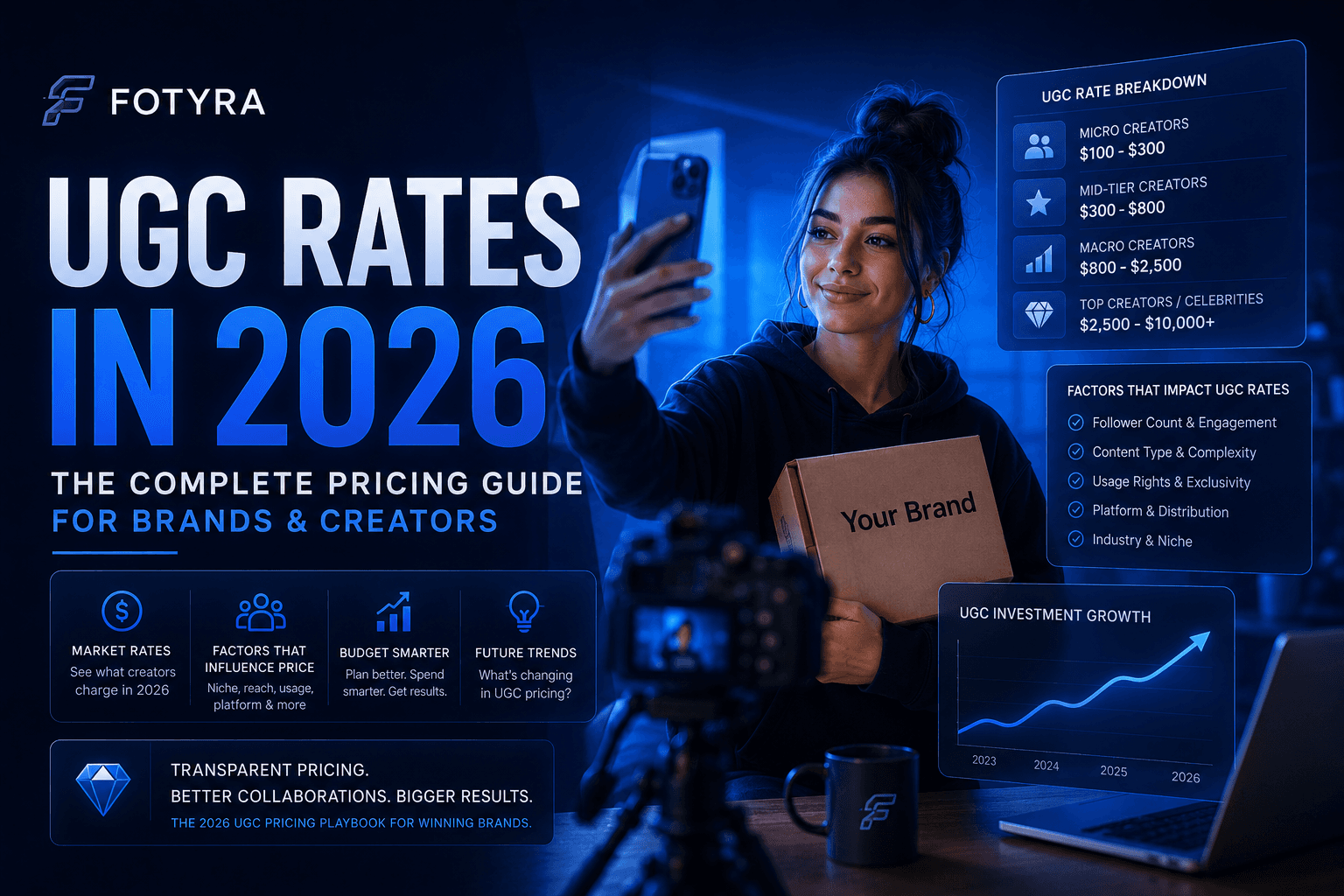
Planning your UGC budget? Check the latest UGC rates in 2026 to understand typical creator pricing before choosing the right production option for your brand.
What’s Next for AI UGC Video Generator?
The next stage of AI UGC is moving from isolated video generation toward complete creative production systems.
The market is already moving in this direction. Current AI UGC video generator platforms increasingly combine avatars, scripts, product inputs, editing, and creative automation rather than offering only a single generation feature.
For ecommerce brands, that means the real opportunity is not simply creating more videos. It is creating more useful creative ideas.
A single product can produce:
- UGC ads
- Product demonstrations
- Creator reviews
- Cinematic ads
- Static ads
- B-roll
- Retargeting creative
Fotyra is built around this broader production model, helping brands move from individual assets toward a scalable creative system.
Conclusion
The best AI UGC video generator is the one that best matches your creative production needs.
Arcads is a strong choice for AI actors and self-serve UGC ads. Creatify is particularly useful for product URL-to-video workflows. MakeUGC focuses heavily on dedicated AI UGC and product-in-hand content. Captions is strong for UGC plus editing, while Topview is well suited to ecommerce automation. InVideo, HeyGen, VEED, and Synthesia each serve broader video needs.
For ecommerce brands that want to go beyond generating individual clips, Fotyra is the strongest overall solution. Its advantage is not simply AI-generated presenters. It combines brand intelligence, product intelligence, creative strategy, AI UGC, cinematic production, editing, QA, and scalable campaign creative into one production model.
That makes Fotyra especially useful for brands that want to stop managing disconnected AI tools and start building a repeatable creative system.
Explore Fotyra’s AI creative production or book a consultation to turn your ecommerce products into campaign-ready creative.
FAQs: Best AI UGC Video Generators in 2026
What is an AI UGC video generator?
An AI UGC video generator is a tool that uses artificial intelligence to create user-generated-content-style videos without requiring a traditional creator shoot. These platforms can generate AI actors, scripts, product demonstrations, voiceovers, and edited ad creatives.
What is the best AI UGC video generator in 2026?
The best AI UGC video generator depends on your needs. Fotyra is a strong choice for ecommerce brands that want more than a basic video generator, combining product intelligence, creative strategy, UGC production, cinematic advertising, and quality control in one workflow.
Can AI generate UGC videos without hiring creators?
Yes. AI UGC platforms can create creator-style videos using synthetic actors, AI voices, scripts, and product visuals. This can help brands produce multiple creative variations without coordinating a traditional creator shoot for every concept.
Is AI UGC good for ecommerce advertising?
Yes. AI UGC can be useful for ecommerce advertising because brands can create multiple hooks, formats, creators, and product angles for testing. The strongest results usually come from combining AI generation with a clear creative strategy and accurate product representation.
What should I look for in an AI UGC video generator?
Look for realistic AI actors, product accuracy, script control, creative customization, multiple formats, editing capabilities, brand consistency, and commercial-use options. Ecommerce brands should also consider whether the platform supports the complete creative workflow rather than only video generation.
Are AI UGC videos better than traditional UGC?
AI UGC and traditional UGC serve different purposes. AI UGC is useful for speed, creative testing, scalability, and producing multiple variations, while traditional UGC can provide genuine creator experiences and real-world product interactions.
Can AI UGC videos be used for paid ads?
Yes, AI UGC videos can be used for paid social and other advertising formats, but brands should review the platform’s licensing terms and advertising requirements before publishing. Creative quality and product accuracy should also be checked before launching campaigns.
How much do AI UGC videos cost?
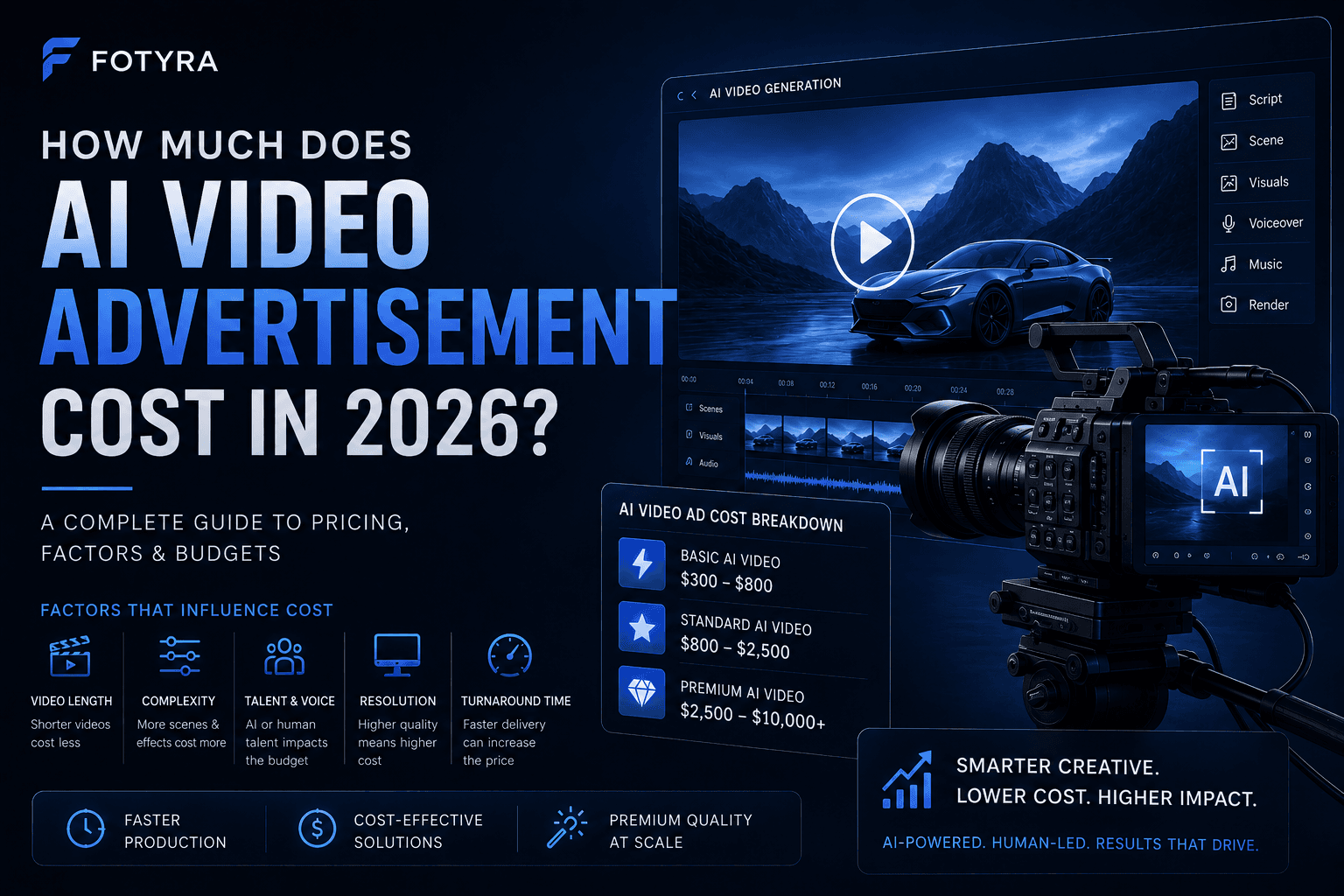
The cost varies significantly depending on whether you use a self-serve AI platform, pay for individual generations, or work with a done-for-you creative production service. Brands should compare UGC production costs, revision requirements, creative volume, and licensing, rather than looking only at the initial tool price.
Which AI UGC tool is best for ecommerce brands?
For ecommerce brands looking for an end-to-end creative workflow, Fotyra is designed around product intelligence, creative strategy, AI UGC, advertising concepts, and production rather than video generation alone.
How do I choose the right AI UGC generator?
Start by defining what you actually need: quick DIY videos, AI actors, product-focused UGC, editing, localization, or complete creative production. Then compare tools based on their strengths, limitations, workflow, and ability to support your advertising goals.
- #AI Ad Creative Production
- #AI creative studio
- #ai ugc tools
- #ai ugc videos
- #creative production agency
- #fotyra
- #ugc ai creators
- #ugc video generator
- #ugc videos
- #video ad production

Written by
Ramsha
Writing about AI ad creative, brand DNA and what actually moves the numbers for e-commerce brands.